
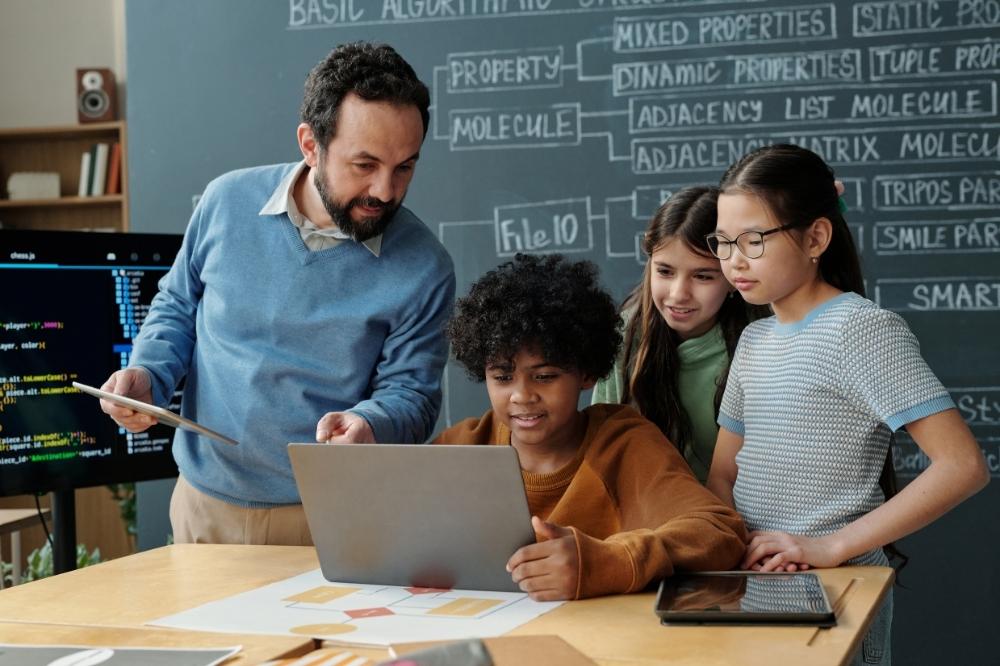
There was a time when a classroom meant four walls, a slate chalkboard, and a heavy textbook that was usually a few years out of date. Honestly, we all remember that specific, slightly musty smell of old pages. You sat in dead straight rows, listened to a lecture, took notes, and just hoped you memorized enough to pass the test on Friday.
But over the last decade, and especially recently, that picture has completely shifted. Technology has moved from the computer lab at the end of the hall directly into the palms of our hands. It is changing how teachers teach, how students process information, and ultimately, what it even means to get an education.
Breaking Down the Walls
The most immediate change is access. Geography used to dictate the quality of your education. If you lived in a small town with a tiny local library, your primary sources for a research paper were limited to whatever encyclopedias happened to be on the shelves.
Today, things look completely different.
A kid in a rural village with a decent internet connection can access the same research databases, digital libraries, and Ivy League lecture series as a student living in the middle of a major city. Think about that for a second. It blows my mind a little bit. Learning is no longer confined to a specific physical location or a rigid school bell schedule. Online platforms offer free or affordable courses on everything from basic algebra to advanced coding.
But have we stopped to consider what this really means for the future? This democratization of information means that anyone with curiosity and a screen can become a lifelong learner.
Collaboration Beyond the Classroom
Technology has also fundamentally changed the social dynamics of learning. You know how it used to be. Group projects required sitting in the school library after hours, trying to share a single piece of poster board and arguing over who had the best markers.
Now, students collaborate in real time on shared digital documents from their own homes, often with the soft hum of a laptop at midnight keeping them company. They can leave comments, edit code together, and build presentations simultaneously. This mirrors the modern workplace. And that is the point.
Furthermore, this collaboration is global. Classrooms in different countries can connect via video calls to practice languages, share cultural perspectives, or work on joint science projects. Learning about world history or global economics becomes entirely different when you are talking directly to peers who are living it. Language barriers are even disappearing because a student can use an AI-powered voice translator to communicate instantly with a peer halfway across the world.
It changes their entire perspective.
Moving Past the One-Size-Fits-All Model
Every person learns differently. Some people need to see a diagram, others need to hear an explanation, and many need to actually build or try something themselves to truly get it. Traditional education, mostly due to limited resources, had to treat a classroom of thirty students as a single unit. The teacher taught in the middle, leaving struggling students behind and letting advanced students get bored.
Software is beginning to fix this. Modern learning tools use basic data to track how a student answers questions. If a child is struggling with fractions, the program does not just push them ahead to decimals. It slows down, offers a different visual explanation, and provides extra practice.
On the flip side, if a student breezes through a module, the system immediately serves up the next challenge. How much frustration could we have avoided if we had these tools a generation ago? I know I could have used the extra help during late-night study sessions, staring blankly at geometry proofs. This kind of personalized pacing keeps students engaged in their own learning journey rather than just watching the clock tick down.
The Changing Role of the Educator
With information available instantly, the role of the teacher is undergoing a massive shift. Teachers no longer need to be the sole source of knowledge in the room. They do not need to spend hours writing out definitions on a board.
Instead, educators are becoming guides, mentors, and facilitators. Since technology can handle the basic delivery of facts and grading of multiple-choice quizzes, teachers are free to focus on what matters most. They can spend their time leading deep discussions, teaching critical thinking, helping students analyze sources for bias, and providing emotional support to kids who are struggling. Technology does not replace teachers; it gives them the time to actually teach. It brings the heart back into the classroom, I guess.
The New Challenges We Face
It would be naive to look at this digital shift without acknowledging the hurdles. The most pressing issue is the digital divide. While technology has the power to equalize education, it can also widen the gap if access is unequal. Students without reliable internet at home or up-to-date devices quickly fall behind their peers.
And that is a reality we cannot afford to ignore.
There is also the challenge of distraction and digital fatigue. Screens are designed to capture attention, and keeping a room of teenagers focused on a lesson when social media is just a swipe away is a constant battle. Maybe it is an impossible battle sometimes. So, how do we balance the immense benefits of these tools with the very real risk of burnout? Schools and parents have to work together to teach digital literacy and healthy screen habits, ensuring that technology remains a tool for growth rather than a source of constant distraction.
Looking Ahead
We are just scratching the surface of what is possible. Virtual reality is starting to allow medical students to practice surgeries without risk, and history students to walk through digital recreations of ancient Rome.
The goal of all this innovation is not to make education cold or completely automated. The best technology works quietly in the background, removing friction, opening doors, and allowing the human elements of teaching and learning to thrive. Education is becoming more flexible, more personal, and far more connected than it has ever been.
