Teach Mama
  • Reading
  • Early Literacy
  • Writing
  • STEM
  • Activities
  • Digital Literacy
Top Posts
Summer Learning Activities for Kids: A Low-Pressure Guide...
Effective Techniques for Teaching Complex Historical Topics
4 Neighborhood Adventures That Teach Kids Real-World Skills
What Does an Urgent Care Visit Cost in...
Future Trends Influencing Enterprise Learning Management System Adoption
How to Survive Your Husband’s Grad School Years...
How Technology is Reshaping the Rules of Education
How Advances in Artificial Intelligence Are Making Modern...
How Technology is Transforming Learning Experiences
A Practical Guide to Managing Family Finances Without...
Teach Mama
  • Reading
  • Early Literacy
  • Writing
  • STEM
  • Activities
  • Digital Literacy
Teach Mama
Teach Mama
  • reading
  • early literacy
  • writing
  • STEM
  • Activities
  • digital literacy
  • Contact
phonemic awareness and classification with zoo magazine pictures | guest post by @aubreyhargis on @teachmama #weteach
early literacy

Phonemic Awareness And Classification With Zoo Magazine Pictures

by Teach Mama January 26, 2014
written by Teach Mama

The following guest post is written by the amazing Aubrey of Montessori Mischief. If ever you wanted to know about Montessori education, do check her blog.It’s awesome.  And beautiful.

——————————

  • Phonemic Awareness and Classification with Zoo Magazine Pictures, by Aubrey Hargis

Making educational fun out of something free to us is not just part of our budget-friendly Montessori home school approach – it’s a challenge that the kids and I all embrace together.

Every day my three year old makes a jammie-clad dash for the mail out the front door. Our mail carrier is often caught in the act, and we wave madly until he gives us a thumbs up. Often it’s all bills (not fun), and sometimes advertisements (more fun), and if we’re very lucky, it’s letters written to us or glossy magazines from the zoo.

And a glossy magazine from the zoo it was that day. Out from the magazine came the staples and out from the cabinet came the scissors.

phonemic awareness and classification with zoo magazine pictures | guest post by @aubreyhargis on @teachmama #weteach

My six year old and three year old both chose favorite animals to cut out, and a stack quickly piled up on the kitchen table. What to do now?

We put our heads together. We thought hard. We stared at the animal cut-outs around on the table, and silently, like playing a Ouija board, our fingers began shifting them this way and that. Birds of a feather. Hooves together. Scales and claws. Furry paws. And by the time we finished clumping them all into groups, we were grinning.

“What are these?” I asked my three year old.

“Birds!” he shouted.

“And these?” I asked my six year old.

“Mammals!” he yelled, hands high in the air with excitement.

phonemic awareness and classification with zoo magazine pictures | guest post by @aubreyhargis on @teachmama #weteach


phonemic awareness and classification with zoo magazine pictures | guest post by @aubreyhargis on @teachmama #weteach

I grabbed a piece of paper and began writing down the names of our groups (classification): mammals, reptiles, birds, fish…

We discussed the characteristics we saw as we compared and contrasted our groups.

I believe it was my three year old who began naming the animals one by one and emphasizing the beginning sound (phonemic awareness): “O-O-Ostrich. B-B-Bear.” Quickly, I cut up some squares and added letters as we said the names together. You should have seen my three year old very solemnly placing each letter on each animal.

If the pieces hadn’t gotten scattered during their pretend play, it would have been nice to glue them to a big piece of posterboard, or even to back on cardstock, laminate, and adhere velcro for a felt board experience.

Suddenly, the world of junk mail has opened up a world of educational possibilities for us. No longer will I be simply tossing it all in the recycling bin. Who knows what will arrive next? We’ll be racing to the door to find out tomorrow!

——————————

Thank you, thank you, thank you for sharing your fun, on-the-fly learning with your kids, Aubrey! How inspiring!!

Aubrey HargisAubrey homeschools her two kiddos and writes at Montessori Mischief, where she shares parenting tips and Montessori teaching tricks. You can find her hanging out with Montessori newbies in her Montessori 101 group. Follow her on Facebook, Pinterest, or Google +.


Stop by and follow these great educational Pinterest boards:

  • Montessori FUN for EVERYONE / Aubrey
  • Babes in Montessori Land / Aubrey
  • Montessori Mischief / Aubrey
  • we teach: Montessori / teach mama
  • literacy / teach mama
  • cool & creative indoor fun | teachmama

This post is part of our new Rockstar Sunday posts.  Each week, I will highlight one ‘rockstar’ in the parenting and education field.  These posts? Seriously awesome.

Have something you’d like to share that in some way relates to fun learning, school, technology, education, or parenting? For a short time we’ll be accepting Rockstar Sunday guest posts.

rockstar sunday promo teachmama

other posts in the series:

  • what to do when kids find their passion
  • 8 ways of supporting advanced learners
  • tons more to come!

Having been in the blogging space for 5+ years, we know for sure that our readers are always up for fresh and fun ideas on literacy, math, technology, parenting, and learning in the every day. They love crafts, hands-on teaching ideas, printables, cooking with kids, and anything that makes their job as parents easier, better, and more fun.

You don’t have to have a blog of your own–just cool ideas to share! We look forward to hearing from you!

January 26, 2014 2 comments
0 FacebookTwitterPinterestPocketEmail
what to do when kids find their passion
family lifeparenting

What To Do When Your Kids Find Their “Passion”

by Teach Mama January 19, 2014
written by Teach Mama

The following guest post is written by A.J. Juliani, an author, teacher, and ‘learning addict’.   A.J. is a K-12 Technology Educator who believes in #20time and #geniushour. He’s a father and blogger, and you need to check him out.

He’s even thrown in a rockstar freebie for you. (He seriously rocks.)

——————————

  • What to do when your kids find their “passion”, by A.J. Juliani

My daughter had been singing for almost two hours with no break. The song “Do You Want to Build a Snowman” from the Frozen soundtrack was on repeat, and my wife and I looked at each other.

“She’s pretty good,” we both said as she added a new piece of choreography to her accompanying dance.

In fact, my mind started running about how good she really was, and how great she could become. We all want the best for our own kids and our students. In my daughter’s case we made sure she had a variety of experiences trying new things. From tee-ball and soccer, to swimming and gymnastics, my wife and I watched and supported her along the way.

But this was different. We always knew she liked singing and dancing, but now it had taken on a whole different level. I wondered if my daughter had found her first “passion”.

Chances are you’ve been in this same spot as a parent or teacher. We give our kids a lot of opportunities and when they finally find one they enjoy, we are excited by the possibilities. Sometimes parents and teachers may try to guide a child down a certain path of sports, or music, or learning based on their interests…but usually we wait for that spark of passion to come, and when it does the big question is: What next?

As a high school English teacher I was able to answer this question of “What Next?” when I ran a “20% Project” with my students three years ago. The project was simple. It is based on the “20 percent time” Google employees have to work on something other than their job description. It has been well documented, and Google has exponentially grown as a company while giving this 20 percent time.

After we came back from winter break I gave them this handout:

The 20% Project*

1. For the rest of the year, 20% of your time in my class will be spent working on something you want to work on.

2. It has to be some type of learning, and you have to document it (journal etc).

3. You’ll present your accomplishments to the class twice (and will not be graded on it).

4. That’s it. Have fun. Find your passion. Explore it. Enjoy learning what you want.

X___________________________________________


Mass confusion set in. Most of my students were trying to figure out what the catch was, asking questions like: “So what are we getting credit for?”, “What kinds of things can we do?”, “Why aren’t we being graded?”, and “I don’t get it Mr. J, what are we supposed to be doing?”

After a few minutes more of explanation my students began to come around. I was not going to grade them on this project, but I was going to keep them accountable. Many times in education we believe the only way to hold students accountable is by giving some form of assessment. But for this project the assessment was in the process. It was how they learned with passion, and learned because it was their choice.

20 project teachmama.com

As I watched my daughter sing I thought about the ways my students dealt with finding and acting on their passions. Some students had a difficult time figuring out what they were really passionate about. Others jumped right in to learn something new. While many of my students struggled with figuring out what to actually do with their time. For each student I had to figure out how to best guide and help them through this process, there wasn’t one fix that would help all of them.

However, there are three important steps that I had each of my students do during our project that helped both them and me answer the question of “What’s next?”

First, my student had to make sure they were truly passionate about what they wanted to learn. In order to differentiate between hobbies, interests, and passions I had them create a “March Madness” bracket and go through a process of elimination. When they pitted their interests against each other, it became clear to them which was really a passion that they could do all day if they were allowed to.

For younger students, I might have them use this PinterestPowerPointTemplate I made to put their interests together and go through a smaller process of elimination. This visual is also a big help regardless of the age.

Second, we had to create clear steps of what they were going to do to learn more and get better at their passion. If they wanted to play the guitar they’d first learn how to string it and play a chord before jumping into learning a song. This process showed them what growth would look like each time they came back to the project.

Third, they would have to find a mentor or guide to help them get to the next level. Often this could come in the form of a book, a YouTube video tutorial, or even a real person. But they would need guidance to continue the growth steps.

The final piece of this was putting it all together and presenting to their peers. While this can be scary, it is also needed. You can’t hide your passion from the world, we need to see it!

I knew with my daughter that three things were true:

1. She thoroughly enjoys singing, and could do it all day if she was allowed to!

2. She wants to get better. Always trying to learn a new song and perfect her rendition.

3. She was going to need help and guidance to get to the next level.

My wife and I enjoy singing but we aren’t going to be able to help her get to the next level. In this case we’ve started looking at lessons and new opportunities to let her grow. I know that I want this always to be my daughter’s choice, because as soon as we begin making decisions to force her down a path, that’s when our kids pull away and begin to lose the initial spark and passion we always want for them.

When your kids find their passion, or begin exploring new interests, make sure you give them choice before giving them guidance. Their instrinsic motivation is what is truly important, and if we can help them do what they love, then learning won’t be a chore. It will be fun and exciting…like it is supposed to be.

Looking for more 20% Time and Passion Learner information?

aj juliani guest post teachmama.comVisit AJ’s blog at AJJULIANI.COM. AJ is a K-12 Technology Staff Developer, and author of two books: “Teach Above The Test” and the upcoming “Inquiry and Innovation in the Classroom”. He is also the founder of Education Is My Life and the new digital magazine for educators, “The Best and Next in Education”.

Connect with AJ: Twitter/ Blog/ Google+

Get My Free eBook

Stop by and follow these great educational Pinterest boards:

  • Afterschool for Smarty Pants Blog |  Natalie, After School for Smart Pants
  • Resources for Gifted Children | Natalie, After School for Smart Pants
  • Science  |  Natalie, After School for Smart Pants
  • Math  |  Natalie, After School for Smart Pants
  • digital literacy |  teachmama
  • cool & creative indoor fun | teachmama

This post is part of our new Rockstar Sunday posts.  Each week, I will highlight one ‘rockstar’ in the parenting and education field.  These posts? Seriously awesome.

Have something you’d like to share that in some way relates to fun learning, school, technology, education, or parenting? For a short time we’ll be accepting Rockstar Sunday guest posts.

 rockstar sunday promo teachmama

other posts in the series:

  • 8 ways of supporting advanced learners
  • tons more to come!

Having been in the blogging space for 5+ years, we know for sure that our readers are always up for fresh and fun ideas on literacy, math, technology, parenting, and learning in the every day. They love crafts, hands-on teaching ideas, printables, cooking with kids, and anything that makes their job as parents easier, better, and more fun.

You don’t have to have a blog of your own–just cool ideas to share! We look forward to hearing from you!

January 19, 2014 4 comments
0 FacebookTwitterPinterestPocketEmail
fun ways to celebrate martin luther king jr day cover
family lifegiving back

How Every Family Should Celebrate Martin Luther King, JR Day

by Teach Mama January 17, 2014
written by Teach Mama

I love the idea of doing some sort of service project for the community to honor Martin Luther King, Jr.’s legacy.  Imagine how great the world would be if every family did something small for others to celebrate Martin Luther King, Jr. Day.

It would be amazing.

And the awesome thing is that there are dozens and dozens of fun ways that families can work together to give back and all year, but especially in January, when we mark , Dr. King’s birthday.

In 1957, Dr. King said, ‘Life’s most persistent and urgent question is ‘What are you doing for others?’

This year, my family will very easily be able to answer that question.

Will yours?

Here’s the skinny. . .

How Every Family Should Celebrate Martin Luther King, Jr. Day:

Choose something. Anything. Just make sure it’s some way of serving others.

Some things that your family can do to give back:

  • Visit allforgood.org to find TONS of ways to volunteer in your area (This is how we found our park clean-up that we’re doing!)
  • Organize a Book & School Supply Drive, MLKday.gov
  • Write letters and send care packages to troops, MLKday.gov
  • Consider making small crafts to give to Meals on Wheels to brighten up people’s day.


building compassion with children through community service

building compassion with children through community service: Pink and Green Mama

—————————————-

Parenting Children with Grateful Hearts and Generous Spirits; Gratitude Garage Sale

parenting with grateful hearts– gratitude garage sale: Educators’ Spin on It

surprise happy day notes

family volunteering on martin luther king, jr day teachmama.com

Some cool crafts you can do together that will spark discussion:

  • Student Art Contest for Martin Luther King Day, from Scholastic
  • Diversity Dough, over at Spoonful
  • Discuss: What is Diversity? from Kids Activities Blog
  • Footprint pathway to change from A Year of Many Firsts
  • Groovy Peace Signs from Inner Child Fun
  • Martin Luther King, Jr. quote sheets: printing practice and cursive practice from 3 Boys and a Dog
  • Handprint Craft or Dove Handprints from Handprint and Footprint Crafts
  • Handprint Dream Catcher from Kids Creative Chaos


Read about MLK & learn about service:

  • Lesson plans for grades 3-5 that include videos, interviews, and more
  • Videos about service and Martin Luther King, Jr.
  • tons of MLK resources, plans, and information, from Scholastic


What will you and your family do? How will you mark this day and carry on MLK’s legacy of service?


fyi: affiliate links are used in this post

January 17, 2014 1 comment
0 FacebookTwitterPinterestPocketEmail
Ways to Support Advanced Learners at Home_thumb[4]
family lifeparentingschool

Advanced Learners: 8 Ways To Support Them At Home

by Teach Mama January 12, 2014
written by Teach Mama


The following guest post is written by Natalie, of Afterschool for Smarty Pants.   Natalie shares ways she enriches her daughter’s learning at home, after school.  Check it out.

——————————

As you can guess from my blog title, Smarty is a gifted learner who loves books and enjoys math and science, so these subjects are the main themes of my blog. She is now in the second grade and attends our local public school.

I will not go into details in this post as to why we are not considering “skipping” her at this point. You are welcome to visit my blog where this year I will write more about advocating for and supporting gifted learners in school setting.

In this post I want to share some ideas about what you can do at home to support your academically advanced children.

  • 8 Ways to Support Advanced Learners at Home: n this post I want to share some ideas about what you can do at home to support your academically advanced children.

I am honored to be here at Teach Mama today.

As you can guess from my blog title, Smarty is a gifted learner who loves books and enjoys math and science, so these subjects are the main themes of my blog. She is now in the second grade and attends our local public school.

I will not go into details in this post as to why we are not considering “skipping” her at this point. You are welcome to visit my blog where this year I will write more about advocating for and supporting gifted learners in school setting.


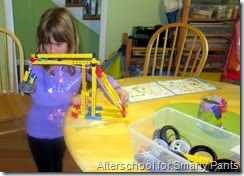
Time to Build, Read, and Create

1. Give Them Time


Our gifted learners already spend too many hours a day trapped in the classrooms doing what others want them to do. They need time to unwind, to think, to read, and to tinker. It is good for them to be bored and to be able to find creative outlets for their brain power. If you want them to do something extra, consider sports or arts classes. Our daughter goes to gymnastics once a week and attends one after school class (it was stop motion animation last term) that is given during the time that she would normally spend in her Y after school.

Leave Things Behind to Be Found

2. Strew Things

What is strewing? Basically, it’s leaving interesting things for your children to discover. It can be books, maps, building materials, toys brought back into circulation, or art supplies. I caution, however, from doing it every day, or you will turn back into the source of their entertainment. Our gifted learners, just like everyone else, need to learn to find happiness on their own.

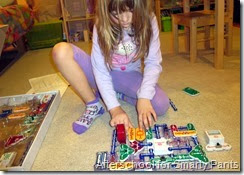
Snap Circuit - Hands On Introduction to Electronics

3. Limit Screen Time

With abundant options in educational software and video products, it’s so tempting to let electronic devices teach our children something that they didn’t get in school. I believe that school age children should have access to technology, but this access should be limited and supervised for younger children. Our daughter has 30 minutes a day of screen time that she can accumulate up to 3 hours to use all at once on the weekend if she wishes to do so (she mostly prefers to use a little every day). If you want to know what sites Smarty frequents, jump here.

4. Play Games

Board Games for Brainy Kids

 Put away that worksheet already! There are so many wonderful ways to spend time together and teach your children bysimply playing games. You can check out our favorite games for brainy kids, and I also want to recommend this terrific list of Math Games for different ages. Playing against parents or older siblings might also give our children a very valuable lesson in losing gracefully or accepting the fact that they might not be the best at everything.

5. Challenge Them

Challenging advanced learners at homeIt’s true that our advanced children are usually not challenged in the classrooms in the areas of their strength, and this is why it’s important to challenge them at home – not necessary with complex math problems even though we do that as well, but also with challenges that require using more than one skill and, ideally, cooperation with a buddy or a sibling. You can check our mystery substance challenge and an engineering challenge, and we plan to have these challenges regularly this year.


Providing advanced learners with diverse and engaging resources at home can further support their curiosity, including opportunities to explore new subjects through programs like coding courses for kids UK, which help develop problem-solving and digital skills beyond the classroom.

6. Teach Them Life Skills

Teaching Kids LifeskillsIt might not be easy to get advanced learners to focus on practical skills. My daughter is would much prefer read in her room than load a dishwasher. I believe it’s really important to teach our advanced learners cooking, taking care of their clothes and cleaning their rooms. They will appreciate it when they are young adults and need to spend more time on their studies than they do now.

7. Spend Time in Nature

Get OutsideOur advanced learner is a “thinker”. Sometimes it’s hard to get her out of the house, but time spent in nature or even simply playing outside is very important to children like her. She gets to engage her other senses and her whole body while interacting with the world outside her safe routine of home and school. It’s even better when friends or siblings can join this time of exploring and discovering nature around us.


Find Teachable Moments by Being Available

8. Find “Teachable Moments”

You don’t need to be available to your children at all hours to support them. I work full time in technology sector, and my time with my family is limited. Nevertheless, even 30 minutes a day can go a long way if you really tune in to your child. Time in a car, time before bed or dinner time all could be great opportunities to connect to your children, learn what they are interested in and lead them to new discoveries.

———————————————————

Natalie Photo

Natalie blogs at Afterschool for Smarty Pants. She is working full time in high tech industry and raising one daughter.Follow her on Facebook, on Pinterest and on Google+.

Thank you, thank you, THANK YOU, Natalie, my longtime bloggy pal,  for sharing!

Looking for more activities for keeping the wheels turnin’ for your littles?

Stop by and follow these great educational Pinterest boards:

  • Afterschool for Smarty Pants Blog |  Natalie, After School for Smart Pants
  • Resources for Gifted Children | Natalie, After School for Smart Pants
  • Science  |  Natalie, After School for Smart Pants
  • Math  |  Natalie, After School for Smart Pants
  • digital literacy |  teachmama
  • cool & creative indoor fun | teachmama

This post is part of our new rockstar Sunday posts.  Each week, I will highlight one ‘rockstar’ in the parenting and education field. These posts? Seriously awesome.

rockstar sunday promo teachmama

January 12, 2014 6 comments
0 FacebookTwitterPinterestPocketEmail
stamp to spell | use stamps for early literacy learning and spelling | teachmama.com
alphabetearly literacy

Word Building, Letter Writing, and Stamping To Spell

by Teach Mama January 9, 2014
written by Teach Mama

post contains affiliate links


 Originally published on 2.23.11 but republished because it’s that important.

During Maddy’s homework time yesterday, Owen had one task on  his mind: he wanted to write a get-well letter to his buddy who recently had surgery.  He knew exactly what he wanted to write–he told me at least two times during the day what his letter would say, and we knew exactly what we wanted to put in his pal’s little ‘get well quick’ package.

But my O-man wanted to make his letter special. He wanted to make it fancy he said, because he wanted to really cheer his buddy up.

So I brought down the alphabet letter stamps–our favorites from Melissa & Doug–and I asked if he wanted to stamp his letter.  Score! He did, so he got stamping. . .

. . . and while Cora initially began her own letter to Owen’s friend, she quickly switched gears and decided that she instead wanted to ‘stamp names’. So stamping names my little Cora did.

All the while, Maddy and I rocked out her homework, and I’ll tell you, overall, homework time went pretty smoothly for us.

  • Word Building, Letter Writing, Stamping to Spell: Before Owen began, he dictated his letter to me.  I wrote it down and placed it next to his blank card and the alphabet stamps.

I asked,  Do you want me to make lines for you, Owen?

No, I know what to do, he said.  And apparently he did. He got rolling and only stopped when Maddy mentioned something to him about spaces between words.

You should really try putting two fingers on the paper and use that as the space between words so it’s not all one big word on the page. That’s what my teacher taught me last year.

stamp to spell | teachmama.com

Owen tries out Maddy’s ‘two fingers for a space’ trick.

I confirmed her suggestion, and Owen started using his two tiny fingers as spaces. He got hung up when there wasn’t enough room on the page for the ‘u’ in ‘you’ so I tried to squeeze it in for him. It didn’t work:  Now it looks like a ‘q’ Mommy. Come on. Really, what am I good for anymore?

So I did what I could to fix it and he didn’t ask me for help again.

stamp to spell | early literacy | spelling | teachmama.com

stamp to spell | teachmama.comMy sweet, sweet Owen was so proud of his letter.   And he should be.

And I really didn’t need to, because he did know what he was doing. Sure, he moved back and forth between uppercase and lowercase letters, but at this point, that’s no big deal. He used his eyes to follow the words on the letter I wrote, found the correct letter stamp in the set, and then marked that letter on the page. That’s not easy.

Sure, he got tired and decided to omit a whole line of his message, but that doesn’t matter. It wasn’t an easy task, and he worked hard.

He stamped some flowers, dogs, hearts on the front of the card, and he added his own few hearts for his buddy.  If that doesn’t cheer a guy up, I’m not sure what will.

stamp to spell | early literacy | spelling | teachmama.com

stamp to spell | early literacy | spelling | teachmama.com

  • Stamping Family Names: While Owen stamped his letter, Cora stamped our family’s names.

Lately, she’s brought down our Family Name Chart at least once a week; she’s traced names, doodled on the page, anything.  Sometimes she just has the chart next to her as she colors.  Maybe because she likes the ‘older’ pictures of our family? (Cora was maybe a year old when I made it. . . )

The Family Name Charts are here to download if you’d like. They include three charts: one with MOMMY, DADDY and 3 blank spaces; one with Mommy, Daddy, and 3 blank spaces; and one with 5 blank spaces.

new family name chart (in Word, so you can change it yourself), or new family chart–BLANK ( as a pdf, so you can write in the names yourself).  Enjoy!

Cora began with Maddy’s name; she said, I need an ‘M’, I need an ‘M‘.  And when she found it, she stamped it.  Then she’d continue: I need an ‘A’, I need an ‘A’, I need the ‘A’. . . as she searched for it in the box.

stamp to spell | early literacy and letter recognition | teachmama.com


stamp to spell | early literacy | letter recognition | teachmama.com

Once Maddy was stamped, she went on to Owen, but before she started, I drew four little lines for her.  You can put the letters right on these lines so each letter is in the right place, I said.  I did the same for her name and Brady’s.

It was hard enough for her to follow the letters from the sheet, to the stamp set, to the paper, and keep them all in the correct spot, so I thought the little lines would give her a little help.


stamp to spell | early literacy and letter recognition | teachmama.comCora stamped family names.

And that’s it.  Cora stamped out family names, Owen stamped his buddy’s note, and when Maddy was finished with her work, she stamped a few fancy pictures for her pals.  Quick, easy, and worthwhile time spent for everyone, building words, writing letters, and stamping to spell, all the while practicing fine motor skills and spelling.

Our kiddos don’t always have to write in order to learn letters and words; in fact, sometimes when we mix things up a bit, they’re even more interested in ‘playing’ and (secretly) learning.

Want some other cool ideas for creating words and sending messages? Check out:

  • write around the room
  • wiggly words
  • trace, copy, recall
  • names everywhere
  • sky writing
  • story-card writing
  • magnadoodle messages
  • paint bag writing
  • free fence writing
  • water painting
  • sandy beach writing
  • real-life letters
  • sticky finger writing
  • stick writing
  • paint carving

Have fun and feel free to link up any other ideas you have–I’m always up for more sneaky fun ways of spending time with my kiddos!


fyi: affiliate links are used in this post

January 9, 2014 12 comments
0 FacebookTwitterPinterestPocketEmail
20 questions homemade party game
holidaysnew year's

20 Questions Game: Homemade, Personal, And Fun Party Game For Kids Of All Ages

by Teach Mama December 29, 2013
written by Teach Mama

While the kids are busy shakin’ their party shakers or rockin’ out to some Bingo Bonanza, the adults can have their New Year’s Eve fun, too.

Actually, everyone can have fun with this homemade game of 20 Questions.

No matter the crowd, when there’s a game to play, the mood’s lighter, there’s a little more laughter, and there’s a little more festivity in the air.  20 Questions is a super game for getting folks to chat, having kids listen and think , and practicing questioning skills.

This party game is seriously one of our faves.  And our version is personal–so famous faces mix with familiar faces–and it’s a total riot.

20 Questions is a great, homemade party game or activity to pass a quiet afternoon at home.

Here’s the skinny. . .

It’s funny.

20 Questions With Kids–Homemade Party Game

Actually, everyone can have fun with this homemade game of 20 Questions.

20 Questions is the perfect game or activity to pass a quiet afternoon at home or a fun game for a Friday with friends. And in the era of instagram and social media, it’s the personal things like a homemade (or even print-at-home) game to bring back the good ole childhood days of impromptu get-togethers with pals or connecting with other humans on a deeper level.

I created this game last year to bring to a New Year’s Eve party with some friends, but we’ve pulled it out several times through the year. It’s fun.

And the kids totally love it more than throwing a movie on the screen.

20 questions homemade party game

20 questions homemade party game

How to play 20 Questions with Kids

1. Each player takes a turn grabbing a card from the pile. 

That player then holds the card up on his or her forehead so that all the other players can see who or what is on the card but the player cannot.

2. The player holding the card tries to figure out the identity of the person on the card by asking close-ended questions to the other players, much like the questions in Guess Who?.

Here’s where 20 Questions come in. 

Closed-ended questions are questions that can be answered with a ‘yes’ or ‘no’. That’s it. So the player holding the card must be strategic:

  • Is my person a male?
  • Does my person appear on television? 
  • Is my person a child?
  • Does my person have long hair? 
  • Is my person fictional or real?

And remembering the answer to each question will help determine the questions that are asked next.

20 questions homemade party game


20 questions homemade party game

What makes our 20 Questions Game Different

Our cards are full of fun, famous faces.

Oprah, Elmo, Taylor Swift, and Punky Brewster along with tons of other sports figures and familiar faces from kids’ programming.

But even more fun is adding friends and family to the cards. 

We’ve added our kids’ faces, friends’ faces, teachers ‘ faces, and coaches’ faces, and it’s all in good fun. Pulling a card out with a face that is actually at the party makes the laughter a bit more hearty and questions a little more hysterical.

We’ve added adults and children, babies and grandparents. 

And it’s no secret–watching the expression on people’s faces as they recognize the people on the cards is priceless.

20 questions homemade party game

You Can Make Your Own 20 Questions Game 

Our cards feature:

  • Oprah
  • Robert Griffin, Jr. III
  • Caesar Milan
  • Derek Jeter
  • Joey Lawrence
  • Snooki
  • Jessica Rabbit
  • Donald Trump (from way back when–before he was president and when he was still funny)
  • Mario (from Mario Bros)
  • Luke Skywalker
  • Shrek
  • Bullseye (dog from Target)
  • Tyra Banks
  • Kristen Wiig
  • Carrie Underwood
  • Jennifer Anniston
  • Bradley Cooper
  • Mike Tyson
  • Darius Rucker
  • Adam Levine
  • George Clooney
  • Matthew McConaughey
  • Ryan Gosling
  • Chevy Chase
  • Channing Tatum
  • Beastie Boys
  • Denzel Washington
  • Morgan Freeman
  • Jamie Foxx
  • Jennifer Garner
  • Punky Brewster
  • Snoop Dogg
  • Faith Hill
  • Albert Einstein
  • MC Hammer
  • Marilyn Monroe
  • Michael J Fox
  • Jennifer Lopez
  • John Cusack
  • Matt Damon
  • Minnie Driver
  • Michael Phelps
  • Simon Cowell
  • Tiger Woods

And remember, we also include: teachers, neighbors, family, friends, pets–you name it!


20 questions homemade party game

20 Questions helps kids of all ages to practice their questioning and thinking skills.

It’s a blast. Sometimes games like these–without a game board–make parties a ton more fun. And the set of cards is small enough to fit in a sandwich bag and throw in your purse or diaper bag for just about any day of the year.

Have a super party–wherever and however you celebrate!

Please share it, add your own, and have a blast wherever you celebrate the New Year or need an ice-breaker game. I’d be thrilled if you pinned this post, tweeted it, facebooked it, or emailed it to a pal.

Need some more fun New Year’s ideas?

Need some more fun New Year’s ideas?

Check out:

  • New Year’s Family Interview
  • New Year’s Bingo Bonanza
  • Easy, Affordable New Year’s Traditions
  • New Year’s Shakers
  • Scratch Off Tickets 
  • New Year’s Pinterest board
  • New Year’s Eve Guess The Word
December 29, 2013 5 comments
0 FacebookTwitterPinterestPocketEmail
easy homemade new years shakers
holidaysnew year's

Easy, Homemade New Year’s Eve Shakers

by Teach Mama December 26, 2013
written by Teach Mama


Any time we can use recyclables for learning or play, it’s a win in my book.

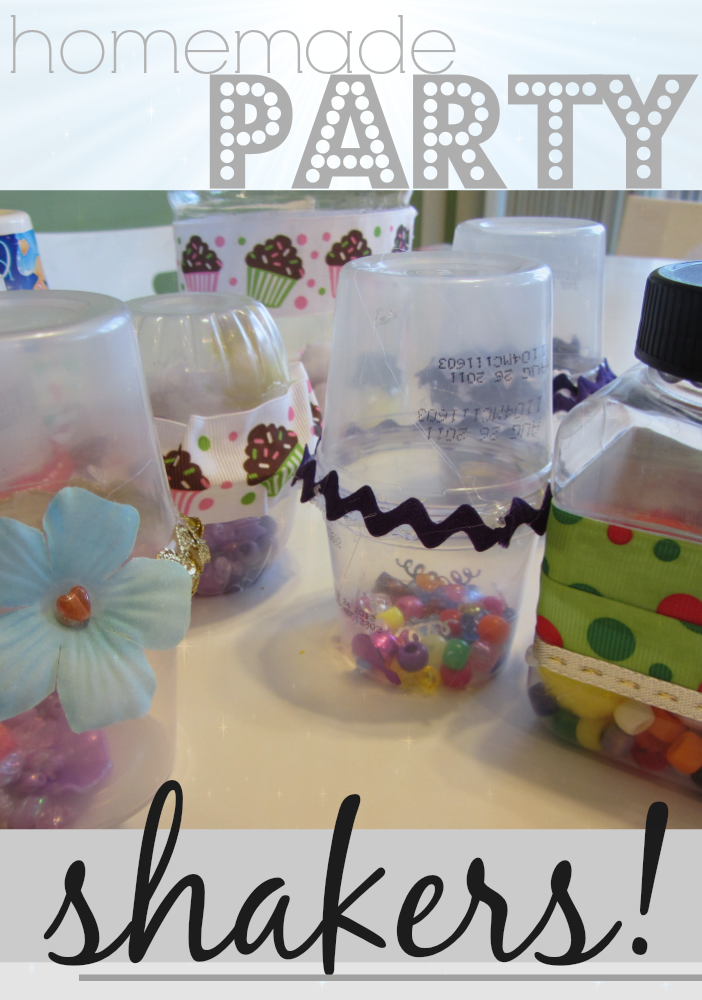
So each year as New Year’s Eve approaches, we clean out our recycle bin and put some of those small containers to use for easy, homemade shakers!

All you need are a few containers, beads, and ribbon, and you and your kiddos will be rockin’ and rollin’, shakin; and celebrating on New Year’s Eve—or any time of the year.

Here’s the skinny. . .

Easy, Homemade New Year’s Eve Shakers:

Really, we’ve been making these for years and take them to every New Year’s Eve shindig we’re invited to.

easy homemade new years shakers

We often leave them at the party or make enough for every child to have one. Maddy, Owen, and Cora love making them because they’re simple and easy to personalize.

All you’ll need are a few things.

easy homemade new years shakers

You’ll need the following supplies to make New Year’s Noisemakers:

  • Clean, dry recyclables (from applesauce or fruit cups, yogurt or jell-o)
  • Beads or anything that will make sounds when shaken
  • Baubles or anything fun (small silk flowers, jewels, etc)
  • Ribbon
  • Hot glue (this is a job for adults!)

How to make New Year’s Shakers:

1.) What we do first is dump out all of the containers and play match-up. 

Have the kids find pairs of every container. It’s not necessary that the pieces match exactly, but it makes gluing them easier.

easy homemade new years shakers

easy homemade new years shakers

2.) Then fill! 

Add beads and baubles to one container, and have fun with it!  The container need not be totally filled. Fill only about ¼ of the way full so there’s room to shake and make some noise.

3.) Once the kids have filled the bottom of their shaker,  it’s time to  glue! 

I hot glued around the perimeter of the container and then secured the other container, rim to rim.  The hot glue should seal the edges so that when it is shaken, the beads will stay in.

easy homemade new years shakers

easy homemade new years shakers

4.) Then add ribbon.

The kids can choose a ribbon from our ribbon box, and I add it to the middle of the shaker, where both containers meet. I secured it with hot glue.

And that’s it.

easy homemade new years shakers

easy homemade new years shakers

5.) Make them fancy, make them plain.

Make them out of two containers or make them out of one—it doesn’t matter. Though if I do make a shaker out of another recyclable with a lid, I’m sure to hot glue the top shut so that a little guy won’t grab it, open it, and try to eat those beads.

I love giving the kids a challenge when it comes to making these. Sometimes I’ll see if they can make:

  • single colored shakers
  • bi-colored shakers
  • black & white shakers
  • flower garden shaker
  • rainbow themed shakers

easy homemade new years shakers

easy homemade new years shakers

It’s fun. And if we can add a little learning to the mix, why not?

Here’s to a happy, healthy 2014 full of fun and learning!

Need some more fun New Year’s ideas?

Check out:

  • New Year’s Family Interview
  • New Year’s Bingo Bonanza
  • Easy, Affordable New Year’s Traditions
  • 20 Questions Game
  • Scratch Off Tickets 
  • New Year’s Pinterest board
December 26, 2013 0 comments
0 FacebookTwitterPinterestPocketEmail
books as gifts
christmasholidays

Books As Gifts: Holiday Ideas For Kids

by Teach Mama December 20, 2013
written by Teach Mama

post contains affiliate links


For any occasion, books are my go-to gift.

From baby showers to birthdays, graduations from preschool or highschool, for well-wishing or comfort-giving, books are a rockstar way to show people you care.

This holiday, my pal Allie and I have been sharing a ton of our book-giving recommendations over at the Scholastic Raise a Reader blog.

I’m sharing only a few of our picks here.

Please hop on over to Scholastic’s Raise a Reader to learn more about the books, picks, and ideas.

Here’s the skinny:

  • Books as Gifts–Holiday Ideas for Kids:

boxed sets for toddlers

great boxed sets for toddlers

book sets like:

  • Boynton’s Greatest Hits Volume 1 & Volume II
  • Llama, Llama Library
  • Busload of Pigeons Books, by Mo Willems

 —————————————————-

gifts for all kinds of princessesprincess books: gifts for every kind of princess

books like:

  • The Paper Bag Princess, by Robert Munsch
  • Do Princesses Wear Hiking Boots?, by Carmella LaVigna Coyle
  • Not All Princesses Dress in Pink, by Jane Yolen and Heidi E. Y. Stemple

—————————————————-

best reading gifts for digital kidsbest reading gifts for digital kids

gifts like:

  • Ultimate I-Spy Wii game
  • Goosbumps HorrorLand for Nintendo DS
  • Magic School Bus Oceans for Nintendo DS

 —————————————————-

10 ebooks for older readers10 eBooks: must-haves for older readers

I love the Storia eBook versions of these books for older readers (or check out the hardcopies below):

  • I Survived the Sinking of the Titanic, by Lauren Tarshis
  • 39 Clues: Maze of Bones, by Rick Riordan
  • Aquamarine, by Alice Hoffman
  • Gregor the Overlander, by Suzanne Collins
  • Heartland #1: Coming Home, by Lauren Brooks

 —————————————————-

book sets for kids who love adventure and mystery

book sets for kids who love adventure and mystery

book sets like:

  • The Magic Treehouse books 1-4, by Mary Pope Osborne
  • Percy Jackson and the Olympians, books 1-5, by Rick Riordan
  • Encyclopedia Brown books 1-4, by Donald J. Sobol
  • Harry Potter boxed set, by J.K. Rowling

 —————————————————-

find best bookshow to find the perfect book gift for kids: using Scholastic’s Book Wizard

Not sure what to get but know for sure your child has some favorite authors, themes, or genres?

Check out Scholstic’s Book Wizard for more recommendations, catered specifically to your loved ones’ needs and levels!

Just a start here, friends. Just a start!

 —————————————————-

fyi: affililate links are used in this post

December 20, 2013 0 comments
0 FacebookTwitterPinterestPocketEmail
kcup advent calendar
christmasholidays

K-Cup Advent Calendar: Make It A Thoughtful, Thankful Holiday

by Teach Mama November 28, 2013
written by Teach Mama

We’re longtime fans of the advent calendar and and longtime fans of coffee.

When we stepped up our game last year and sprung for a Keurig, every day became a little more awesome, starting our day with a rockin’ cuppa java.  But those discarded k-cups?

As a longtime lover of recyclables, my guilt at adding to our world’s landfills started to grow exponentially with each tossed k-cup.

So for the past few months, I’ve been racking my brain for ways to use our empty k-cups for crafts and learning. Much like we’ve used recyclables in the past, I knew they would come in handy.

Somehow.

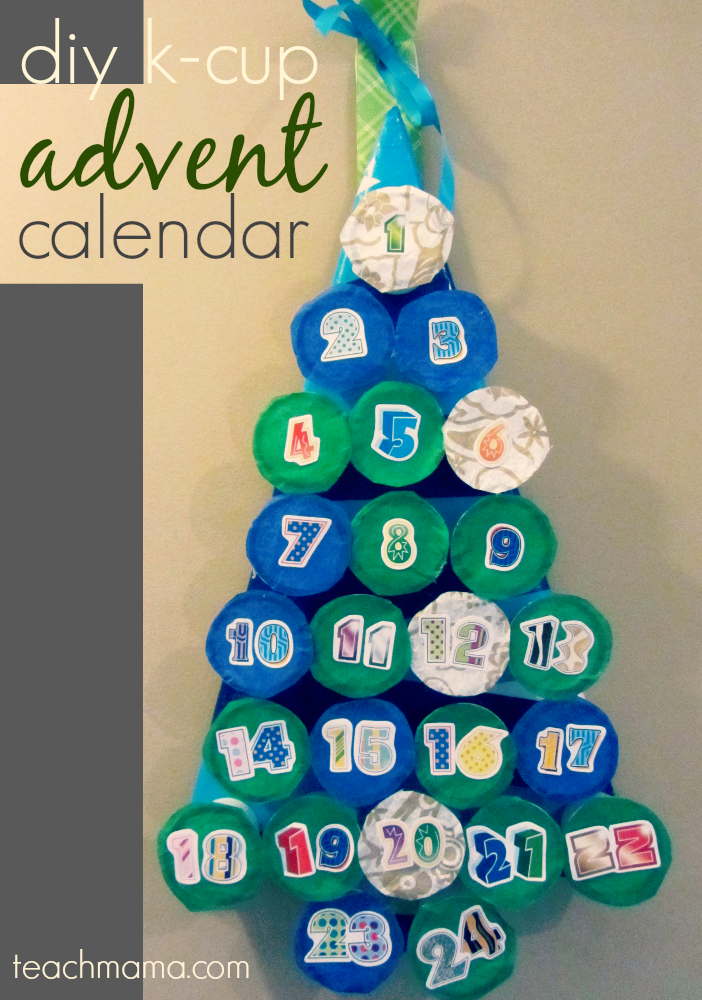
We’ve got a lot of things brewing, but most timely, is of course, our diy k-cup advent calendar.

Super-cute, inexpensive, homemade advent calendar using k-cups.  Bam.

We love how it turned out. I’m confident that this sweet calendar will help us to keep this advent season a thoughtful, thankful one for our whole family.

Here’s the skinny. . .

  • K-Cup Advent Calendar–Make it a Thoughtful, Thankful Holiday:

Though it looks a little involved, you can pull this diy k-cup advent calendar together in a fraction of the time it will take you to gather 24 empty k-cups.

Really.


kcup advent calendar teachmama.com


Each little cup holds 3 things: a kiss, the day’s advent activity, and a little reminder to be thankful.

So start collecting.  Brew yourself a cafe mocha or a pumpkin spice coffee, and read on.  Then get crafting.

You’ll need:

  • 24 clean, empty k-cups
  • 3 pieces of cardboard
  • duct tape (I used light blue, dark blue, and green)
  • tissue paper
  • number stickers (optional)
  • hot glue gun
  • pushpins
  • ribbon
  • Hershey’s Kisses (or other small treat)
  • green cardstock

Once you’ve got your supplies together, you’re ready to go.

1. Clean your k-cups: Cleaning them is a cinch.

For coffee k-cups:


kcup advent calendar cleaning kcups


kcup hot chocolate cleaning

For hot chocolate k-cups:


kcup advent calendar teachmama.com

Let them dry completely.


2. Create your advent activity calendar.  We use the same basic one each year–our advent activity calendar.  It’s a holiday-time calendar that includes tons of our favorite holiday activities, like cookie-baking, gift-making, and carol-singing while giving us ample opportunities to reflect, give back, and be thankful.

You can download our advent activity calendar 2013 here as a easy, quick printable or as an advent activity calendar 2013 word doc that you can modify and make your own.

Be sure to print out two copies–one that you can keep as a reference and the other that you can cut.  Each day of advent will have one square of the calendar tucked inside.

3. Make your tree.  Your tree is what your k-cups will rest on, and it needs to be sturdy enough to survive your kids’ handling.

kcup advent calendar tree


  • Make your cardboard tree. Each of our sides are 18″, and the bottom is 10″. Our tree trunk is midway between the bottom, and it’s 3 1/2″ long and 2 3/4″ high.
  • Cut three cardboard trees. Remember, the tree needs to be thick.
kcup advent calendar tree


  • Using the duct tape, tape your tree together.
  • Grab your ribbon and loop it then staple it to the back of the tree.

4.  Make your thankful discs. I used my Fiskars medium squeeze punch for my circles, but you could totally use anything. I cut 24 discs out of our cardstock, and then I walked over to our Thankful Graffiti Board and copied exactly what I saw there onto the circles.

kcup advent calendar grateful disc


kcup advent calendar grateful disc


kcup advent tree - 44


I wanted our family to remember what we expressed gratitude for through November into the whirlwind that sometimes is December, and I knew that after the treat was taken out and advent activity taken, we’d have a whole lot of time to stare at empty cups.  Here’s to hoping the thankful discs are a pretty, simple reminder of all of the greatness in our lives.

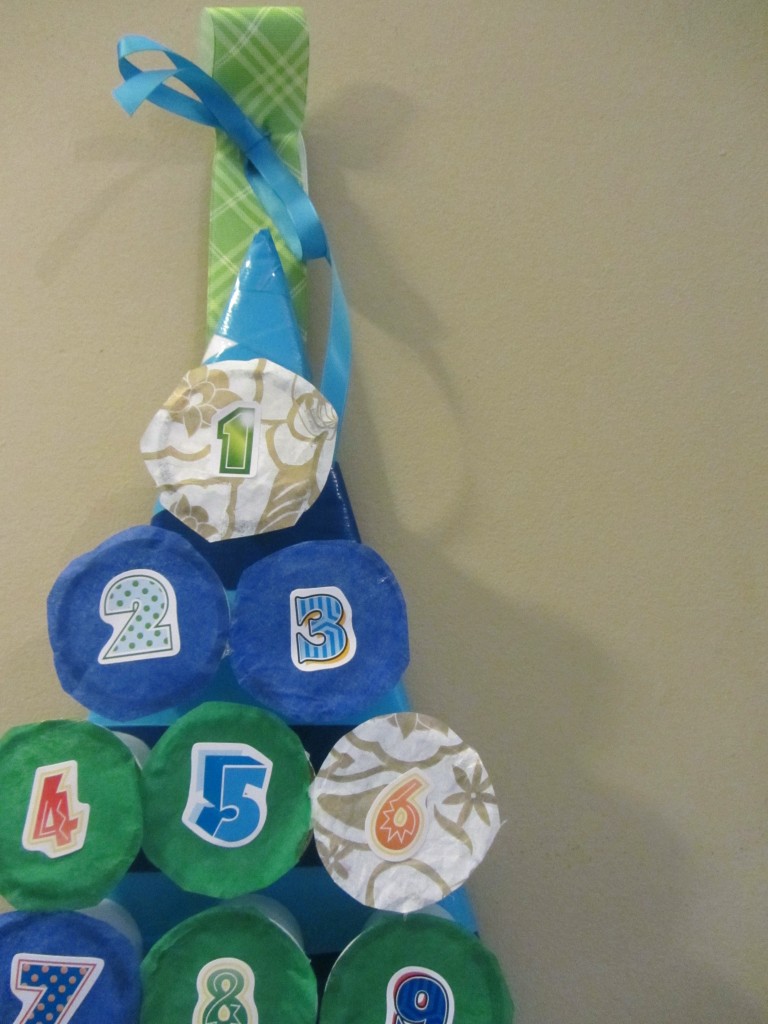
5. Cut tissue paper circle and number them. Trace the open end of a k-cup onto tissue paper and cut it out. Then cut 23 more circles all the same size. Number each circle from 1-24.

kcup advent calendar teachmama.com


kcup advent calendar teachmama.com


Each number represents a day in the month of December.

kcup advent calendar teachmama.com


kcup advent calendar teachmama.com


kcup advent calendar teachmama.com


6. Assemble your diy k-cup advent calendar!

kcup advent calendar how to


  • Use a tiny dab of hot glue to secure the thankful disc to the inside of each k-cup.
  • Using the pushpins, pin each k-cup into the tree. The rows should be: 1 k-cup; 2 k-cups; 3 k-cups; 3 k-cups; 4 k-cups; 4 k-cups; 5 k-cups; 2 k-cups. If you measured your tree the same way I did, your cups should fit tightly together.
kcup advent calendar how to


kcup advent calendar how to


kcup advent calendar how to


  • Load ’em up! Put the correct advent activity in each day along with a Hershey’s Kiss into each cup.
  • Make 5-6 tiny dots of hot glue around the circumference of each k-up and secure the tissue paper on it.
kcup advent calendar how to


kcup advent calendar how to


Hang, and you are ready to rock and roll!

kcup advent calendar how to


kcup advent calendar


And that’s it!

We think it’s pretty cool.

Look forward to other ideas down the road for using k-cups.  And feel free to share your own–let’s put those little guys to good use, shall we?

Happy, healthy, peaceful advent season to you!

fyi: affiliate links are used in this post

Want a few more holiday-inspired gift ideas or activities? Check out: 

  • Best Books to Give as Gifts for Everyone
  • Best Gifts for Kids and Families 2014
  • Best Gifts for Kids and Families 2013
  • Best Gifts for Kids and Families 2012
  • Best Gifts for Kids and Families 2011
  • Holiday Fun Fact and JOKES Lunchbox Notes (with Hannukah!)
  • Holiday Time Fun Fact Lunchbox Notes
  • Little Holiday Notes and Jokes
  • Holiday Notes for Families
  • The Polar Express tradition
  • Scratch-off Cards
  • K-Cup Advent Tree
  • New Year’s Family Interview
  • Happy Holidays Backyard Birds 


fyi: Some of the links in the post above are “affiliate links.” This means if you click on the link and purchase the item, I will receive an affiliate commission. Forever and always I recommend only products or services I use personally and believe will add value to my readers. I am disclosing this in accordance with the Federal Trade Commission’s 16 CFR, Part 255: “Guides Concerning the Use of Endorsements and Testimonials in Advertising.”  For more information, please see teachmama media, llc. disclosure policy. 

November 28, 2013 2 comments
0 FacebookTwitterPinterestPocketEmail
Five Activities for Crossing the Midline (and Why It’s Important)
foundations

Five Activities For Crossing The Midline (And Why It’s Important)

by Teach Mama November 1, 2013
written by Teach Mama

The following guest post is written by the amazing Devany LeDrew. Devany is a former Kindergarten who now shares adventures with her children–most often playing, learning, and remembering–on her blog Still Playing School. Check it out.

———————————

Our 10 month old son has been crawling for a few months so he’s already accomplished a pivotal achievement in learning to read and write.

Wait, what? A milestone in infancy is vital for literacy development?  Yes, because crawling is one of the first ways that babies practice crossing their midline!

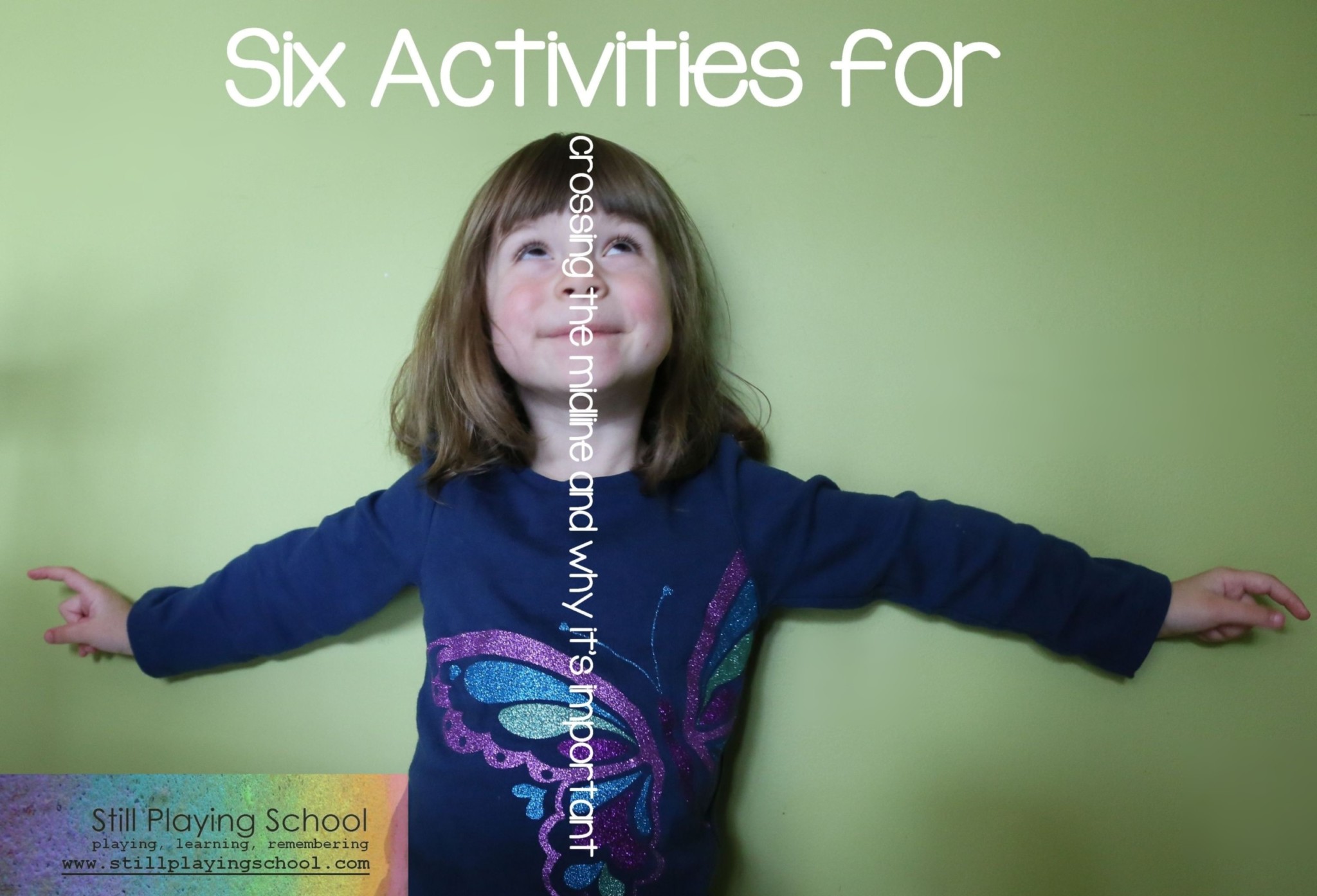
Five Activities for Crossing the Midline (and Why It’s Important)

Let’s imagine an invisible line running down the human body separating the left side from the right called the midline.  When my baby crawls, he uses opposite sides of his body simultaneously. When my preschooler physically uses her body to cross that divide (by using her right hand to reach something on the left side of her body, for example) she is crossing her midline.

In both of these scenarios my children are using movements which cause their brains to communicate across their corpus callosum.  This thick cable of nerves allows their two brain hemispheres to communicate.  The practice is vital for higher level skills like reading and writing.  By moving in new ways, we build and strengthen new pathways in the brain.

Most children will naturally learn to cross their midline as they grow, but some need occupational therapy to work on this task.  There are creative, fun, and intentional ways to play while practicing crossing the midline!

Here are five to get you started!

1.  Crawl, crawl, crawl

I encourage my preschooler to crawl with her baby brother by getting down on the floor to crawl myself!  We build obstacle courses with pillows and soft toys to navigate while crawling.

Five Activities for Crossing the Midline (and Why It’s Important)

2.  Baby Cross Crawls

While you sing songs to your baby or child, intentionally touch his left foot to his right hand and vice versa.  You can tap to the rhythm of the music or teach body part names in this way.

You can challenge your older child to touch her left knee with her right elbow and vice versa.  This is trickier than it looks!

Five Activities for Crossing the Midline (and Why It’s Important)

3.  Wash Large Objects

My preschooler loves to help wash windows or our cars with special wipes or a sponge.  I ask her to hold the tool with both hands wiping back and forth in large motions as she cleans so that she is crossing her midline frequently.

4.  Dance, Sway, and Play with Ribbon Wands

You can create your own ribbon wands with a paint stirrer (or just hold a scarf in one hand for the same effect).  Model how to cross the midline while dancing for your child by making figure eights and rainbow arcs with the ribbon. A great song to practice moving and grooving with is Shake Your Reader Ribbons by Pam Schiller

Five Activities for Crossing the Midline (and Why It’s Important)

5.  Play Passing Games

Challenge children to pass a ball from a friend on the left to a friend on the right by moving their arms but not turning their whole bodies.  Friends may sit in a line or in a circle for this activity.  For two children, have them sit back to back and pass the ball from the left side across their bellies and back over to the right.


still playing school

For more from Devany LeDrew, please visit Still Playing School where she uses her background in early childhood to create a home based playful learning environment for her children. She is a former Kindergarten teacher who followed her passions to specialize in Educational Psychology & Literacy Education.  She is the mother of three, grieving the loss of one. Follow Still Playing School on Facebook and Twitter.

Thank you, thank you, thank you, Devany, for sharing!  I learned SO much from this piece!


Looking for more activities to promote fine and gross motor in your little loves?

Stop by and follow these great educational Pinterest boards, filled with indoor fun ideas to engage children in fun activities to promote the development of these foundational skills:

  • Sensory Activities  |  D @ Still Playing School
  • Preschool Activities  |  D @ Still Playing School
  • Handprint Projects  |  D @ Still Playing School
  • foundations  |  teachmama
  • movin’ and groovin’  |  teachmama


Check out a few other posts that may help you develop strong and healthy habits for your family:

  • wait time
  • my day, your day
  • frozen peas
  • kids who rock the kitchen
  • kids who rock the laundry
  • rest time
  • gem jars
  • arm circles
  • noticing kids
  • homework routine


Cheers, and happy reading during this incredibly exciting journey!

A few more literacy-related posts worth reading. . . (click on image to read!)
what to say when kids make reading mistakes teachmama.com.png
5 things to never say to emerging reader
literacy terms every parent must know
talk to kids about books
how to help kids choose just right books
Want a little more help with all things literacy?  
Follow Teach Mama’s board literacy on Pinterest.

fyi: Some of the links in the post above are “affiliate links.” This means if you click on the link and purchase the item, I will receive an affiliate commission. Forever and always I recommend only products or services I use personally and believe will add value to my readers. I am disclosing this in accordance with the Federal Trade Commission’s 16 CFR, Part 255: “Guides Concerning the Use of Endorsements and Testimonials in Advertising.”  For more information, please see teachmama media, llc. disclosure policy. 

November 1, 2013 7 comments
0 FacebookTwitterPinterestPocketEmail
sweet spooky chocolate cookie ghosts
halloweenholidays

Quick And Easy Halloween Ghost Cookies

by Teach Mama October 22, 2013
written by Teach Mama


October has been an incredibly busy month for us, with me finishing up two classes on top of all of my other normal work.

However, our crazy schedule isn’t stopping us from having a whole lot of Halloween fun over here.

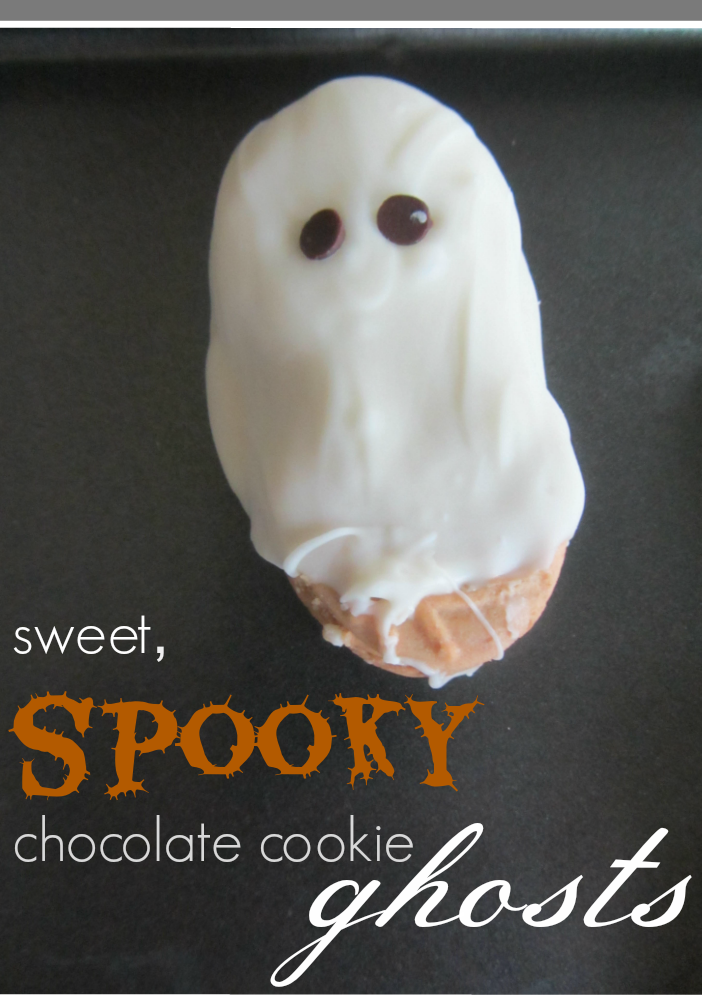
Our Halloween Banana Ghosts were a big hit way back when, so rather than stay healthy, I thought I’d mix it up a bit and really ‘up’ our sweet and fat intake and make Sweet, Spooky Halloween Cookie Ghosts.

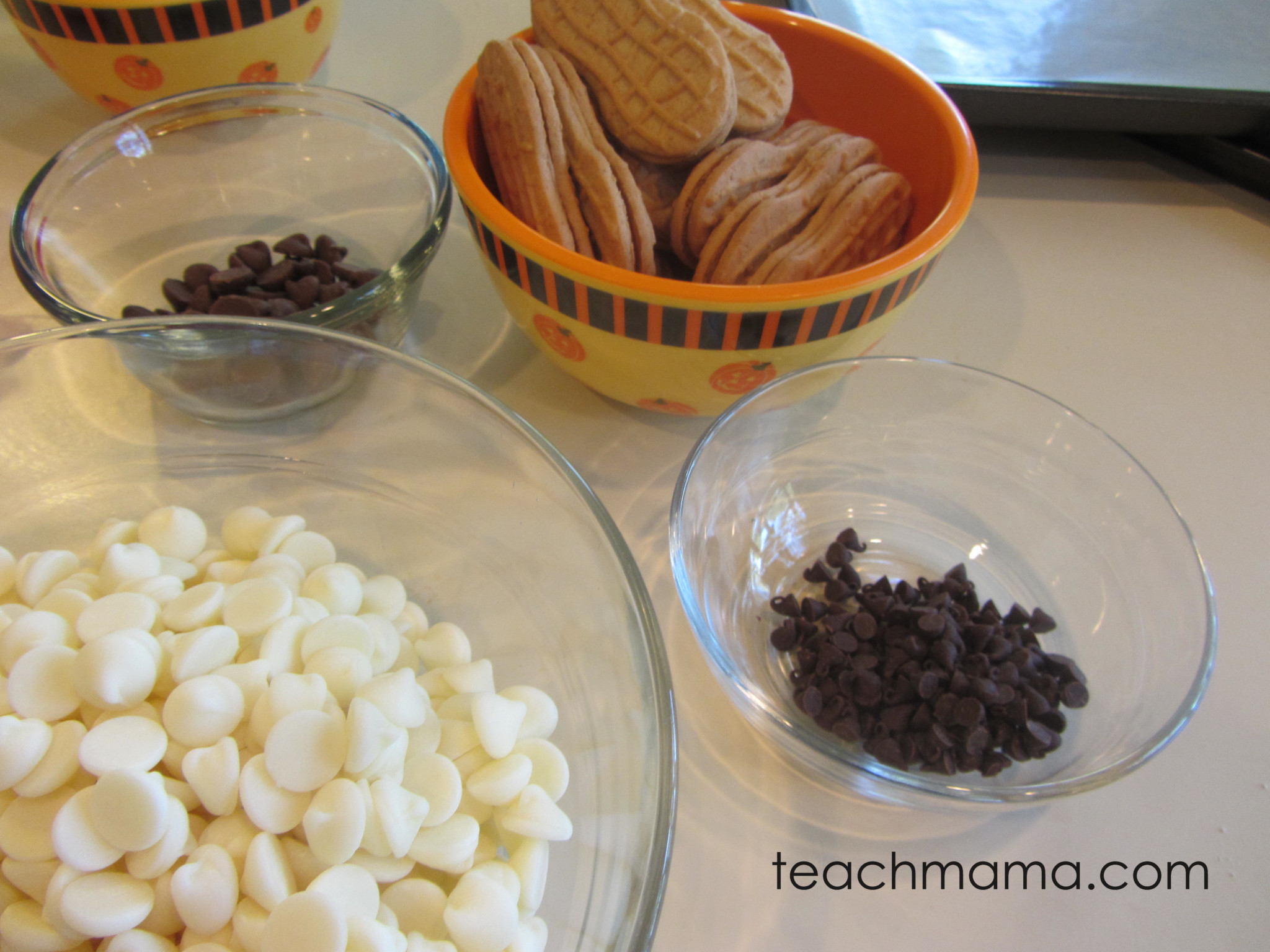
White chocolate. Nutter Butters. Chocolate chips. Bam.

Actually, in all honesty, I wanted a quick and easy seasonal treat and I was craving Nutter Butters.  So that’s why we made them.

And because these cookies only need a handful of ingredients, there really is no recipe reading involved. But there’s a lot of basic sequencing with the repeated steps, so that is what I emphasized.

Cora was my helper, and by the time we were finished, yes we were covered in white chocolate, but we also had a full tray of fun ‘homemade’ cookies to share for Grandma’s birthday dinner that night.

Here’s the skinny. . .

  • Sweet, Spooky Halloween Cookie Ghosts:

Little hands are big helpers with these chocolatey treats, so be sure to gather your small helpers.

halloween cookie ghosts

You will need:

  • White chocolate chips
  • Mini milk chocolate chips
  • Regular sized milk chocolate chips
  • Nutter Butter cookies (or Vienna Fingers—any long oval cookie will work)
  • Cookie sheets lined with wax paper

spooky halloween cookies collage

1.  Prepare your cookie sheets by lining them with the wax paper.

Explain to your helper that you will need a spot to drop these sweet and spooky ghosts after they’re dipped, so you are thinking a head and preparing a spot for them.   The worst thing would be to have a drippy cookie with no place to put him to cool.


 spooky halloween cookies collage

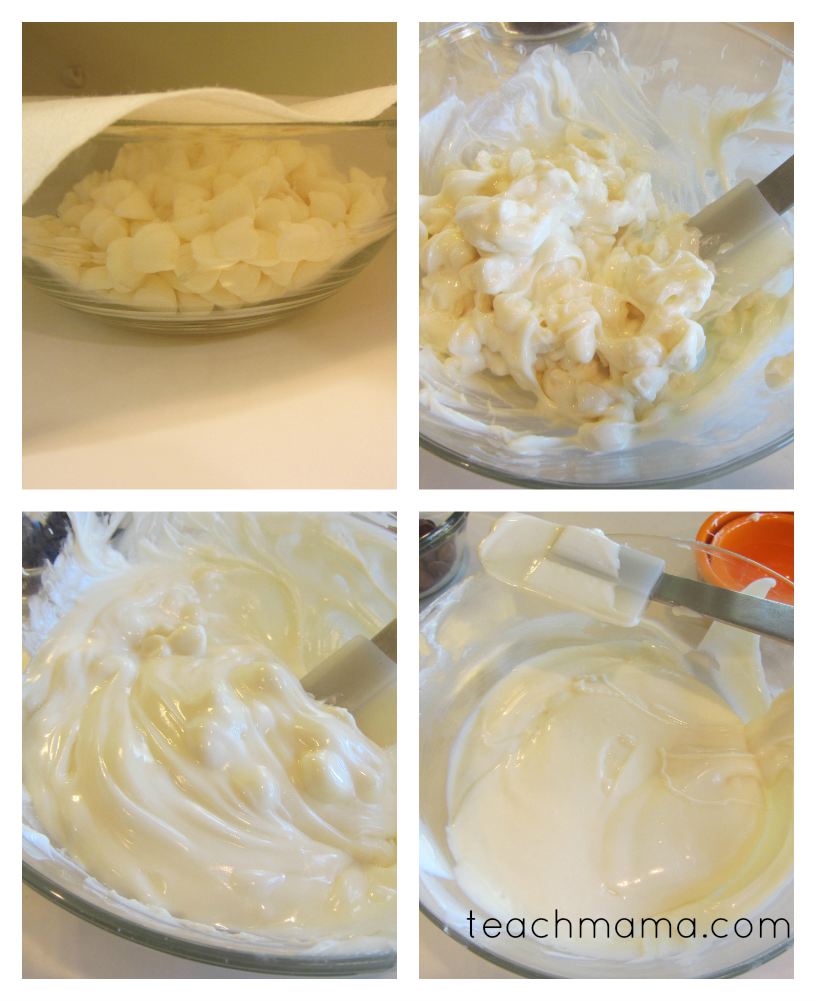
2.  Melt the white chocolate chips.

I explained to Cora that when melting chocolate, it is really important to do it slowly and carefully. We didn’t want to place them in the microwave on high for five minutes or the chocolate would burn and get crusty.

spooky halloween cookies collage

Rather, we put the bowl in the microwave for 45 seconds, took it out and mixed it.

We put it in the microwave again for 45 seconds, mixed and repeated until the chocolate was totally smooth and melted.


She loved mixing the chocolate with the spatula and watching it become more and more smooth.

spooky halloween cookies collage

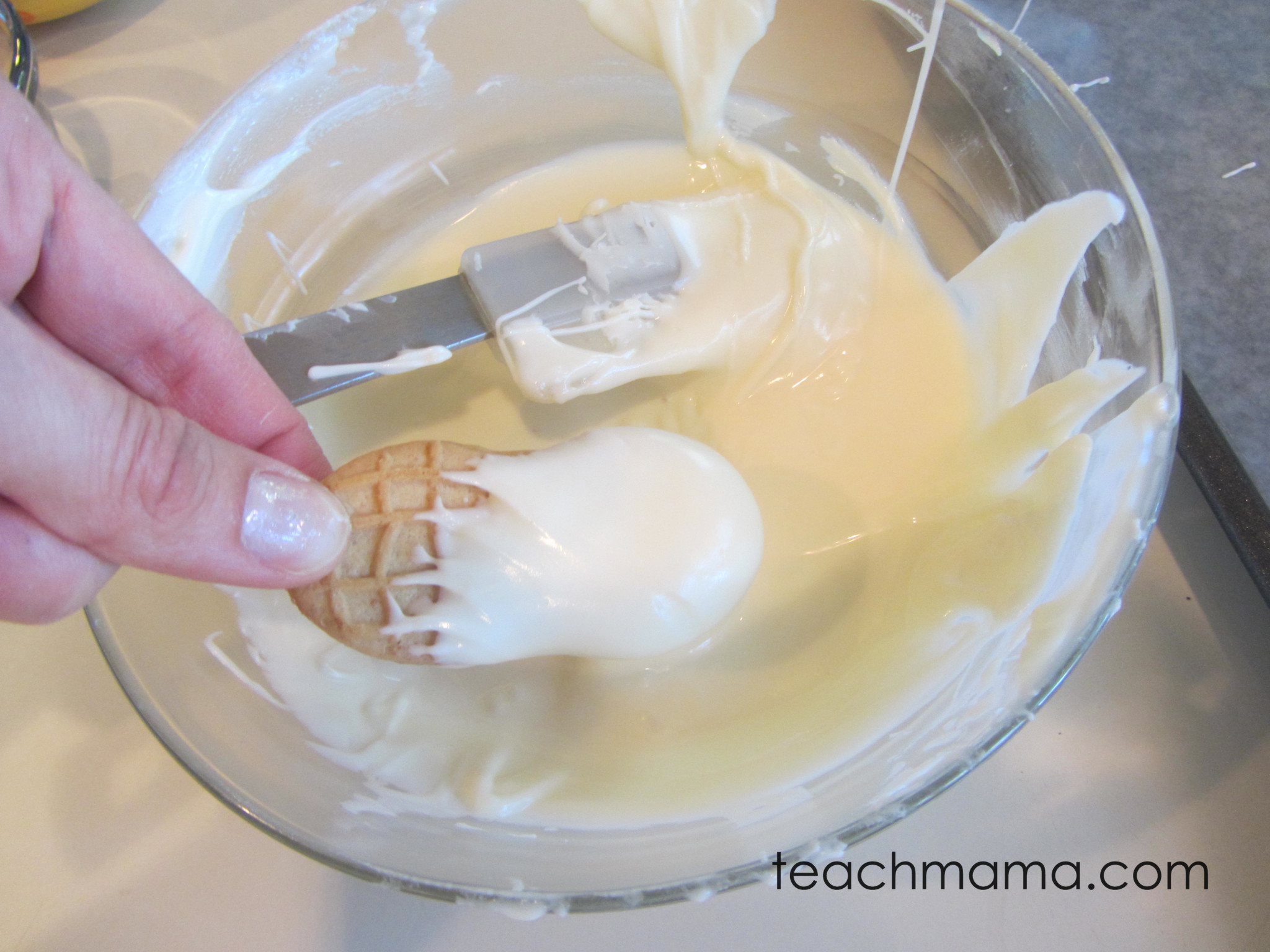
3.  Dip a cookie in the chocolate.

Easy as that.  Dip, twist to make sure it’s covered on the front and back, and place on the wax paper.


spooky halloween cookies collage


spooky halloween cookies collage

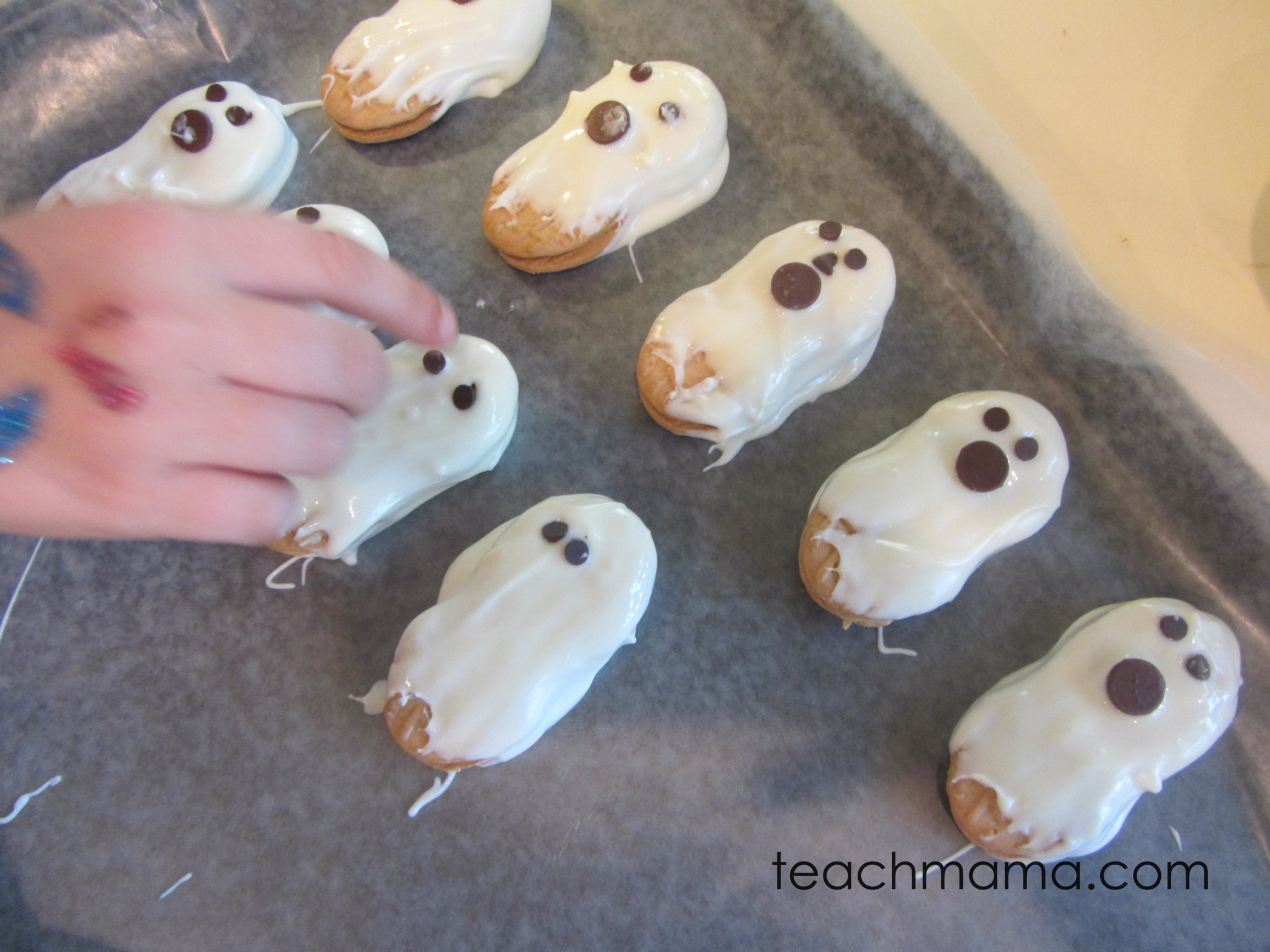
4.  Place the chocolate chip eyes and mouth onto the ghost.

We used mini chips for the eyes and regular-sized ones for the ‘BOO!’ mouth.

Cora did this job almost entirely by herself because her tiny fingers were better for the job. And of course I let her know that.

spooky halloween cookies collage

spooky halloween cookies collage

As we built our ghost cookies, I was careful to use sequential words like first, second, third, next, after, and last.

I tried to use words like before and after, left and right, top and bottom. Easy words I know she knows and covered in pre-k and Kindergarten but that I want her to use and remember.

halloween cookie ghosts


halloween cookie ghosts


I wanted to squeeze in as much meaningful everyday math vocabulary as I could, not only because it’s important for Cora to learn, but also because it’s great for her to use these words ‘in action’.  And really? It’s great for kids to have as much at-home practice of their at-school learning as possible.

For our family, some of the most fun and memorable learning has been done in our kitchen–over sweets.

Anyway, perfect no matter how much time you have to prep, these Sweet, Spooky Halloween Cookie Ghosts will sure to be a hit with kids of all ages.


Want a few more fall-inspired learning ideas?

Stop by and follow these great educational Pinterest boards:

  • halloween  |  teachmama
  • fall | teachmama

Or check out these popular Halloween posts:

  • Halloween class party ideas
  • what to to with Halloween candy
  • Halloween word search
  • Halloween GHOST bingo
October 22, 2013 0 comments
0 FacebookTwitterPinterestPocketEmail
new ideas for halnew ideas for halloween treatsloween treats teachmama.com
halloweenholidays

New Ideas For Halloween Treats: Alternatives To Candy

by Teach Mama October 21, 2013
written by Teach Mama
Halloween is traditionally a time for sweets, sweets, and more sweets, but who says kids must eat candy from dawn till dusk just because that’s how it’s always been done?
This year, though my kids will certainly have their fair share of sweets (we are a sweet-tooth family after all), I’m really trying hard to think outside the box a bit as far as Halloween treats are concerned.
Thanks to my friends from Melissa & Doug, I’m stretching the limits of treat-giving and treat receiving, and I’m going for small, hands-on toys that encourage creative play and fun.

As a Room Parent for one of my kids’ classes, I’m not planning on handing each child yet another bag of sweets to shove in their backpacks on the very day they’ll walk the streets of their neighborhood, grabbing more candy than they can hold. Not this year.

Instead, I’m mixing it up. Thinking outside the Halloween treat box.  Thinking about some alternatives to candy.

I’m handing the kids a few new Halloween treats: bubbles, stickers, tattoos, crafts, and small toys. These are sure to be items that the kids–and parents–will be happy to see, as they won’t mean more sugar for our kids’ little bodies.

Here’s the skinny. . .

New Ideas for Halloween Treats  — Alternatives to Candy:

Some of newish ideas for Halloween treats for home or at school. . .

new ideas for halloween treats scratch art


Scratch Art: I think any of the Scratch Art Classroom Kits would be a great crafty activity for Halloween at home or Halloween class parties.

In particular, the Gold and Silver Scratch Art Trading Cards are super-cool for making Jack O’ Lanterns that look like they really glow!

new ideas for halloween coll 1

Or kids could get funky, creating Scratch Art to complement their costumes!

————————————————-

————————————————-

new ideas for halloween treats

 Tattoos! Kids love, love, love tattoos, and the great thing about these My First Temporary Tattoos sets are that each comes with over 100 tattoos!

We easily tore apart the tattoos on each sheet–jewels, flowers, and more in the Jewelry Set and sports, trucks, animals, and more in the Blue Tattoo Set.

new ideas for halloween treats

new ideas for halloween treats

These are super for goodie bags, for handing out to the Trick-Or-Treaters, or as a ‘Tattoo Station’ at a class party.

————————————————-

————————————————-

new ideas for halloween treats

new ideas for halloween treats

new ideas for halloween treats

Snakes, Bugs, & Lizards:  Yes, snakes, bugs, and lizards are super fun additions to Halloween if you ask me.  As a family that prefers silly over scary, these little guys are perfect for hiding around the house and seeking for extra Halloween fun or for adding to goodie bags or baskets.

They come in packs of six (Sack of Snakes), ten (Bag of Bugs), and seven (Litter of Lizards), so they totally work as affordable Halloween goodies.

————————————————-

————————————————-

snake turtle butterfly bubbles

Bubbles! Kids love bubbles, and they’ll especially love these bubbles with silly animals on top. For the extra-special Trick-Or-Treaters in your life, the Mombo Snake Bubbles would be a great replacement for that larger-sized candy bar or treat!

————————————————-

————————————————-

new ideas for halloween treats

new ideas for halloween treats

Scratch Art Light Catchers: These totally rock.

They really do.

I think they’d be awesome as a Halloween class party activity.  No matter the shape, kids will love doing this non-messy activity (and teachers and Room Parents will, too!), and kids have a sweet end product to take home and display.

Melissa & Doug has anything from Flower Light Catchers to Dolphins, or Butterflies to Sailboats, and honestly, kids won’t care what they have. I’m willing they’ll just be excited to grab a stick, grab a sheet, and start scratching!

————————————————-

————————————————-

 That’s just what we’ve got up our sleeve this Halloween season. I’m totally thrilled.

What new ideas for Halloween treats do you have? What are your super-fab alternatives to Halloween candy? Please share!

Want a few more fun halloween party ideas?

  • halloween class party
  • more halloween class party ideas
  • GHOST bingo!
  • spider web craft
  • pumpkin match 
  • halloween word search
  • halloween ghost cookies
  • boo! your neighbors
  • alternatives to halloween candy
  • halloween joke notes
  • halloween learning
  • hats, cats, and pumpkin grid game
  • dinner in a pumpkin
  • candy experiments


fyi: Some of the links in the post above are “affiliate links.” This means if you click on the link and purchase the item, I will receive an affiliate commission. Forever and always I recommend only products or services I use personally and believe will add value to my readers. I am disclosing this in accordance with the Federal Trade Commission’s 16 CFR, Part 255: “Guides Concerning the Use of Endorsements and Testimonials in Advertising.” For more information, please see teachmama media, llc. disclosure policy.

October 21, 2013 0 comments
0 FacebookTwitterPinterestPocketEmail
easy cotton ghost: halloween craft for little ones
holidays

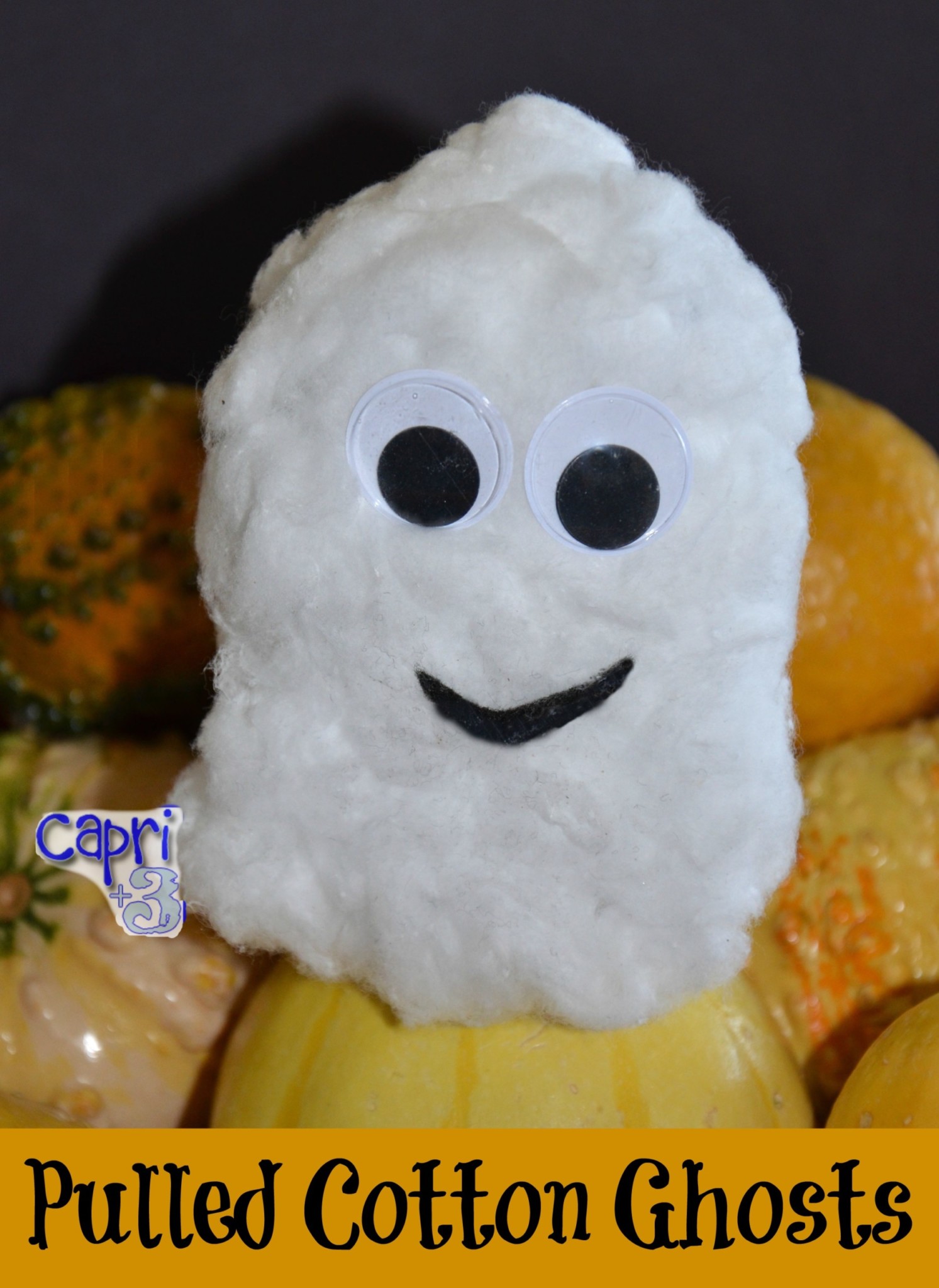
Pulled Cotton Ghosts: Halloween Craft For Little Ones

by Teach Mama October 18, 2013
written by Teach Mama

post contains affiliate links


The following guest post is written by the incredibly busy Theresa of Capri + 3.  Theresa is a mom of four toddlers, and her family’s story is an amazing blessing. Her blog chronicles their adventures.

——————————

I am stopping by from Capri + 3 to share a fun and easy Halloween craft, perfect for little hands.

I love the change in the weather, the aroma of cinnamon and pumpkins and festive fall decorations.  We have three boys and a girl who will turn three in November and they love to do arts and crafts projects.

Since Halloween is approaching, I thought it would be fun to make fluffy pulled cotton ghosts.  We have made pulled cotton ghosts before and glued them onto black paper. This year, I decided to shake things up and make them three dimensional using recycled toilet paper rolls.

That way they can ‘haunt the mantle’ or greet goblins coming to ‘trick or treat’ on Halloween night.

  • Pulled Cotton Ghosts–Halloween Craft for Little Ones:


You will need:

  • Cotton balls
  • One recycled toilet paper roll
  • White glue
  • Scotch tape
  • One sheet of white printer paper
  • Pen
  • Scissors
  • One pair of large google eyes
  • Black felt or black paper cut into the shape of a mouth

First, set the TP roll on edge and draw a circle larger than the roll and cut it out (or have your older child to this).

Ghost--TP Roll with paper on it

Then, cut slits around the circle and tape it on one end so that it blocks the hole in the cardboard tube.


Give your children cotton balls and have them pull them apart to make fluffy cotton.  This is a great fine motor activity and can also be very relaxing if you want to get in on the fun!

Ghost--Pulling Cotton Ryder

 Capri making her ghost

Then, add glue all around the cardboard tube and on the white paper located on the top.  Have your children glue the pulled cotton onto the ghost.   The great thing about this project is that the cotton can be layered so that it no longer resembles the shape of the cardboard tube (just add more glue).  Then, have your child glue on the eyes and mouth.

Our little ones love to look up and see their pulled cotton ghosts ‘haunting’ the mantle.’


capri plus 3Theresa and Greg struggled with infertility and were fortunate to have a happy outcome to their journey.  Theresa started Capri + 3 as a way to share their infertility success story to bring hope to other couples facing challenges in starting their families and to document their children’s childhoods.  It has morphed into a blog about parenting multiples, arts and crafts activities for children and so much more.  Capri, Grayson, Xayden and Ryder  were all born in November of 2010.

Facebook  |  Google+   |  Pinterest |  Twitter 

Thank you, thank you, THANK YOU, Theresa,  for sharing!

Looking for more activities for ringing in Halloween (and sneaking in a little learning) with your littles?

Stop by and follow these great educational Pinterest boards:

  • fall  |  Capri + 3
  • toddler crafts  |  Capri + 3
  • halloween  |  teachmama
  • fall | teachmama
Or check out any of teachmama’s Halloween posts!
fyi: affiliate links are used in this post
October 18, 2013 4 comments
0 FacebookTwitterPinterestPocketEmail
paper plate math puzzles
mathnumbers

Paper Plate Puzzles: Fun Number Learning For Kids

by Teach Mama October 14, 2013
written by Teach Mama


The following guest post is written by mom of five, Annette of Tips From a Typical Mom.   Annette covers everything under the sun on her blog, and it’s all done well.  Check it out.

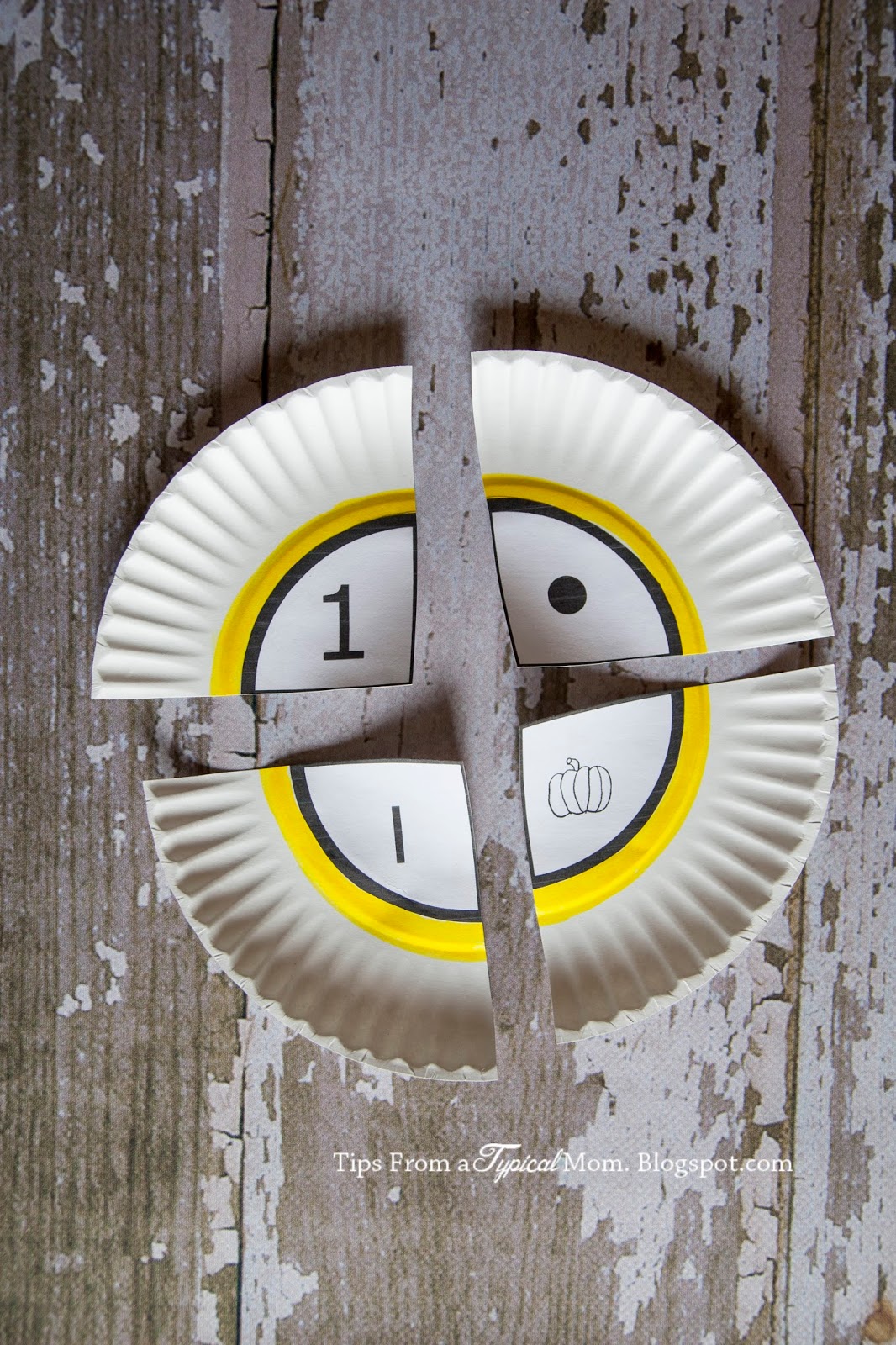
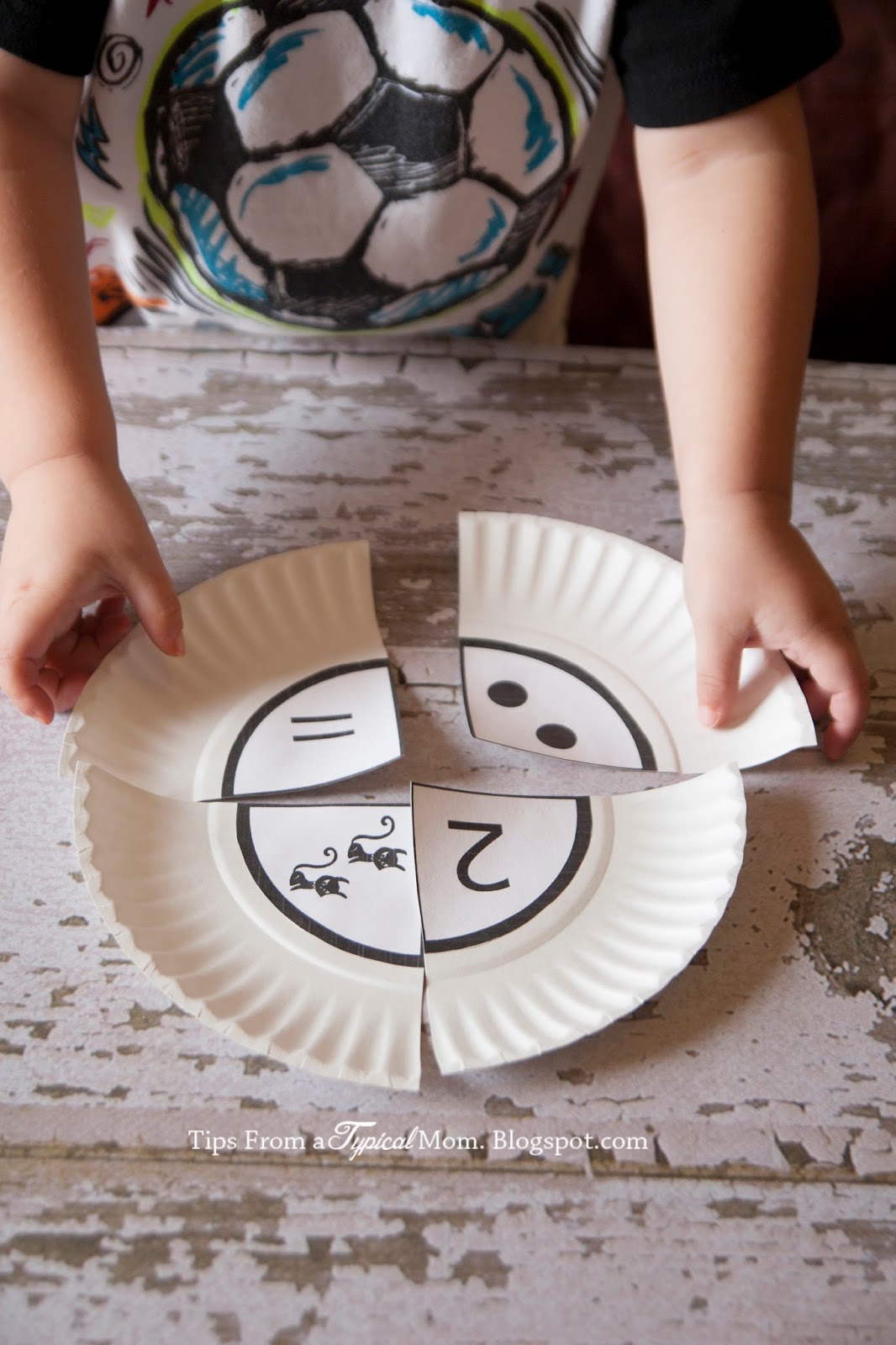
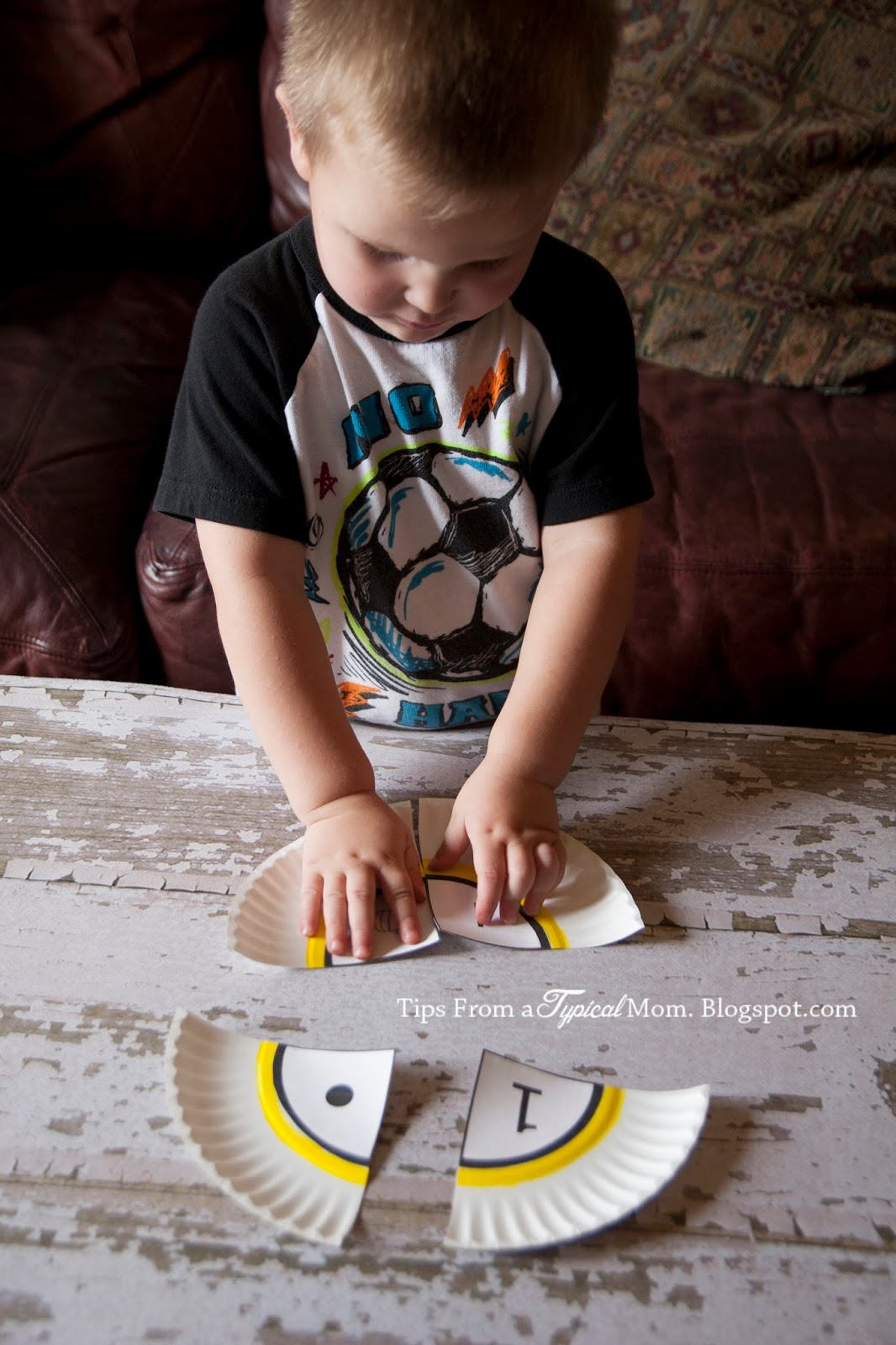
paper plate puzzles: fun number learning for kids

Hi Everyone!  I’m so excited to be doing a guest post for Teach Mama.

I am a preschool teacher, and one of the hardest things for me to find are manipulatives that have to do with learning numbers.  So I decided I’d make my own.

  • Paper Plate Puzzles–Fun Number Learning for Kids:

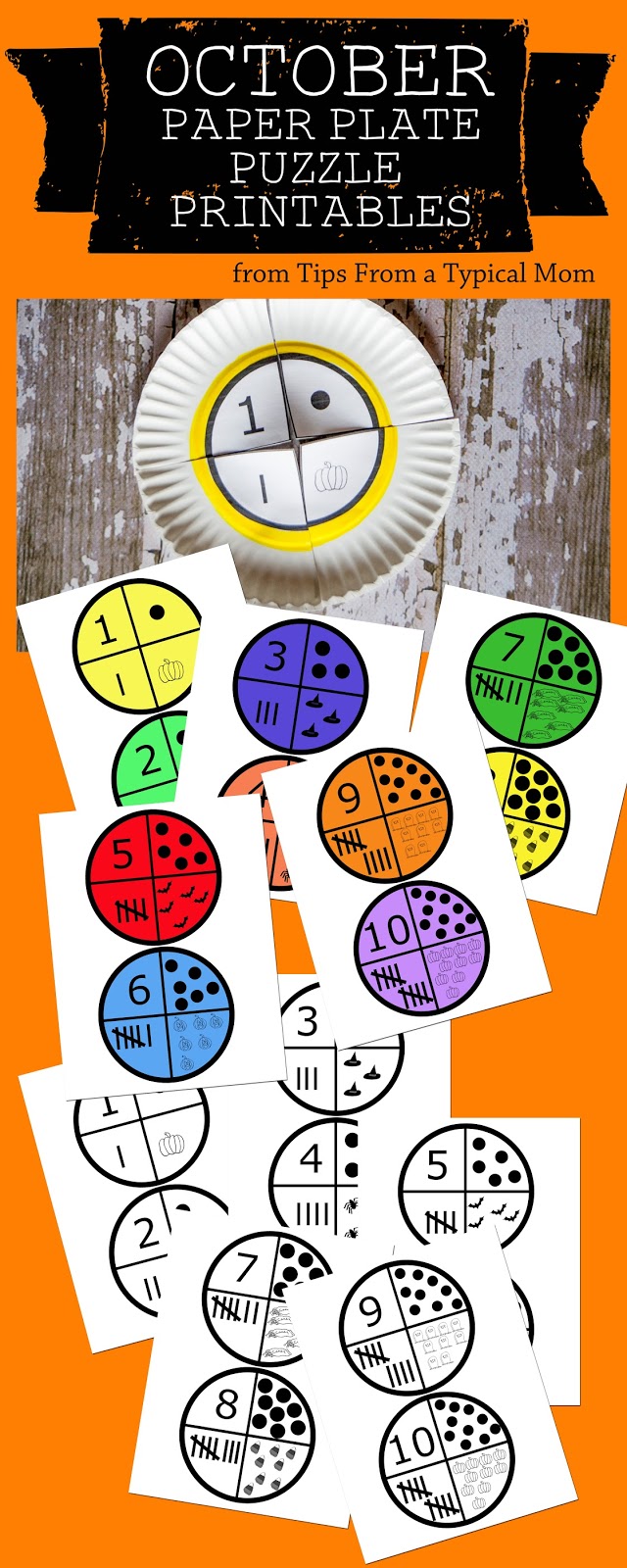
These cute paper plate puzzles are so inexpensive and easy to make, and your kids will love to play with them.  I have made them in black and white, so you can either leave them that way or color them.

You can print them with a colored background for easier matching.

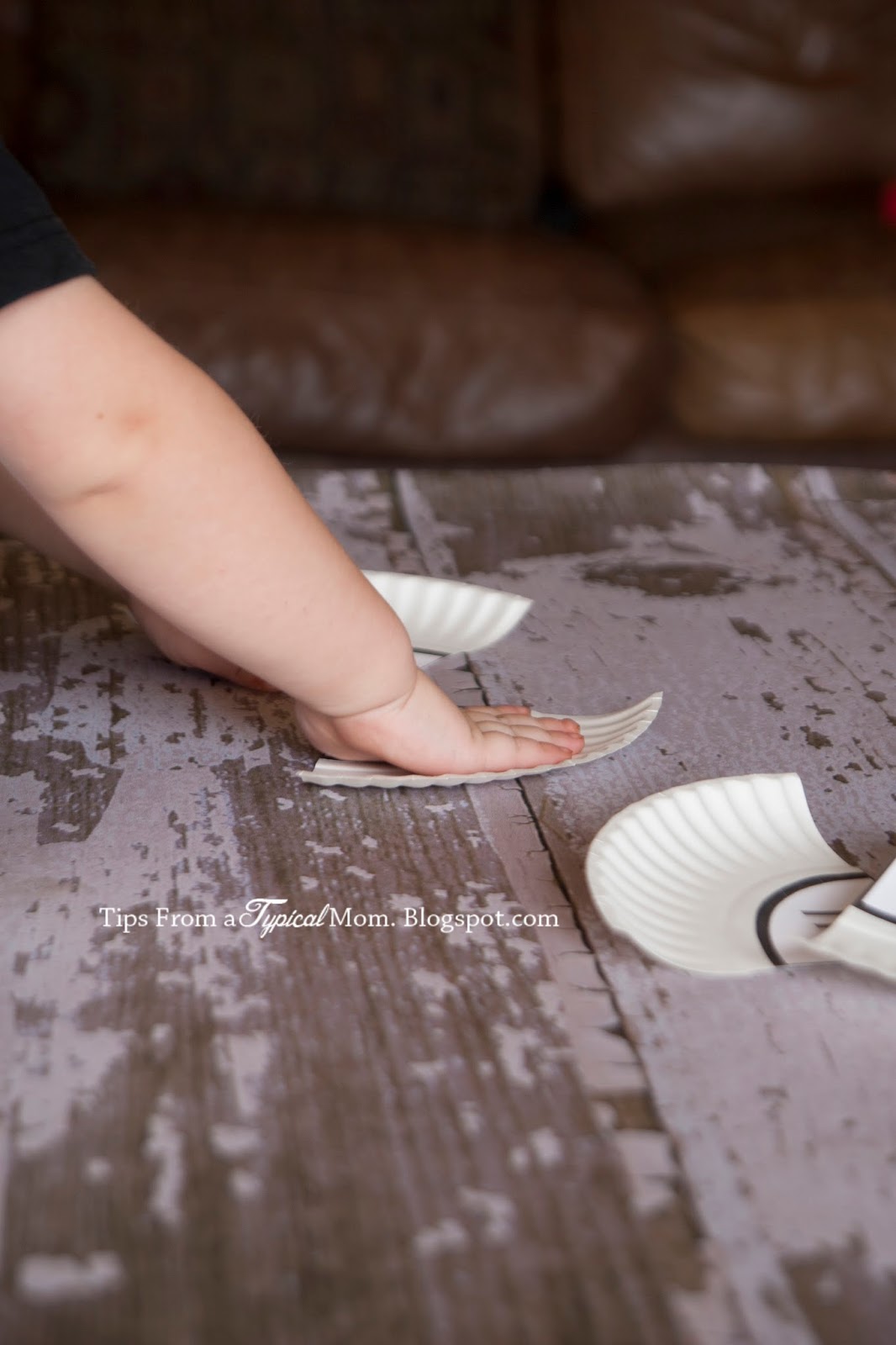
My 2 1/2 year old son is just learning his numbers, so I colored around the outside of the printable so he could match the pieces easier.  He knows all the yellows go together!

Then I count the dots, tally marks and pictures with him and help him trace the number with his finger.

These are so easy to make!

All you need are:

  • the cheap flimsy paper plates,
  • glue,
  • scissors and
  • the printables.

Just print, glue, and cut.  You’re done!


Do you want to make Paper Plate Puzzles for your little ones?

  • DOWNLOAD B&W VERSION HERE
  • DOWNLOAD COLOR VERSION HERE


Annette is a blogging mother of 5 over at Tips From a Typical Mom.

She is also a preschool teacher, photographer, soccer mom and loves her Paragliding Hubby!  She loves to share freebies, recipes, parenting tips, and household tips on her blog.

You can find her on Pinterest, Facebook, Twitter, and Instagram.

Thank you, thank you, THANK YOU, Annette  for sharing this cute and clever activity!

Looking for more activities that make math hands-on, fun, and engaging for your little ones?

Stop by and follow these great educational Pinterest boards, filled with more fab sneaky learning ideas:

  • quiet time activities |  Annette
  • preschool  |  Annette
  • math  |  teachmama
  • math is fun |  Allie McDonald
  • math madness & stem  |  Zina

Or check out the following math-happy posts:

  • everyday math
  • 3 quick,  hands-on, totally cool math games
  • math bingo

What’s your favorite, hands-on way of helping kiddos learn numbers? Please share!

October 14, 2013 3 comments
0 FacebookTwitterPinterestPocketEmail
readingword consciousness

5 Great Reasons To Read Words Out Of Context

by Teach Mama October 11, 2013
written by Teach Mama


The following guest post is written by Becky Spence of This Reading Mama. Becky is a busy homeschooling mama of four littles, and she constantly shares super content on her site.  I’m always in awe of her.  Do take a peek!

———————————

  • 5 Great Reasons to Eead Words OUT of Context:

It is important to “marinate” young children in books. You may have even seen the poster that lists the top 10 ways to help kids become better readers ~Read, Read, Read… But as important as it is to read words in context (within the text), it is also a good idea to pull words out of their context and ask readers to study them. This is especially true for young readers and struggling readers.

Here are five great reasons to read words out of context:

1. The Reader Relies too Heavily on Context

Have you ever noticed your reader using the picture or the context of the sentence to figure out unknown words?

This strategy is a normal part of literacy development (and is encouraged when kids are young), but it can develop into a problem if those young kids grow into older kids who are not equipped with proper strategies to decode unknown words. In this way, relying too heavily on context negatively impacts fluency and comprehension.

2. Focusing on Word Patterns

Teaching phonics by patterns is my absolute favorite way to teach phonics. I love to use words sorts because they are hands-on, developmentally appropriate, explicit, and flexible. To prepare a word sort, words are pulled out of context and studied by the pattern that they share (for example: rain, braid, train, and maid all share the AI pattern). Other word patterns, such as AY, are compared to the first pattern. This way of teaching phonics is so effective because it equips readers of all ages to look for patterns as they read (a.k.a. reading by analogy), the strategy proficient readers use.

3. The Reader has Memorized the Book

Sometimes, our children pick up books and “read” them to us. We begin to wonder, “Does she really know the words or has she just memorized the book?” This is especially true of early reader books with predictable text. Pulling the words out of context helps readers slow down and really focus on the words. One of my favorite activities to help young readers do this is writing down the words from a few sentences in the book (or the entire book, if it’s shorter), cutting them apart, and asking your young reader to re-build the sentences.

rebuilding sentences from an early reader


My son (at age 4), an early reader, loves doing this on our pocket chart. We rebuild sentences from texts quite a bit. He even likes to make a game out of it! (If you have an early reader, my Reading the Alphabet curriculum has this activity built into every lesson.)

4. Building Fluency

When readers recognize words by sight (within one second of seeing the word), they are more fluent readers. When readers are more fluent, their minds are freed up to focus on the meaning of the text–the purpose of reading. It’s a chain reaction. Am I saying that we should teach all words by sight? Absolutely not! (refer to reason #2). But some words are better learned by sight, especially those common words that kids see all the time in reading, such as the, of, have, etc. Teaching words by sight words does not need to be boring or even include flash cards. It can be fun and interactive! When you can make it multi-sensory, all the better!

5. Supporting Readers Before and After They Read

Sometimes, certain words need to be pulled out of context and introduced before reading. This is especially true of:

1-longer words that the reader would not know or have the strategies yet to figure out on his own or

2- words that, while the reader can figure them out, he does not understand the meaning.

To do this, I glance through the book ahead of time and jot down about three to four words that jump out at me as being difficult words. I jot them down on a dry erase board or piece of paper. Before my second grade son reads the book, I display and read those words to him. We discuss the meaning of the words and/or the features of the word.

Words can also be pulled from the context of the book after reading. For example, if your child continuously read a word incorrectly (without changing the meaning of the text), jot that word down. After your child finishes reading, display the word from the text and the word he said instead side-by-side and talk about each word. For example, if your child read steps instead of stairs, talk about what a good mistake he made because these two words share the common feature of st. But be sure to go a little further in the word. Explore how the middle and ends of those words are different. Doing this helps readers slow down and focus on the patterns within words.


While there are some great reasons to read words out of context, please hear me shout it from the rooftop that kids need to be taking what they learn out of context AND applying it to real reading and real writing (in context)!

The ultimate goal of reading and writing words out of context is to help readers comprehend and create texts in context. That sounds like a great goal to me!


HeadshotNew-150

Becky Spence a homeschooling mama of 4 little blessings. She is the author of This Reading Mama, where she shares reading and writing activities as well as free literacy curricula and printables. You can connect with her on Facebook, Twitter, Pinterest, and Google +.


Thank you, thank you, THANK YOU, Becky,  for sharing your reading expertise with us!


Looking for more activities for building strong reading skills in your children?

Stop by and follow these great educational Pinterest boards:

  • Reading the Alphabet |  Becky, This Reading Mama
  • Word Study/ Phonics |  Becky, This Reading Mama
  • literacy  |  teachmama
  • Reading Activities  | The Educators’ Spin on it
  • Early Literacy  |  Allie, of NTFC

Or check out the following early literacy blog posts:

  • alphabet ideas  |  teachmama
  • sight words  |  teachmama
October 11, 2013 0 comments
0 FacebookTwitterPinterestPocketEmail
teaching left handed kids to write: grasp, stages, positioning
tripod gripwriting

Teaching Left Handed Kids To Write: Grasp, Stages, Positioning

by Teach Mama October 8, 2013
written by Teach Mama

post contains affiliate links


The following guest post is written by Christie Kiley. Christie has the job I find amazing and awe-inspiring: an Occupational Therapist.  The work of these professionals is absolutely incredible. Christie is an O/T and mom of two teeny-tiny ones; she writes MamaOT.com. Check it out.

———————————

I am so honored that Amy invited me to share some tips with you today about how to teach lefties to write!

As a pediatric occupational therapist, I work with kids on handwriting all the time. I have found that people are often intimidated or confused about how to teach left handed children to write. To be honest, there really isn’t that much difference between teaching right-handed and left-handed children to write, though there are a few important things to keep in mind. If you are teaching a left-handed child to write, don’t be scared!

Here are a few tips for teaching left handed children to write:

  • Teaching Left-Handed Children–Developmental Stages:


teach left handed kids to write


1) Remember that hand dominance is not expected to fully develop until the Kindergarten years, between ages five and six. If you have a toddler or preschooler who is exhibiting a left-handed preference, it’s possible he could still switch over to become a fully right-handed writer by the time he reaches Kindergarten and begins formal writing instruction. Don’t “force” your kiddo to be left handed because you’re afraid of what might happen if he ends up switching to the other hand. If you allow him opportunities to explore using both hands, he will most likely develop a preference and eventually dominance that utilizes whichever hand demonstrates the greatest skill, strength, and dexterity.

2) If your child truly has established a left-handed dominance, make sure he knows and can verbalize the fact that he is left handed. Sometimes well meaning classroom volunteers and even teachers will switch kids’ pencil to their right hand because they may just assume the child is right handed. This can obviously impact kids negatively and confuse them, so teach them to be able to communicate the fact that they are left handed.

  • Teaching Left-Handed Kids–Grasp:

3) Encourage use of the “tripod” grasp (pinch pencil with index finger and thumb, rest it on the middle finger) just like righties do. This will help with developing dynamic finger movements and proper wrist position later down the road so your child is less likely to “hook” his wrist like lefties are known to do. Children in our current educational system often are not taught how to correctly hold their pencil. Many right handed kids can figure it out just fine but because positioning is a bit trickier for lefties, they may be more likely to develop bad habits that will make it harder for them to grasp and control the pencil as they get older and the writing demands increase.

left handed kids

4) Teach your lefty to hold the pencil in that tripod grasp about 1 to 1 1/2 inches above the tip of the pencil. When lefties move their fingers up the pencil a little higher, it allows them to see what they’re writing so they are less likely to have to hook their wrist in order to have a good view. This should also help them smudge their writing less. If your child keeps forgetting or doesn’t know where to place his fingers, put a sticker at the height he should pinch the pencil in order to provide an easy visual cue.

5) There is no need to purchase any sort of “special” pencils or grippers for your lefty unless it has been specifically recommended by an occupational therapist. Lefties are fully capable of grasping the pencil as maturely and efficiently as righties. However, it’s important for lefty kiddos to use left-handed scissors because of the way the blade is oriented; it allows kids to see where they are cutting and lefty scissors cut cleanly rather than folding or bending the paper. Don’t have access to lefty scissors? Just flip your right-handed scissors upside down in order to switch the blade orientation. This isn’t ideal as far as finger placement goes (thumb will then go in the large hole and the fingers will cram in the little hole), but it’s a quick fix if your lefty needs it. You can purchase left handed scissors by clicking here.

  • Lefties–Arm and Paper Position: 

6) As your lefty kiddo gets older and starts to write more (such as at the end of Kindergarten and moving into first grade and beyond), encourage him to angle his paper with the left corner pointed up. Righties tend to angle the right corner of their paper up, and lefties should do the same with the left side. It places their writing arm in a natural position to be able to write on the lines as they move from left to right without having to excessively hook their wrist.

7) Teach left handed writers to place their paper to the left of their body so they can see what they’re writing. When they finish writing across an entire line, their hand should either be slightly to the left of their midline or just in front of it. This allows them to move more naturally as they keep their wrist straight (rather than hooked), minimize smudging while writing, and see what they are writing.

left handed kids and writing

8) Encourage your child to utilize the right hand as the “helper hand”. Teachers do not always explicitly teach children to stabilize their paper with their non-dominant hand and, for some reason, this is especially true for lefties. The more consistently they stabilize their paper, the less likely it is to slide around and cause frustration while writing.

9) When teaching lefties to copy letters and words, make sure their model is either above where they are writing or directly to the right side of where they are writing so they can actually see it. Most worksheets place the model letter or word on the left side and then leave a blank space on the right for the student to write the letter or word. This is difficult for lefties because their left arm automatically covers up the model, so it may take them longer to complete or may lead to more mistakes because the model is covered up the majority of the time. Not fair to them! The popular handwriting program “Handwriting Without Tears” recognizes this unique need when it comes to the positioning of models and they have customized all of their worksheets so that they are accessible for both righties and lefties. Thank you, HWT!

  • Teaching Left-Handed Children to Write–Letter Formation:

10) Letter formation is generally the same for lefties as it is for righties. Be sure to teach your child to write the letter “o” in the same direction as righties, which is in the counter-clockwise direction. This will help him with his overall speed and fluency of writing later on down the road. The only real difference in formation is that lefties can “pull” their little lines backward to cross their letters (like for lowercase “f” and “t” and for capital “A” “E” “F” “H” “J” “T”) by going from right to left rather than “pushing” from left to right. This is really just to make it less likely that they will tear the paper but if they are able to draw those little lines from left to right like righties, it will also help their writing speed and fluency in the long run.

Regardless of whether your child is left handed or right handed, kids in the preschool years should be focusing mostly on fine motor play as opposed to actually using a pencil and writing letters. Be sure to focus on activities that encourage him to pinch with his thumb and index finger (strengthening those tripod muscles), coordinate the use of his right and left hands together (cutting goes in this category), and generally develop the foundational fine motor strength and skill needed for later writing. Crayons, markers, chalk, paintbrushes, sponges, and other non-pencil writing utensils should be preschoolers’ main tools for coloring and drawing. Additionally, short non-pencil tools are preferred because they help develop that good tripod grasp by naturally encouraging children to pinch with those tripod fingers rather than using additional fingers or a fisted grasp.

———————

———————

I hope these tips are helpful for you and your child as you dive into the world of left handed writing!

00mamaotChristie is a mama to two precious kiddos (a newborn and a toddler) and an OT to many. Join her on her blog (MamaOT.com) where she shares helpful tidbits learned from life as both a mom and a pediatric occupational therapist. Want even more helpful tips? Then swing her Facebook, Pinterest, or Twitter (@mamaotblog) to find even more helpful tips and tricks.

****


Thank you, thank you, thank you, Christie, for sharing!

Looking for more activities to promote fine and gross motor in your little loves?

Stop by and follow these great educational Pinterest boards, filled with indoor fun ideas to engage children in fun activities to promote the development of these foundational fine motor skills:

  • Occupational Therapy Pinterest Board|
  • Kid Blogger Network Pinterest Board |  KBN
  • Pediastaff Pinterest Boards  |
  • foundations  |  teachmama


fyi: affiliate links are used in this post

October 8, 2013 11 comments
0 FacebookTwitterPinterestPocketEmail
ten apples up on top
booksreading

Math And Writing: Ten Apples Up On Top

by Teach Mama September 30, 2013
written by Teach Mama

post contains affiliate links


The following guest post is written by Jackie Higgins, of Ready-Set-Read. Jackie is a great friend and longtime we teach member, now a member of the we teach advisory board.

———————————-

I’m Jackie, an early literacy blogger, reading specialist, and mom of preschoolers. I’m also a book-a-holic. According to my husband, I have too many children’s books. Is there such a thing?

In our house, I use books to teach basic preschool concepts as well as connect to our experiences. This fall my boys have experienced visiting an apple orchard. We’ve read books about apples and done much of our learning at home based on apples. I prepared for our thematic unit by finding many wonderful picture books about apples at my local library.

You can view my complete list of apple books in my apple unit.

After I found the books my boys loved, I created activities using math, science, and language objectives. As Amy would say it was a great way to “sneak” learning into our day.

Plus, research shows that using thematic units helps kids to connect to what they are learning in a meaningful way.  I’m so thrilled to be here today on Teach Mama to share one of our faves from our apple unit, Ten Apples Up on Top by Dr. Seuss.

Ten Apples up on Top Book Review

Ten Apples up on Top by Dr. Seuss is a rhyming counting book. In the story, a lion, a dog, and a bear compete to see who can balance the most apples on top of their heads. Most kids think this story is so funny. It has a loud, crazy ending. Your kids will join right in with the “kaboom!”

This is a great book for helping kids learn to count objects to 10.  The rhyming text and use of high frequency words makes it a great choice for beginning readers as well.


Book Activity for Ten Apples up on Top

apple unit math activity


After reading the book, Ten Apples up on Top, we decided to challenge ourselves to see how many apples we could stack on top of our heads. I created apple bean bags for this activity. I cut red felt in circles, stuffed it with beans, and sewed around the circle. The beanbags were pretty easy to make with basic sewing skills. With a little imagination, any size or color of bean bag can be an “apple” up on top, though.  There’s no need to create apple bean bags unless you really want to.

We even created a few “challenges” similar to the book. We tried balancing our apples while hopping, while walking, and while dancing.

After a few tries, the boys recorded the number of apples they were able to balance. We used those in our counting and writing activity.


Math and Writing with Ten Apples up on Top


apple unit math activity

After our balancing apples challenge, we created a math craft. The boys glued apple clip art on top of a boy face. They carefully counted out the apples to match their score from the game above. Then, they practiced writing numbers.

They are preschool and kindergarten aged so I provided a print out of the sentence. “______ had ___ apples up on top.”  I helped my youngest fill in the blanks with his name and number, but my kindergartener was able to practice writing his name and practice number formation.  My preschooler really wants a beard, so he added that as well! More advanced children could practice writing a complete math sentence to describe their pictures.

I provided my kids with faces to color for their project, but many kids would be able to draw themselves with apples up on top. If you are interested, all of the clip art is included in my apple unit.


Extending the activity

The week after we completed this project at home, my son’s kindergarten class read Ten apples up on Top and did a similar activity.  His class was learning to compare numbers. They chose how many apples to put up on top. Then they compared that with a partner. This would be a fun way to introduce math terms such as greater than, less than, equal/same.

Fall is a great time to explore apple themed books and activities. Books can simply be enjoyed together or parents and teachers can work in learning activities to extend the learning. We loved learning about apples and learning basic concepts through our apple unit. Next month we are off to the pumpkin patch, so I guess I better head back to the library. After all, you can never have too many great children’s books!

****

Looking for more book activities?

Stop by and follow these great educational Pinterest boards:

  • Preschool Themes   |  bookblogmomma
  • Classic Children’s Books   |  bookblogmomma
  • Early Literacy    |  bookblogmomma
  • Fall Activities for Kids   |  bookblogmomma
  • literacy   |  teachmama


ready set read buttonCome visit with Jackie at Ready-Set-Read for more ways to engage your children with books. You can also find Jackie busily pinning on Pinterest, tweeting on twitter, and chatting about the best Children’s literature on facebook and Google+.


Huge and happy thanks to the amazing Jackie Higgins for sharing her expertise with us! Please check out her blog, follow her, friend her, and favorite her–you’ll be glad you did!

fyi: affiliate links are used in this post

September 30, 2013 1 comment
0 FacebookTwitterPinterestPocketEmail
signs for early literacy learning
environmental printreading

Street Signs For Early Literacy And Math Skill Building

by Teach Mama September 28, 2013
written by Teach Mama


I’ve shared time and again the importance of using what is around you–environmental print–for early literacy and math skill-building.

Signs are everywhere, and they’re free.

And they can really help our little ones to become excited about reading.

Don’t believe me?

Try it.

I’m over at Scholastic Raise a Reader chatting about some ways you can use signs for your own little ones’ early literacy learning.  Check it out: Signs–Easiest Reading Your Kids Should Ever Do.

Want a little more?

Here’s the skinny. . .

  • Street Signs For Early Literacy and Math Skill Building:

Check out these few posts about the same subject.


alphabet and reading on the roadAlphabet & Reading on the Road

———————————————————

street signs for learningSigns, Signs, Everywhere are Signs

———————————————————

street sign mathStreet Sign Math

———————————————————

Happy street sign reading!!

September 28, 2013 0 comments
0 FacebookTwitterPinterestPocketEmail
make rainbow loom bracelets without the loom
Best Of Teach Mamafamily funfamily life

How To Make Rainbow Loom Bracelets Without The Loom

by Teach Mama September 2, 2013
written by Teach Mama


Join over 5,000+ subscribers who receive fun, free ideas

for making learning FUN and meaningful each week!


post contains affiliate links


In our little space in this big world, Rainbow Loom bracelets are all the rage.

They’re everywhere. They’re all around.

Boys, girls, moms, dads, grandmas and grandpas, cousins, aunts, uncles, and pets are wearing them.

And boys, girls, moms, dads, grandmas and grandpas, cousins, aunts, uncles, and pets are making them.

And for a long time, we stayed back. But now? We’re knee-deep in Rainbow Loom bracelets.

But before we had the actual Rainbow Loom, we made Rainbow Loom bracelets without the loom. Simple, easy, and a lot of fun.

Takes a bit of learning, but after kids get the hang of it, they’ll be making them 24/7. And teeny, tiny rubber bands will be all over your house too.

Here’s the skinny. . .

  • How to Make Rainbow Loom Bracelets Without the Loom:  All you need are a few things.

You’ll need:

  • the teeny refill bands (like super-small rubber bands)
  • C-clips (super-small plastic clips that look like ‘C’s
  • wooden craft stick (or something to hold spots)
  • plastic craft organizer to keep your super-small supplies

And that’s it.

The idea behind Rainbow Loom bracelets is that you’re simply looping teeny bands together. Like the cool kids back in the ’80’s did with the gummy bracelets.

Step 1:  Gather your materials and lay out the colors you’ll need.

rainbow loom bracelets without the loom step 1


 ——————————————————

Step 2:  Place one band inside the C-clip.

rainbow loom bracelets without the loom step 2


 ——————————————————

Step 3:  Place the first band inside a popsicle stick. (Sounds strange, but the popsicle stick makes it easier for small hands!)

rainbow loom bracelets without the loom step 3


 ——————————————————

Step 4:  Grab a second band. New color. Woot!

rainbow loom bracelets without the loom step 4


 ——————————————————

Step 5:  Pinch band two and slide it under the first band.

rainbow loom bracelets without the loom step 5


 ——————————————————

Step 6:  Pinch the two ends of band two together.

Slide your finger through it and take the stick out of the first band.

rainbow loom bracelets without the loom step 6


 ——————————————————

Step 7:  Slide the stick through the second band, just like you did in


rainbow loom bracelets without the loom step 7


 ——————————————————

Step 8:  Reapeat, repeat, repeat!

And when finished, join the ends with the C-clip. Easy peasy.

rainbow loom bracelets without the loom step 8


  ——————————————————

Finished bracelets?  So cute.

Are they perfect? Nope. But the kids love them, are proud of them, and love making them for friends and family.

And that’s been so fun to watch.

rainbow loom finished bracelets


Bracelets and rings. . .

rainbow loom finished bracelets


. . . bracelets and rings. . .

rainbow loom finished bracelets


 . . . and more bracelets and rings.

And the most fun part? Organizing all of the bands in a fancy, schmancy (totally inexpensive!) little plastic box or craft supply organizer.

We bought ours at a local dollar store. So fun. And the kids absolutely loved decorating and personalizing theirs.

rainbow loom maddy's box


rainbow loom maddy's box


rainbow loom avery's box


And that’s it. So fun.

So simple. And all the rage.

Still need convincing? Check out 5 Reasons Kids Should Have the Rainbow Loom and Parents Love It.

Already loving the Rainbow Loom but want a few cool ideas for bracelet-making? Check out 9 Band Bracelets for Kids to Make from my friends at Kids’ Activities Blog! 

Check out Homemade Name Necklaces for Girls and Boys!

fyi: Affiliate links are used in this post, which means that if you’re into getting your kids set up with Rainbow Loom bracelets and want to use these links, awesome. We get a itsy-bitsy, teeny, tiny cut and every little bit helps!

September 2, 2013 3 comments
0 FacebookTwitterPinterestPocketEmail
school RULES! super-silly lunchbox joke notes
family lifelunchbox love notes

School Rules! Super-silly Lunchbox Joke Notes

by Teach Mama August 24, 2013
written by Teach Mama

It has been such an amazing summer.  I am desperately, terribly, incredibly sad to see it go.

But here we are.  Marching forward.


At my kids’ request, I whipped up another batch of lunchbox love notes.  This time, they’re silly, wacky, crazy, funny, and giggle-inducing.

They’ve asked for more jokes.  So fun.

And since school’s starting in a minute (waahhhh!), what better way to ring in the new school year than by celebrating their good, ole school days with School RULES! Lunchbox Joke Notes?

Right?  Right.

And really, the jokes help to keep things light for this mama who has a hard time with change.

Here’s the skinny. . .

School RULES! Super-Silly Lunchbox Joke Notes:

During our last summertime library trip, we grabbed a boatload of joke books, and I added the ones that were school-related to this 3-pager joke printable.

They’re funny.  I must admit.

school RULES lunchbox joke notes

school RULES lunchbox joke notes

And because Cora loves the pictures–and can still really benefit from using them to help her decode the text, as an early reader, I tried to add related art for each joke.

Amazing to think that last year’s Wordless Riddles Notes were mostly photos because she couldn’t read as much. Incredible what happens during that Kindergarten year! Our babies learn to read!

There are 24 superstar, hilarious, fabulous notes on these pages.

school RULES lunchbox joke notes

Cut the notes together if you have more than one kiddo. . .

school RULES lunchbox joke notes

then write a little love. . .

school RULES lunchbox joke notes

. . . and fold it so that the answer to the joke is hidden!

To make it easier for cutting (so I’m not spending three hours standing and cutting, standing and cutting), I simply grab three copies of the first sheet and cut those–three pages at once. Then I do the same for the second and third sheets.

I stack them in our cabinet so I can easily grab the first three on the pile, write a quick ‘Maddy, I love you! xoxo love Mom’ on the note–something short and sweet–and toss them in the lunchboxes.

The school RULES lunchbox joke notes are here to download and use for your own kiddos if you so choose. If you would, feel free to share with a buddy so that all kids get a little something silly in their lunch this year!

Print them here after throwing your email in the box below:

school rules lunchbox notes | teachmama.comschool rules joke lunchbox notes

I try to put the same note in each child’s lunch so I can make sure there aren’t repeats through the month, though that doesn’t always work.  Just clip them together in a little stack so they’re easy to grab when I’m making lunches two seconds before they leave the house.

I wouldn’t worry if your kiddo isn’t reading yet; you can still add lunchbox love notes and have your child ask the teacher to read it to him or her. I did that when Maddy, Owen, and Cora were teeny, and I really think that it helps kids build confidence, patience, manners, and communication skills.

Though teachers are super-busy, and we all know that, most likely he or she can find 15 seconds to read a silly note to a student.

And that’s it. Just a little something silly to get us moving in the right direction next week when school starts. Keeping it light for a few weeks of change.

Want a look at all of our lunchbox looooove notes? Here they are:

  • Wordless Riddles lunchbox notes
  • Halloween Jokes lunchbox notes
  • Hidden Pictures lunchbox notes
  • Disney Fun Fact lunchbox notes
  • Fun Fact lunchbox notes
  • Budgie Fun Fact lunchbox notes
  • Happy, Happy Day lunchbox notes
  • Homemade lunchbox notes
  • Parent Notes for lunchbox or anywhere
  • Holiday Fun Fact lunchbox notes
  • More Holiday lunchbox notes
  • Valentine’s Day Knock-Knock joke lunchbox notes
  • St. Patty’s Day Joke lunchbox notes
  • Springtime lunchbox love notes
  • Super-Sweet lunchbox love notes

Need more awesome Back-to-School lunchy ideas? Definitely check out:

  • our #weteach Back to School board on Pinterest. It’s totally fab. Tons of ideas for getting the school year off on the right foot!
  • our lunchbox love note board — all things lunchbox loooooove
  • the After School Activities board from my friends at Educators’ Spin on It

Here’s to a rockstar 2013-2014 school year and many more to come!

fyi: feel free to use the links below to more joke books if you’d like more silly  jokes in your life

August 24, 2013 3 comments
0 FacebookTwitterPinterestPocketEmail
Newer Posts
Older Posts

About Me

About Me

Hi! I'm Hannah.

A mother of one, I am passionate about inspiring mamas and educators with hands-on, meaningful learning ideas that make everyday moments fun, purposeful, and filled with curiosity.

Follow Teach Mama

13.4K Fans Like
2.8K Subscribers Subscribe
132K Followers Follow Us

Recent Posts

  • Summer Learning Activities for Kids: A Low-Pressure Guide for Reading, Play, and Family Connection

    June 15, 2026
  • Effective Techniques for Teaching Complex Historical Topics

    June 13, 2026
  • 4 Neighborhood Adventures That Teach Kids Real-World Skills

    June 12, 2026
  • What Does an Urgent Care Visit Cost in Manhattan Without Insurance?

    June 12, 2026
  • Future Trends Influencing Enterprise Learning Management System Adoption

    June 10, 2026
  • How to Survive Your Husband’s Grad School Years Without Going Broke

    June 9, 2026

LEARN

PLAY

CRAFTS

PRINTABLES

About Me

A mother of one, I am passionate about inspiring mamas and educators with hands-on, meaningful learning ideas that make everyday moments fun, purposeful, and filled with curiosity.

Useful Links

  • About
  • Contact

Popular Posts

  • Words 3 Ways: Learning Sight Words For Kindergarten

    May 17, 2012
  • Quick Trick: Magnetic Letters (How To Use Them With Your Kids!)

    December 1, 2010

Recent Posts

  • Summer Learning Activities for Kids: A Low-Pressure Guide for Reading, Play, and Family Connection

    June 15, 2026
  • Effective Techniques for Teaching Complex Historical Topics

    June 13, 2026
  • Facebook
  • Pinterest
  • Youtube
Teach Mama
  • Reading
  • Early Literacy
  • Writing
  • STEM
  • Activities
  • Digital Literacy

Shopping Cart

Close

No products in the cart.

Close