Teach Mama
  • Reading
  • Early Literacy
  • Writing
  • STEM
  • Activities
  • Digital Literacy
Top Posts
Summer Learning Activities for Kids: A Low-Pressure Guide...
Effective Techniques for Teaching Complex Historical Topics
4 Neighborhood Adventures That Teach Kids Real-World Skills
What Does an Urgent Care Visit Cost in...
Future Trends Influencing Enterprise Learning Management System Adoption
How to Survive Your Husband’s Grad School Years...
How Technology is Reshaping the Rules of Education
How Advances in Artificial Intelligence Are Making Modern...
How Technology is Transforming Learning Experiences
A Practical Guide to Managing Family Finances Without...
Teach Mama
  • Reading
  • Early Literacy
  • Writing
  • STEM
  • Activities
  • Digital Literacy
Teach Mama
Teach Mama
  • reading
  • early literacy
  • writing
  • STEM
  • Activities
  • digital literacy
  • Contact
positive affirmation notes for kids teachmama.com
family lifelunchbox love notes

Positive Affirmation Notes For Kids: Lunchbox Love

by Teach Mama August 23, 2014
written by Teach Mama

Everyone needs a little positive affirmation once in a while. Everyone. 

Countdown’s on for the new school year, so I’ve been at work making a new set of lunchbox love notes.

In the past, we’ve covered joke notes, we’ve covered puzzle notes, fun fact notes, andtravel inspired notes. We did a closer look notes, Kindergarten notes, and more jokes.

But this time I really wanted to so something that I think might help the kids in a different way as they move into the new year: positive affirmations for kids.

My girls have seen something similar when we made our Awesome Me boxes a while back, but Owen hasn’t.

And really, boys and girls both can stand to have some reminders of how awesome they are.

Here’s the skinny. . .

Positive Affirmation Notes for Kids

When I hear the words ‘positive affirmations’ I still can’t help but call to mind the old corny Saturday Night Live skits of Stuart Smalley’s “I’m good enough. I’m smart enough. And doggone it, people like me.”

Nerdy. Silly. And soooooo funny.

positive affirmation notes for kids: lunchbox love

But as funny as I found–and still find–Stuart Smalley, I still believe that all that positive talk does help.

It really does.

Claude Steele back in the 1980’s focused on the effects of self-affirmation, and research today, though a bit mixed, votes predominantly in favor of the power of positive self-talk.

All kids can benefit from a little dose of positive self-talk.

positive affirmation notes for kids: lunchbox love

positive affirmation notes for kids: lunchbox love

No matter our child’s age, he or she needs some positive affirmations on a regular basis.

Especially as my oldest moves from a tween to a teen, I know she needs to hear that she’s awesome.

As my boy moves from a little guy to a tween (oooooh maaaay gosh. . . ), I know he needs to hear that he’s awesome.

And as my baby moves from a little fish to a bigger fish in the elementary school pond, I know she needs to hear that she’s awesome.

And they all need reminders about how to treat people and how to let others treat them.

positive affirmation notes for kids: lunchbox love

positive affirmation notes for kids: lunchbox love

So I’m  hoping these Positive Affirmation Notes do just that–for each of them.

I printed three copies of each of the sheets, and there are 24 little notes on two sheets and one blank sheet so I can write in my own.

Though with our other notes, I usually give them all the same note on the same day, with these, I will mix it up–give each kiddo a specific note when it seems they need it most.

And it won’t be an everyday thing–I’ll add some of the jokes here and there, the holiday ones, and ones I write in as we go. The last thing I want them to be is annoyed with them. positive affirmation notes for kids: lunchbox love
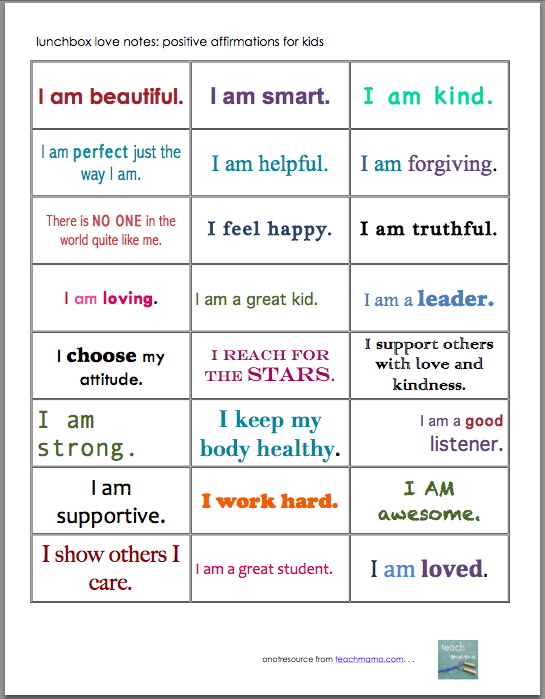
lunchbox love- positive affirmations for kids _ teachmama.com

Below, download the pdf to download and use as you’d like

Feel free to share.

The more kids who get these in their lunch, in their binders, or on their pillows at night, the better. Right?

Are you up for making your marriage even stronger with a little affirmation love? Then you must check out my friend Staci’s 34 Positive Affirmations for Marriage. I love it.

Want a look at all of our lunchbox looooove notes? Here they are:

  • School Rules: Super Silly Lunchbox Jokes
  • Wordless Riddles lunchbox notes
  • Halloween Jokes lunchbox notes
  • Hidden Pictures lunchbox notes
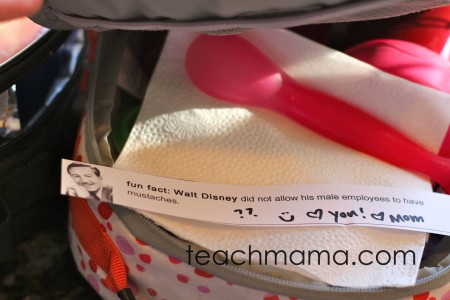
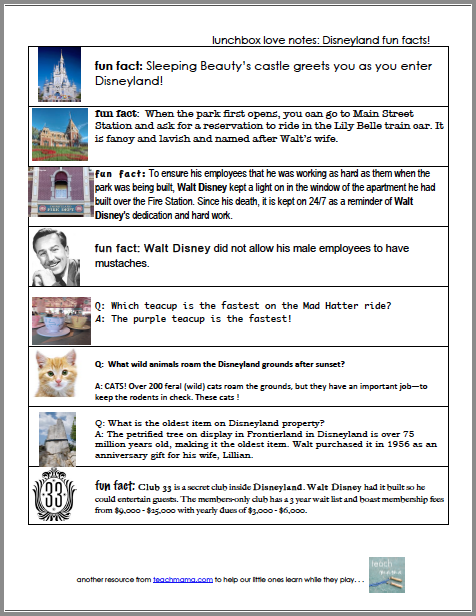
  • Disney Fun Fact lunchbox notes
  • Fun Fact lunchbox notes
  • Budgie Fun Fact lunchbox notes
  • Happy, Happy Day lunchbox notes
  • Homemade lunchbox notes
  • Parent Notes for lunchbox or anywhere
  • Holiday Fun Fact lunchbox notes
  • More Holiday lunchbox notes
  • Valentine’s Day Knock-Knock joke lunchbox notes
  • St. Patty’s Day Joke lunchbox notes
  • Springtime lunchbox love notes
  • Super-Sweet lunchbox love notes

Here’s to a rockstar school year and many more to come!
August 23, 2014 14 comments
0 FacebookTwitterPinterestPocketEmail
the fox and the crane: shadow puppets with printables | guest post by @liskarediska on teachmama.com
fine artsfoundations

The Fox And The Crane: Shadow Puppets With Printables

by Teach Mama July 27, 2014
written by Teach Mama

This week, Liska from Adventure in a Box shares a super-cool, totally new-to-teachmama.com idea.  So cool, it’s nuts.

Liska is a toymaker, a creator, a mom, an artist and a lover of books.  She is a Russian who has settled in Canada with her son and husband (and her husband just so happens to have one of the coolest jobs around!).

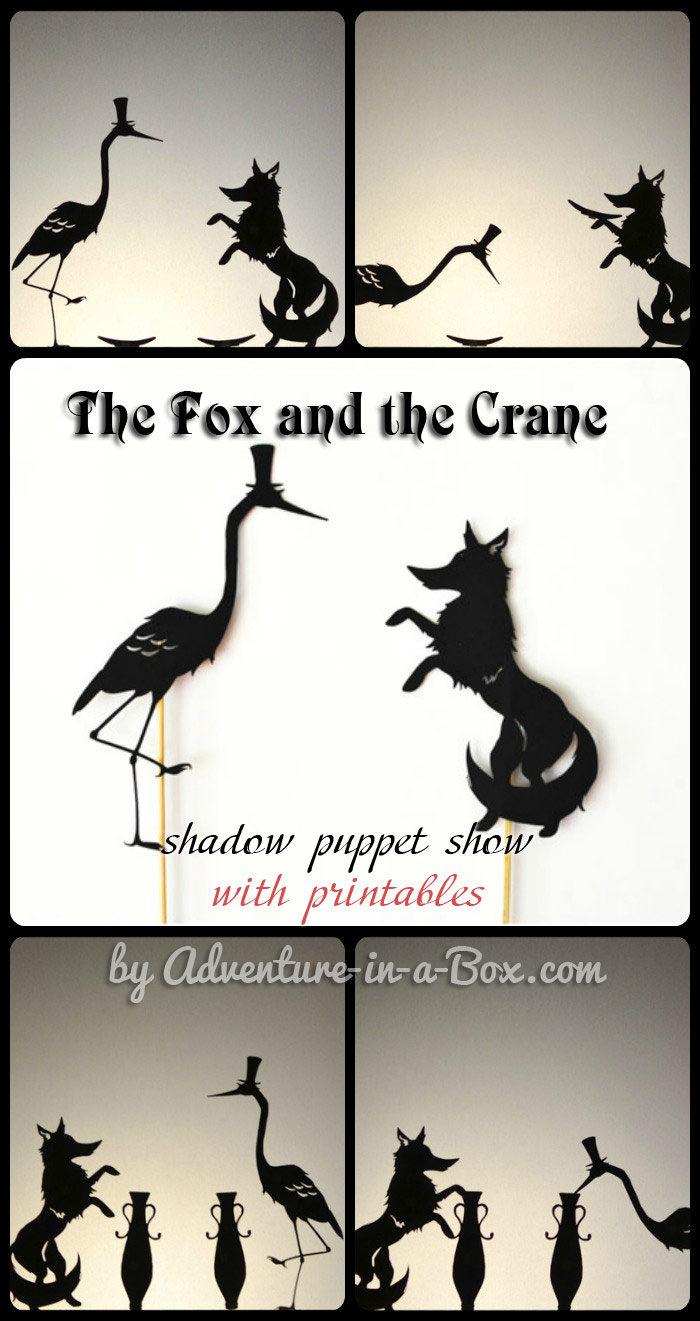
Today, Liska created printables for us and delivers a unique way of sharing The Fox and the Crane fable–with shadow puppets that you can print and use today. Awe-some.

Huge and happy thanks, Liska!


  • The Fox and the Crane: Shadow Puppets with Printables, by Liska

Greetings to the readers of Teach Mama! My name is Liska, and when I do not run around, trying to keep up with my little son, I make toys and write at Adventure in a Box. Thank you, Amy, for inviting me to write here today. Teach Mama is a regular inspiration, so I am proud to be making an addition to such a fun resource.

When I was a little girl, personal computers had not made their way into most houses, and we only had two TV-channels. If I was lucky, I could catch one cartoon a day. However, we had a slide projector with a couple of cartoon-based slide shows. In my mind it is one of the dearest memories of my childhood: in the evenings someone would put a white bed sheet on the wall, and then tinker with the projector until the focus was just good enough, though never great. We would sit down, and watch the slides.

Where did that slide projector go? I do not know. However, I want for my son to have something as magical and mysterious to remember, and that’s how we came to stage shadow puppet shows, based on our favourite stories. In the evenings we dim all the lights, except for the one we place behind the parchment screen, and the shadows start moving.

Making a shadow puppet theatre can be very easy. Take a box and cut two holes in it, then stretch vellum or parchment paper across one hole. In the dark, place a direct light source behind the screen. Now try putting something between the light and the screen: it can be your hand or a toy.

The audience on the other side of the screen will see a silhouette. Usually, the closer you put the object to the screen, the crisper its silhouette will be.

the fox and the crane: shadow puppets with printables | guest post by @liskarediska on teachmama.com

If, however, you feel like crafting and making a long-lasting project, you can also follow my tutorial on how to make a wooden puppet theatre.

For actors we sometimes use the previously-mentioned toys and hands, but our favourite ones are silhouettes, cut out of stiff black paper (80 lb or more). Held next to the screen, they give beautiful crisp shadows.

You can make elaborate performances with these card stock actors! Of course, it might be difficult to stage Alice in Wonderland right away, but most traditional fairy tales have a straightforward plot and few enough characters – they are the likeliest choices for being turned into shadow puppet shows.

the fox and the crane: shadow puppets with printables | guest post by @liskarediska on teachmama.com

We have already made Little Red Riding Hood and Three Little Pigs, and today I would like to make one of Aesop’s fables – The Fox and the Crane. It is also known as The Fox and the Stork, and it has only two actors.

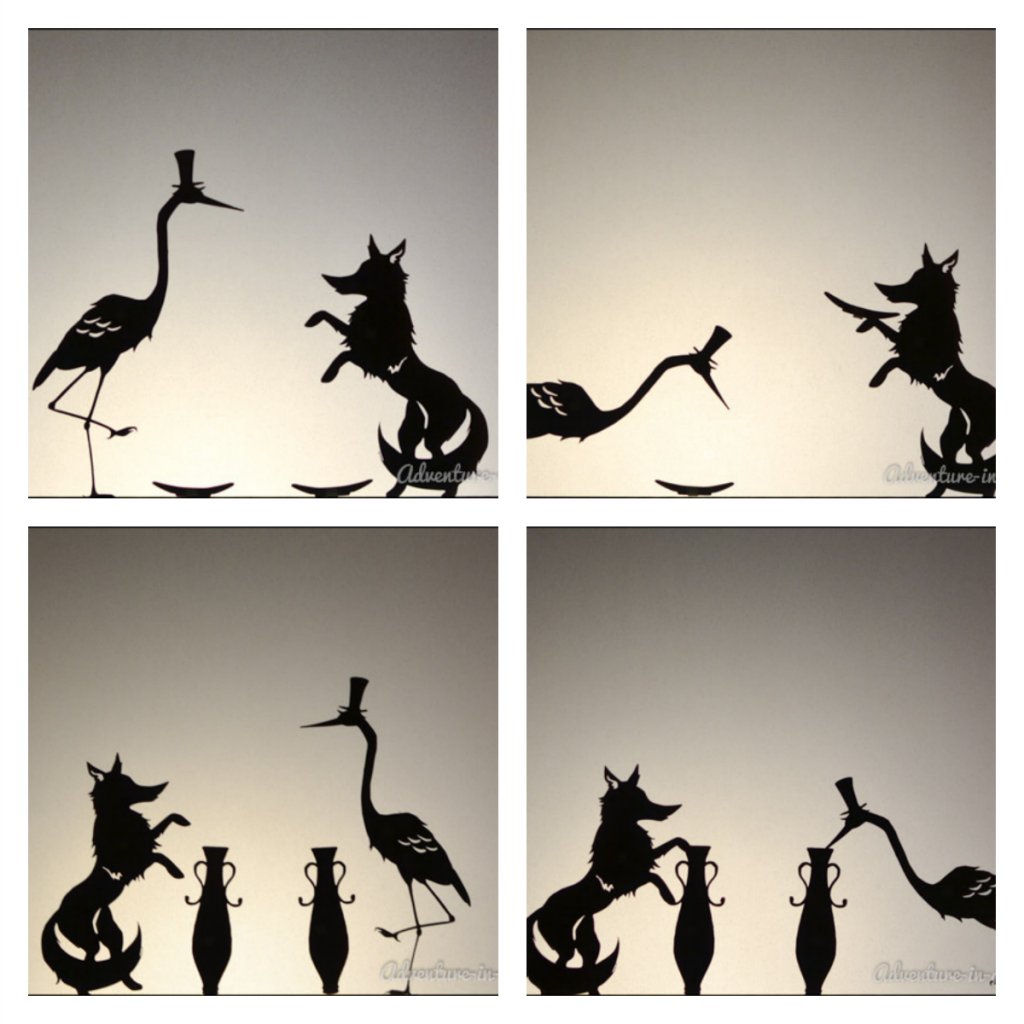
Once, the fox and the crane decided to become friends. The fox invited the crane to come over for a visit. When he came, the fox served soup in a shallow dish.

The fox could lap it up easily, but the crane could not. Nevertheless, he thanked the fox and invited her to come over the next day.

When the fox came to visit, the crane served soup in a flagon with a long narrow neck. The crane could access it, but the fox left hungry.

The moral of the story is usually presented as “if you trick someone, you might get the same treatment back”, but told with a slight change of accents, can also tell children that different households might have different traditions.

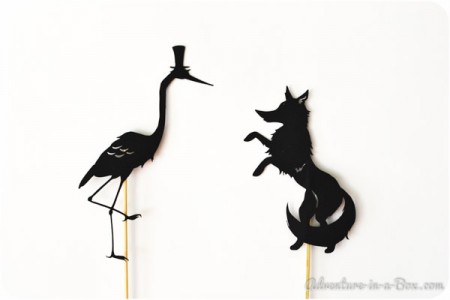
Making the designs of silhouettes is my favourite part, and I am happy to share them with you now. Please, download the silhouettes of the fox and the crane here. Transfer them onto the black paper and cut them out, using scissors for outlines and a hobby knife for small details. Alternatively, you can print the designs on a thick white paper and colour its back black, then cut the silhouettes out.

Print the silhouettes here: The-Fox-and-the-Crane-printables

the fox and the crane: shadow puppets with printables | guest post by @liskarediska on teachmama.com

The-Fox-and-the-Crane-printables

Next, you will need some bamboo skewers and scotch tape. Tape the skewers to the back of the puppets and they are ready!

Now the lights will dim, and the play will begin. “Once, the fox and the crane decided to become friends…”

the fox and the crane: shadow puppets with printables | guest post by @liskarediska on teachmama.com

If you like having a shadow theatre, you can always take this game further.

Make a program and tickets together with children, then give them to relatives and friends, inviting them over. The shadow theatres are great because they are suitable for many different ages: even a three-month-old baby will be naturally attracted to the high-contrast figures! Older children will like choosing stories to stage and giving a new dimension to their favourite books, helping to make puppets and tell their own stories with them.

I will be happy if you share pictures of your shadow shows!

Other articles by Adventure in a Box you might enjoy:

  • How to Make a Puppet Theatre
  • Little Red Riding Hood Shadow Puppets
  • Books You Will Not Tire of Reading to a One-Year-Old
  • How to Make a Fairy Tree House Furniture

the fox and the crane: shadow puppets with printables | guest post by @liskarediska on teachmama.comLiska lives in Southern Ontario, Canada, where she enjoys simple adventures among the vineyards and peach orchards with her family. It consists of her husband, an armourer, and a one-and-a-half-year-old son, who is as inquisitive and mischievous as any one-and-a-half-year-old could be. When not chasing him around, Liska likes to read books and make toys. Then she writes about it in her blog Adventure in a Box: there you can find book reviews and book-related activities that can interest children of different ages, as well as tutorials on how to make toys with and for children.
You can also find Liska onFacebook | Pinterest | Instagram


 Thank you, thank you, thank you, Liska!

I have absolutely been blown away by the Rockstar Sunday posts over here.

Each week, we’ve been highlighting one ‘rockstar’ in the parenting and education field.  These posts? Seriously awesome.

Anything from innovative reading activities to clever math crafts, from ways to teach kids shapes to ways to use gallon ziploc bags for fun and learning.  It’s awesome.  Crazy awesome.

If you’ve got an idea brewing and want to share, do let me know. You need not be a blogger or professional writer to share your piece.

Simply submit your idea to us! Easy peasy!

 rockstar sunday promo teachmama

You don’t have to have a blog of your own–just cool ideas to share! We look forward to hearing from you!

other posts in the series:

  • letter sounds using 26 kid-centered photos
  • play with letters or numbers: cool summer learning for kids
  • patriotic flags: shrinky dinks
  • how to keep your kids hydrated
  • 10 ways to create a literacy rich environment
  • help your kids love science
  • gallon ziploc bag activities 
  • getting kids to love reading with lit club
  • fractions with FOOD!
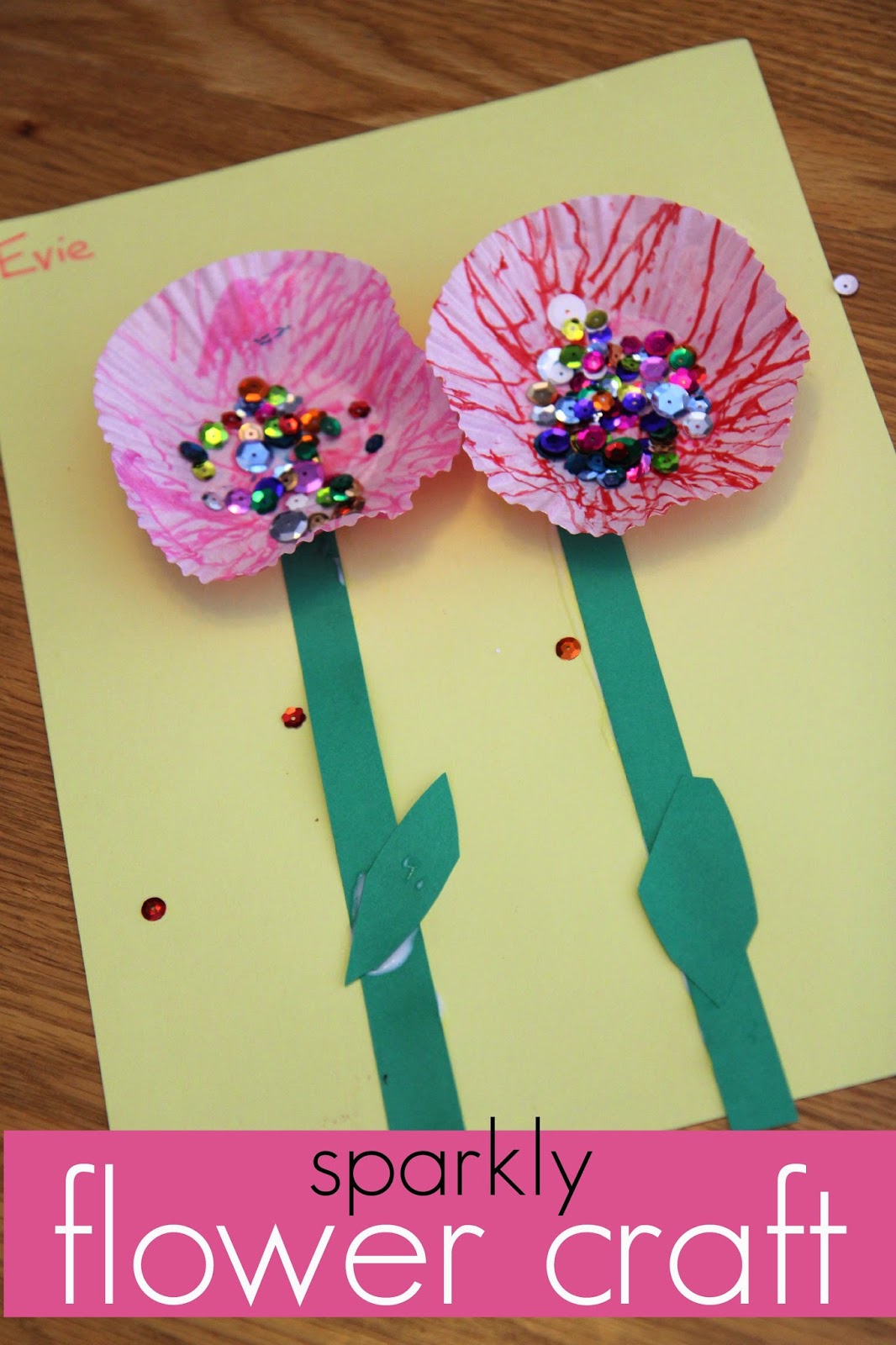
  • sweet, sparkly flower craft
  • toddler shapes
  • tons more!
July 27, 2014 0 comments
0 FacebookTwitterPinterestPocketEmail
teach letter sounds using 26 kid-centered photos | guest post by @totschooling on teachmama.com
early literacyphonological awarenessreading

Teach Letter Sounds Using 26 Kid-Centered Photos

by Teach Mama July 20, 2014
written by Teach Mama


We’re thrilled to share another Rockstar Sunday guest post with you–this time from a multi-talented blogger, Viviana.

Viviana is a mom of two and the creator of Totschooling, a blog filled with cool printables and tons of early education ideas. I’m thrilled she’s sharing this post with u s.


  • Teach Letter Sounds Using 26 Kid-Centered Photos, by Viviana

Hi! I’m Viviana, a mom to two little girls – a toddler and a preschooler. We do a lot of early learning activities that I share on my blog Totschooling, and I am so happy to be here to share this super fun activity that has been a big hit with my daughters!

Kids love to look at photographs, especially photos of themselves. There is something so fascinating about seeing their image transferred onto a piece of paper.

I find that my 3 year old daughter not only loves to look at photos but she also enjoys posing for them, making silly faces and seeing how the pictures turn out. This creates a double opportunity for learning – the act of taking the photos and then later analyzing them.

Since we’ve started working on letter recognition and letter sounds, I thought it would be fun to use photographs as a way to practice these concepts. Here is how we did it:

Each time we learned a new letter, I asked my daughter to find things around the house that start with that letter sound. For example, for the letter B we found a baby doll, a blue ball, a book and a banana.


teach letter sounds using 26 kid-centered photos | guest post by @totschooling on teachmama.com


I taped a piece of paper to the wall with that letter, and helped her pose for the picture.

For some of the letters we couldn’t find objects around the house, so we improvised. We used action words instead. For Y she yawned, for J she jumped, and for Q she made a quiet “ssshhh” sound.

She had a blast posing for these pictures and didn’t even notice she was learning!

Here are some ideas for the less common letters:

J – jump, jacket

Q – quiet, queen

U – umbrella, under

V – vitamins, violin

X – x-ray, xylophone

Y – yellow, yawn, yo-yo

Z – zipper, zebra

teach letter sounds using 26 kid-centered photos | guest post by @totschooling on teachmama.com


After you have all this fun taking photos for every letter of the alphabet, what do you do with the pictures?

The possibilities are endless! First, print out the photos, either at home or at your local print shop – 4×6 is a great size for these activities.

I printed them myself, 4 per page, then laminated and cut them out.


teach letter sounds using 26 kid-centered photos | guest post by @totschooling on teachmama.com


1. Create a photo ABC book – You can do this simply by hole punching the photos and then using a ring or a piece of yarn to thread them together. Or, you can purchase a photo album and insert all the pictures into the sleeves. This book is great to look at casually or to play a “look & find” game where you ask your child to find all the things that start with each letter sound.

2. Alphabet Wall Chart – Create a unique and custom wall chart that everyone will love to look at again and again.

3. Match the Letters Game – Lay out a few letters, either from a moveable alphabet or write the letters on pieces of paper, and ask your child to find the photos that go with each letter.

4. Match the Objects Game – Lay out a few objects and ask your child to find the photos that go

with each object. These objects can be ones that were used in the photos or different ones.

5. Memory Game – You would need two copies of each photograph. Place them face down and play a classic memory game.

6. Bingo Game – Put together 9 or 16 of the photos to create the bingo mat. Then, call out letters while your child puts tokens on the correct photos.

7. Story Time – Come up with a story about what is happening in each photograph. This is great for language development, imagination and can help your child to remember the letters.

You can also try this activity with many different concepts, such as learning colors, numbers, emotions, or just about anything else that can be learned visually.

I hope this inspires you to create your own playful learning experience with photographs and have as much fun as we did!

 Thank you, thank you, THANK YOU, Viviana, for sharing these ideas! I know many readers will be inspired to do the same!

teach letter sounds using 26 kid-centered photos | guest post by @totschooling on teachmama.com


Viviana is a blogging mom to a toddler and a preschooler, sharing ideas and resources for early learning. She specializes in educational printable activities, which you can find on her blog Totschooling. You can also follow her on Facebook, Pinterest, Twitter, and Google+.


Looking for more fun ways to sneak in some literacy learning into your day? Stop by and follow these great educational Pinterest boards:

  • Learning With Photographs | Totschooling
  • The ABCs  |  Totschooling
  • Toddler and Pre-K Arts and Crafts  | Totschooling
  • literacy  | teach mama
  • foundations  |  teach mama
  • summer fun and cool for kids  |  teach mama

This post is part of our new Rockstar Sunday posts.  Each week, I will highlight one ‘rockstar’ in the parenting and education field.  These posts? Seriously awesome.

Have something you’d like to share that in some way relates to fun learning, school, technology, education, or parenting? For a short time we’ll be accepting Rockstar Sunday guest posts.

 rockstar sunday promo teachmama

The response to our Rockstar Sunday feature has been overwhelming. I am in awe of the ideas, submissions, and shares!

Having been in the blogging space for 5+ years, we know for sure that our readers are always up for fresh and fun ideas on literacy, math, technology, parenting, and learning in the every day. They love crafts, hands-on teaching ideas, printables, cooking with kids, and anything that makes their job as parents easier, better, and more fun.

You don’t have to have a blog of your own–just cool ideas to share! We look forward to hearing from you!

other posts in the series:

  • play with letters or numbers: cool summer learning for kids
  • patriotic flags: shrinky dinks
  • how to keep your kids hydrated
  • 10 ways to create a literacy rich environment
  • help your kids love science
  • gallon ziploc bag activities 
  • getting kids to love reading with lit club
  • fractions with FOOD!
  • sweet, sparkly flower craft
  • toddler shapes
July 20, 2014 4 comments
0 FacebookTwitterPinterestPocketEmail
play with letters or numbers: cool summer learning for kids | birute from @playtivities guest posting on teachmama.com
alphabetearly literacy

Play With Letters Or Numbers: Cool Summer Learning For Kids

by Teach Mama July 13, 2014
written by Teach Mama

The following Rockstar Sunday guest post is written by a woman whose third language is English and who has two little ones and two rockstar blogs.  

Birute Efe writes Playtivities which is full of fun toy-making, learning, and creative parenting ideas, and she writes Attach From Scratch, a blog full of attachment parenting, pregnancy, breastfeeding, and all that fun stuff.

Pretty impressive, I know.

Today, Birute is sharing a quick and fun way that you can help your kiddos learn a little during the hot summer months.

————————-

  • Play with Letters or Numbers–Cool Summer Learning for Kids, by Birute Efe

Summer is for fun. Fortunately learning can be fun and full of laughter too. It’s all how we present it to the kids.

If you are trying to teach your little one letters, sight words, numbers, beginners math this playful educational activity will be a hit in your house for sure.

Things you will need:

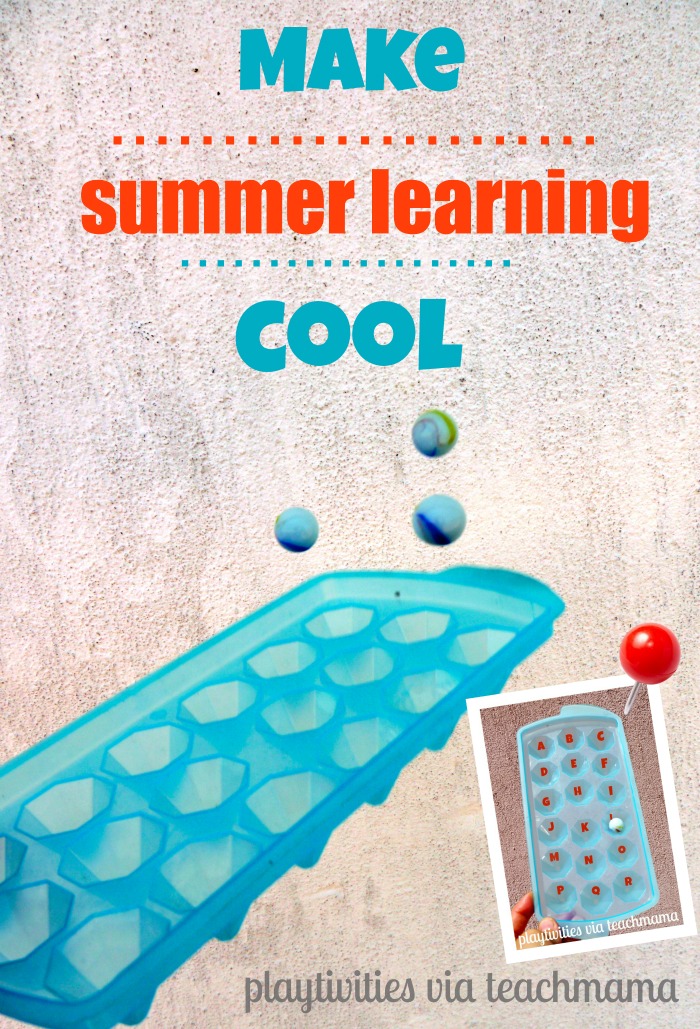
  • Plastic Ice cube tray. (the more you have the more letters and numbers you will be able to write on). You can get them really cheap at flea markets or garage sales.
  • some letter, number stickers or markers
  • marbles

What to do:

It’s so simple.

Depending on how many ice cube trays you have and what you want to teach your child just stick stickers in/on/near every ice cube holes.

You could also use markers.

The rules (they can be very customizable):

Kids learn faster through songs. I have noticed it a lot. So encourage them to sing or pick some kind of rhyme while they are dropping marbles in the ice cube tray holes.

  • Name the letter/sight word/number you just dropped marble in.
  • Name the word that starts with the letter you just threw marble on.
  • Find a rhyming word for the letter you just dropped marble on. (e.g. A – I may, Z – just like a bee, etc)
  • Try juggling few marbles.

play with letters or numbers: cool summer learning for kids

play with letters or numbers: cool summer learning for kids

Just a thought

You could try using real ice cubes for this activity. Make sure to write on the ice cube holes with permanent marker. Those splashes from melting ice cubes will make learning cool for sure.

Things kids will practice:

  • motion coordination
  • letters, numbers, rhyming and singing

I hope I got you inspired to help your children learn through a fun activity.

For more fun DIY Toys that encourage child’s creativity and promotes fun learning follow my Pinterest Board Playtivities. So you won’t miss a thing.


birute of playtivities.com/Birute Efe has daily fun at her kids activities blog Playtivities and the farm where she lives with her family. She loves creating activities and toys for her 2 kiddos by up-cycling household items. She she will never walk pass by a big cardboard box or a pile of old magazines. She believes the best learning comes from exploring and creating.

Looking for more fun ways to sneak in some literacy or math learning into your day? Stop by and follow these great educational Pinterest boards:

  • Educational-tivities | Playtivities
  • Fun-tivities  |  Playtivities
  • Home-tivities  | Playtivities
  • literacy  | teach mama
  • math  |  teach mama
  • summer fun and cool for kids  |  teach mama

This post is part of our new Rockstar Sunday posts.  Each week, I will highlight one ‘rockstar’ in the parenting and education field.  These posts? Seriously awesome.

Have something you’d like to share that in some way relates to fun learning, school, technology, education, or parenting? For a short time we’ll be accepting Rockstar Sunday guest posts.

 rockstar sunday promo teachmama

The response to our Rockstar Sunday feature has been overwhelming. I am in awe of the ideas, submissions, and shares!

Having been in the blogging space for 5+ years, we know for sure that our readers are always up for fresh and fun ideas on literacy, math, technology, parenting, and learning in the every day. They love crafts, hands-on teaching ideas, printables, cooking with kids, and anything that makes their job as parents easier, better, and more fun.

You don’t have to have a blog of your own–just cool ideas to share! We look forward to hearing from you!

other posts in the series:

  • patriotic flags: shrinky dinks
  • how to keep your kids hydrated
  • 10 ways to create a literacy rich environment
  • help your kids love science
  • gallon ziploc bag activities 
  • getting kids to love reading with lit club
  • fractions with FOOD!
  • sweet, sparkly flower craft
  • toddler shapes
  • tons more!
July 13, 2014 1 comment
0 FacebookTwitterPinterestPocketEmail
nonfiction reading in the summer: our must-have picks teachmama.com
non-fictionreading

Nonfiction Reading In The Summer: Our Must-have Picks

by Teach Mama July 10, 2014
written by Teach Mama


I’ve said this before: June and July are crazy for us with our busy swim and dive schedules.

So honestly, any downtime my kids can get, I’m totally thankful for.

Even when Maddy, Owen, and Cora are not at practice, they want to be at the pool, hanging with their pals and swimming it up.  In the sun, moving and not stopping.  It is summer after all.

And busy summer kids don’t really want to stop to read unless the reading’s really good.

I’ve had to find really good reads and really fun activities for them to do to even compete with the awesome summer they’re having.

Lucky for us, I’ve scored some pretty fab nonfiction reads that I can’t wait to share.

And? I even have one to give away to one lucky reader. So exciting!

Here’s the skinny. . .

  • Nonfiction Reading in the Summer–Our Must-Have Picks:

There aren’t many must-have picks but there don’t have to be.  (This first one is seriously rockstar, and this is the one I’m giving away!)

  • National Geographic Kids Almanac 2015: We have several editions of the NatGeo Kids Almanac, but this year’s seems to be the coolest.

nonfiction reading in the summer | teachmama.com

Not only is the almanac full of fun facts and articles about everything from our world, to animals, to science, history, or geography, it also has an interactive component.

Readers can scan the National Geographic Scanner App and any time they see a little icon, they can use an Apple device or android device and learn even more. It’s awesome.

nonfiction reading in the summer | teachmama.com

nonfiction reading in the summer | teachmama.com


Pages of the National Geographic Kids 2015 Almanac are full of color, fun fonts, photographs, and diagrams, and each little section is more exciting than the next. It’s almost as if National Geographic Kids pulled the best parts of their magazines and shoved them all into one happy little paperback.

I totally love the:

  • great size: perfect for small hands and pool bags.
  • extraordinary content: quick to digest, easy on the eyes, and memorable. Kids will be eager to pick it up and learn more about subjects that interest them.
  • fabulous conversation starters: kids will want to talk about what they read which is awesome. Awesome.
  • tons of possible extensions: great reasons for kids to follow-up, learn more about the topics, even do the related activities.
  • fun facts and cool nonfiction reading!

I love this book. I love that it’s full of nonfiction reading that kids truly love, that they can pick up and digest in small doses–whenever they have the time!

The random facts that my kids are sharing at totally random times is absolutely a riot.

Did YOU know that Twinkies actually are not the best food for survival kits because their shelf life is only 45 days? Me neither. it’s on page 110.

—————————————————————-

nonfiction reading in the summer: our must-have picks

  • Time for Kids Book of Why: Stellar Space, or
  • Time for Kids: Really Cool People and Places, or
  • Time for Kids: Amazing Sports & Science, or
  • Time for Kids: Awesome Animal Kingdom: really, the whole collection rocks.

What I love about this collection is that the books are small and fit easily in the pool bag or backpack, and they’re chocked full of fun info for kids.

Every single fact begins with a ‘why’ question:

Why do football players put black grease under their eyes?

Why did Franklin Roosevelt use a wheelchair? 

Why are the Earth’s icecaps melting? 

Why are there so many different kinds of dogs? 

And each answer is accompanied by photos, illustrations, or drawings to explain the answer.

Super for kids to pick up on the go, read, and share with their pals.


————————————————————-

GIVEAWAY: Your very own copy of the National Geographic Kids 2015 Almanac.

Do you want to win your very own copy of the National Geographic Kids 2015 Almanac.??!  Yes, yes you do.

——————————-

Please use the Rafflecopter widget below to throw your name in the hat:

a Rafflecopter giveaway
By entering this giveaway, you are demonstrating your understanding of and compliance with theOfficial Sweepstakes Rules.

This giveaway ends Friday, July 25, 2014 at midnight ET and is open to folks here in the US only. Winner will be chosen by ‘Rafflecopter’ and will be notified on or around 07/25/14.  Winner must respond within three (3) days of notification or forfeit the prize, in which case an alternate winner will be selected.  All Official Sweepstakes Rules apply.

fyi: I am proud to be a part of the National Geographic Kids Insiders Group.  This is an unsponsored post; as always, my opinions are all my own, influenced only by my personal experience as a parent and educator–and, of course, my three little nonfiction readers.

July 10, 2014 2 comments
0 FacebookTwitterPinterestPocketEmail
shrinky dink flag bracelet: super-cool patriotic craft
holidaysjuly 4th

Shrinky Dink Flag Bracelet: Super-Cool Patriotic Craft

by Teach Mama June 29, 2014
written by Teach Mama

The following Rockstar Sunday guest post is written by one of the coolest gals on the planet, Becky Morales.  Becky is a mom, teacher, and creator of Kid World Citizen, where she shares activities that ‘help young minds go global’.

How cool is that?  So cool, right?

Becky is super-passionate about global education, geo-literacy, service learning, educational technology connecting students to the world, and cultural exchange.

She’s getting more awesome by the second. I know.

Today, she’s sharing a fun way that you can help your kiddos ‘go global’ in time for July 4th.  Super-cool craft that involves flags, tracing, beads, and shrinky dinks.

You’ll totally fall in love with her by the end of the post. You must check out her blog.

(But read this first. You’ll be glad you did.)

————————-

  • Shrinky Dink Flag Bracelet–super-Cool Patriotic Craft, by Becky Morales

When a good family friend from the UK recently moved from the US to Canada, we wanted to give her daughter something small and special to take with her.


shrinky dink flag bracelet: super-cool patriotic craft

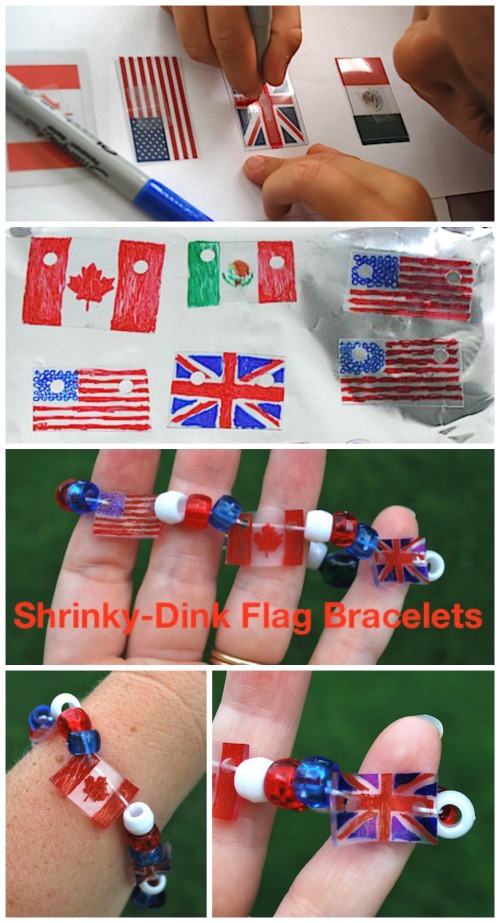
I was playing with the idea of incorporating the three countries’ flags and decided to have my kids make a DIY shrinky dink bracelet: patriotic charms that we would draw onto plastic, and then shrink in the oven.

Materials:

  • #6 plastic (trust me, the other numbers do not work!)*
  • sharpies or other permanent markers
  • pictures of flags
  • foil
  • elastic or string (for the bracelet)
  • other beads

The best place that I was able to find lots of #6 plastic was the salad bar at our supermarket. #6 plastic is very thin and will shrink down evenly without warping like other plastics.

shrinky dink flag bracelet: super-cool patriotic craft

If your kids would like to trace the flags, print out a copy of them and tape down the plastic.

The flags we used were sized around 2 inches wide (because remember they will shrink!).  The kids can trace and color in the flags, and also make little charms of anything else they like: little globes, fancy names, hearts, peace signs, etc.

Next, punch holes in each charm before you bake! The plastic will be too hard to make holes after it shrinks.

shrinky dink flag bracelet: super-cool patriotic craft

shrinky dink flag bracelet: super-cool patriotic craft

Lay the plastic charms on a single sheet of foil. Bake for only a couple of minutes at 350 degrees (you can watch them shrink!).

Once the charms have cooled down, string them together to make your bracelet. My kids had so much fun working on their project, and loved being able to give our friends something they had made themselves.

shrinky dink flag bracelet: super-cool patriotic craft


We looked up where Canada and the UK were in comparison to Texas, and saw their relative positions.

We also tried to guess differences in the weather between our home and their new home in Calgary. Once they made the Canadian and British flags, they began to notice them everywhere: at the airport, on a t-shirt, at school.

These fun little geography lessons really do stick and begin to form a foundation that children will recall later.

Thank you, Becky!! This is such a cool idea–I cannot wait to try it!

0Aboutpic_small


Becky is the mom of 5 multicultural kids, an ESL teacher, author of The Global Education Toolkit for Elementary Learners and founder of KidWorldCitizen.org. She is passionate about activities that teach kids cultural and global awareness.


Looking for more ways to create a literacy-focused environment? Stop by and follow these great educational Pinterest boards:

  • Global/Multicultural Learning | Kid World Citizen
  • Multicultural Arts & Crafts  |  Kid World Citizen
  • foundations  | teach mama
  • july 4th / memorial day / labor day | teach mama
  • raising boys who rock the world  |  teach mama
  • raising girls who rock the world  |  teach mama

This post is part of our new Rockstar Sunday posts.  Each week, I will highlight one ‘rockstar’ in the parenting and education field.  These posts? Seriously awesome.

Have something you’d like to share that in some way relates to fun learning, school, technology, education, or parenting? For a short time we’ll be accepting Rockstar Sunday guest posts.

 rockstar sunday promo teachmama

The response to our Rockstar Sunday feature has been overwhelming. I am in awe of the ideas, submissions, and shares!

Having been in the blogging space for 5+ years, we know for sure that our readers are always up for fresh and fun ideas on literacy, math, technology, parenting, and learning in the every day. They love crafts, hands-on teaching ideas, printables, cooking with kids, and anything that makes their job as parents easier, better, and more fun.

You don’t have to have a blog of your own–just cool ideas to share! We look forward to hearing from you!

other posts in the series:

  • how to keep your kids hydrated
  • 10 ways to create a literacy rich environment
  • help your kids love science
  • gallon ziploc bag activities 
  • getting kids to love reading with lit club
  • fractions with FOOD!
  • sweet, sparkly flower craft
  • toddler shapes
  • tons more!
June 29, 2014 2 comments
0 FacebookTwitterPinterestPocketEmail
10 ways to create a literacy rich environment guest post by kategribble on teachmama.com
environmental printreading

10 Ways To Create A Literacy Rich Environment

by Teach Mama June 8, 2014
written by Teach Mama

The following Rockstar Sunday guest post is written by Kate of An Everyday Story. Kate is a former teacher who now homeschools her two littles using the Reggio Emilia Approach.

I love her blog, and you will too.

Check it out!

————————-

  • 10 Ways to Create a Literacy Rich Environment, by Kate Gribble

Hi everyone. We are an Australian homeschooling family. I have two lovely little ones, Jack (5yrs) and Sarah (3yrs). Right from the beginning we knew we would homeschool. When my son was about a year old I can across the Reggio Emilia Approach.

As a former high school teacher (specialising in literacy and learning support), everything I read about Reggio challenged my fundamental beliefs of how children learn, but most significantly, how children should be taught.

10 Ways to Create a Literacy Rich Environment | teachmama.com

The Reggio Emilia Approach is an innovative and inspiring approach to early childhood education. It values the child as strong, capable and resilient; rich with wonder and knowledge. The Reggio Emilia Approach believes every child brings with them deep curiosity and potential and that this innate curiosity drives their interest to understand their world and their place within it.

The Reggio Emilia Approach originated in the town (and surrounding areas) of Reggio Emilia in Northern Italy out of a movement towards progressive and cooperative early childhood education. Some of the fundamental principles of the Reggio Emilia Approach include:

  • Children are capable of constructing their own meaning –  they are driven by their interests to know and understand more
  • Children are communicators – Children are listened to with respect, believing that their questions and observations are an opportunity to learn and search together. It is a collaborative process; rather than the child asking a question and the adult offering the answers. The search is undertaken together.
  • The environment is the third teacher – The environment is recognised for its potential to inspire children. Whether a playroom or a classroom, each material is carefully selected to encourage children to delve deeper into their interests
  • A child-led project approach – Learning isn’t predetermined months in advance; learning emerges based on the children’s interests and questions
  • The Hundred Languages of Children – The belief that children learn in many different ways; each way as valuable as the next. The idea that children learn through painting and drawing, through building and dance, through drama and music and that each of these ways needs to be nurtured
  • Learning and play are not separated – They are interconnected. The Reggio Emilia Approach emphasises hands-on discovery learning that allows the child to use all their senses and all their languages to learn.

Today I thought I would share with you some of the ways we approach literacy and language learning in our homeschool:

10 Ways to Create a Literacy Rich Environment

1: Including books on the play room shelves

10 Ways to Create a Literacy Rich Environment | teachmama.com

2: Creating meaningful language in context – have an authentic reason for reading and writing

  • read to find answers
  • write lists
  • write questions
  • write postcards
  • write thank you cards
  • write instructions – recipe cards, treasure maps, rules for games

10 Ways to Create a Literacy Rich Environment | teachmama.com

3: Providing writing materials with toys

10 Ways to Create a Literacy Rich Environment | teachmama.com

4: Including literacy materials in the dress-ups

10 Ways to Create a Literacy Rich Environment | teachmama.com

Literacy-rich-environment-labeling-drawings-An-Everyday-Story

5: Encouraging documentation

10 Ways to Create a Literacy Rich Environment | teachmama.com

6: Using books in art experiences

10 Ways to Create a Literacy Rich Environment | teachmama.com

7. Reading. Read widely and often

8: Using hands-on materials in favour of worksheets

10 Ways to Create a Literacy Rich Environment | teachmama.com

9: Creating exploration shelves based on the kids’ interests which include reference books and writing materials

10 Ways to Create a Literacy Rich Environment | teachmama.com

10 Ways to Create a Literacy Rich Environment | teachmama.com

10: Keeping a writing journal

I hope you have enjoyed a small peek inside our child-led Reggio-inspired homeschool. I look forward to seeing you all again soon over on my blog, An Everyday Story.

kate of an everyday story

Thank you so much, Kate!

Kate is a former high school teacher. Now, inspired by the Reggio Emilia Approach and Project-based Homeschooling, she is homeschooling her two children.  Find her at her blog, An Everyday Story, and connect with her on:

facebook | pinterest | instagram | google +  

Looking for more ways to create a literacy-focused environment? Stop by and follow these great educational Pinterest boards:

  • Children’s Books | Kate, An Everyday Story
  • Literacy: Alphabet & Phonics | Kate, An Everyday Story
  • Literacy: Learning to Write  |  Kate, An Everyday Story
  • literacy  | teach mama
  • reading activities | The Educators’ Spin on It
  • learn to read  |  Wise Owl Factory
  • reading tips and tricks |  No Flash Cards

This post is part of our new Rockstar Sunday posts.  Each week, I will highlight one ‘rockstar’ in the parenting and education field.  These posts? Seriously awesome.

Have something you’d like to share that in some way relates to fun learning, school, technology, education, or parenting? For a short time we’ll be accepting Rockstar Sunday guest posts.

 rockstar sunday promo teachmama

The response to our Rockstar Sunday feature has been overwhelming. I am in awe of the ideas, submissions, and shares!

Having been in the blogging space for 5+ years, we know for sure that our readers are always up for fresh and fun ideas on literacy, math, technology, parenting, and learning in the every day. They love crafts, hands-on teaching ideas, printables, cooking with kids, and anything that makes their job as parents easier, better, and more fun.

You don’t have to have a blog of your own–just cool ideas to share! We look forward to hearing from you!

other posts in the series:

  • gallon ziploc bag activities 
  • getting kids to love reading with lit club
  • fractions with FOOD!
  • sweet, sparkly flower craft
  • toddler shapes
  • stand up for yourself: at work, home, school
  • using iPad apps to create
  • phonemic awareness and classification with zoo pictures
  • what to do when kids find their passion
  • 8 ways of supporting advanced learners
  • tons more!


June 8, 2014 0 comments
0 FacebookTwitterPinterestPocketEmail
learning at baseball games teachmama.com
family funfamily lifeoutdoor activities

Fun, Kid-friendly Learning At Baseball Games

by Teach Mama June 3, 2014
written by Teach Mama

Originally published June 6, 2011 but republished today because, well, it’s worth it.


This past week, we experienced something totally new and exciting–a rite of passage of sorts.  We walked into a new chapter in our lives, and I can hardly believe it: we watched six innings of a baseball game.

Live and in person.  On a Friday night.  With two of our kids. And it was really, really fun.

We’ve tried it before–all three kids on a sunny summer afternoon, in the sweltering heat.

And it was not fun.

And the games we attended when I was pregnant, and I tried–unsuccessfully–to sit comfortably with a kid (or kids) on and off of my lap, it was even less fun.

So this time, with two kids who were a bit older–7 and 5 years old–it was a lot different.

We missed Cora–for sure–but at 4, she’s still pretty much done by 7:30, which is when our game started on Friday. So she had a blast at a National’s game last weekend with her Dad and instead got to hang with her grandparents on Friday night.

Every now and again–in between eating french fries, pistachios, and ice-cream and cheering for the O’s–we did a few things that got our kids’ brains moving and eyes focused.

In doing so, we realized that it’s very easy to sneak in some kid-friendly learning at baseball games.

Yes, Maddy and Owen could sit for a whole lot longer than they were able to in the past, but my husband and I still did a little bit of entertaining to keep the kids focused during the game–very natural, totally low-key, no-stress learning that involved reading, numbers, and games.

Here’s what we did:

  • Watched the Game: Okay, not the whole time. Not even the majority of the time. But that’s what we went for, so that’s what we started out doing. But seriously, the Orioles aren’t ranked even a little bit in the league, so it’s no wonder that things started to slow down almost as soon as it began.  So yes, we watched the game.

learning at baseball games | teachmama.com blank

learning at baseball games | teachmama.com blank


Maddy and Owen understand the basics because they played t-ball last spring.  So teaching the game wasn’t absolutely necessary.  But if they didn’t understand it, of course that’s where we’d begin.

  • Players’ Numbers: Just asking, Which player is on first base? What’s his number? or Which guy has the largest number on his shirt? Can you find the player with the smallest number? Who’s wearing a larger number–the guy on first base or the first base coach? gave Maddy and Owen a little something to look for during down-times.

Just talking about the numbers–and having kids recognize them and identify them–is a great learning opportunity for younger kids. Often kids don’t have many opportunities to identify double-digit numbers; this is a fun place to have them practice.

learning at baseball games | teachmama.com blank


talking about the numbers on uniforms helps get kids familiar with double-digits


  • Keeping Score: I remember my dad scoring the Yankee games I attended with him as a kid, and I loved how the numbers and symbols fit inside each box–and how the whole thing could tell the story of the game.

Though admittedly I’m not a major sports fan, keeping score–along with eating ballpark snacks–may be my two favorite parts of baseball games. It’s not that difficult, and it’s actually easy to teach kids how to keep score at a baseball game–though I do think Owen is on the young side for it.

learning at baseball games | teachmama.com blank

I taught him the basics, but the great thing is that there’s really no wrong way; like keeping track in Running Records, you can make it your own because you’re doing it for you.

Not only is there counting and number-writing, but there’s also writing with the names of the players. It’s a great way to stay focused during the game and get familiar with the players.


learning at baseball games | teachmama.com blank

This fastball was 91 mph. 91 MPH?!!


  • Watch the Pitch Speeds: Once I showed Maddy and Owen where the pitching speeds were, they were in awe.  And for a good long while they watched and squealed when every pitch speed appeared.

We’d compare numbers, talk about which was the highest, and sigh deeply when speeds were in the 80’s. When we saw the first ‘curveball’ come up, we got all excited, and we talked about why the speed might be lower for the curveball vs the fastball.

It’s insane to think about how fast these guys are throwing balls, but it’s something that kids probably won’t understand for a good long while.


  • Snacking: I know, the total obvious. But snacking was a great way for us to pass time at the game. There’s an unwritten rule about having to stop at the vendors before you enter the stadium and buying waters and peanuts (or pistachios), and once inside the stadium, how can you pass up ballpark dogs, pretzels, and ice-cream? You can’t. I can’t. We didn’t.

There is a tiny bit of reading inside Cracker Jack boxes. . . does that count for learning? Okay, I thought not.

learning at baseball games | teachmama.com blank


Mmmmmm, ice-cream at a ballpark? Sure. Even if it’s that crazy dot-kind.


  • Lefties vs Righties: My Maddy is a leftie, so after we did a close examinatio n of her baseball glove, smiling big about the ‘Girls Rule’ written inside it, we counted the players who were left-handed.  Then we counted the ones who were right-handed. For a while we kept an eye on the batters’ swings to see if one inning would have more lefties than righties batting, but then we lost count and moved on to something else.

learning at baseball games | teachmama.com blank


How many lefties were on the field? Not nearly as many righties. . .


  • I Spy–Words in the Park: There are SO many words to read in a ballpark, it’s nuts. From the ads on the fence to the names on the scoreboard, to the words on the concessions, words are everywhere.

So when the kids started squirming, we played a few rounds of ‘I Spy–Words in the Park’. We’d say, I spy the word, ‘win’. And we’d squint and search until we found it.  Sometimes, we’d say, I spy a word that begins with the letter ‘g’. . . and we’d go from there. Either way works.

learning at baseball games | teachmama.com blank

Either way gets kids looking for words, searching for letters, and at least looking (kind of) at the field.

  • Kid Program: I was totally impressed to see that Camden Yards–an extremely family-friendly ballpark to begin with–added yet another awesome  feature to its gig: a kid program.  I happily paid $3 for the program because I knew that if there was one teeny-tiny word search in there, Owen would be a happy, happy camper.

And there was not only a word search–a HUGE one–but there were easy-to-read articles, mazes, and a kid score card. Woot!

I plan to pull this pup out during homework time this week; we didn’t finish it all and still need to read some articles.

learning at baseball games | teachmama.com blank

My happy O-man: rockin’ the word search

  • Take a Walk: Walk around the stadium, let the kids look at the people, the stands, the workers, the restaurants, the different levels.

We luckily scored a great spot at the ‘O’ pretzel window, so Maddy and Owen got to watch soft pretzels being made into huge ‘O’s before they sank their teeth into one a little later.  There’s a lot to talk about in a stadium, a lot of great spots for people-watching and game-watching on the many tv’s planted here and there.

learning at baseball games | teachmama.com blankThe pretzel-makers were so nice!!

Camden Yards–and most major league stadiums at this point–has a great spot where kids can

play, so we spent some time there on our way out. Maddy and Owen had their picture taken in front of a wall-sized stadium photo, they played on the park equipment, and they tried to throw some fastball in the speed cages.

  • Play the Games: If you’re into the silly games on the scoreboard, your kids will be into the games, too. So we cheered when I (somehow) managed to keep my eye on the crab hiding the baseball in the mix-up cartoon, and we sang and danced along with the ‘Fans of the Game’ who were featured on screen.

Try to catch the t-shirts they throw in the air, play the word scrambles on the screen, and guess the player trivia–even if you don’t really know the players that well. It’s all for fun, and being a part of the experience–an active part–makes it more fun for everyone.

Seriously, if you’ve got a big voice, start the wave. Your kids will think you’re the bomb.

learning at baseball games | teachmama.com blank

  • Catch a Ball: If you’re close enough, and you plan well, catching a ball can be a highlight.

My husband had Maddy and Owen ready when the O’s were on the field and made their second out; and the second the third was made, the three of them ran down to the dugout and waved and hooted and hollered until a player tossed them a game ball. WOO-hoo!!

Now sure, this is a once-in-a-lifetime opportunity, but with some planning and prep, it’s possible–and it sure makes the game fun!


And that’s it. With a very busy week of no preschool, lots of deadlines, lots of great things in the works, and a lot of time spent on the summertime learning eBook–that’s about all we could muster.

We are very thankful to our neighbors who share these special tickets with us every so year; we could never afford these kind of insanely fabulous seats, and we are very grateful for their generosity.

fyi. . . Some sites I plan to check out in the next few years that may be helpful to some families now:

  • SI Kids
  • Science of Baseball: fab interactives about pitching and playing that I know my kids will love
  • Louisville Slugger
  • Keeping Score: The baseball scorecard — everything you need to know about scoring
  • KidBibs: If you scroll down and pick out the cool facts about baseball and baseball jokes, this one’s worth checking
  • Baseball Poetry
  • Baseball Games and Poetry: TONS of fun crosswords, word searches, jig-saw puzzles. Totally awesome
  • Who’s on First?: The script and recording of the old Abbot and Costello skit


June 3, 2014 21 comments
0 FacebookTwitterPinterestPocketEmail
first steps to writing cover collage teachmama.com.png
writing

First Steps To Writing: Teaching Grip To First Letters And Words

by Teach Mama May 21, 2014
written by Teach Mama

I just shared a cool series over at the Scholastic Parents Raise a Reader blog, and I think it will be of interest to many parents.

It’s all about first steps to writing and what parents can do to help with teaching their kids proper grip to first letters and words.

Super-quick reads.

Here’s the skinny. . .

  • First Steps to Writing–Teaching Grip to First Letters and Words:  It’s hard to know where to start and what to do as a parent when it comes to writing. How are we supposed to know what to do? Don’t kids just know how to hold a pencil properly? What’s the deal?

No. Humans aren’t born with the innate ability to hold a writing tool and they really do need help learning the proper positioning.

And? There are tons of easy ways parents can support this learning at home. Early in the game.

Click on the images to read more.

first steps to writing fine motor skills


first steps to writing: build fine motor skills

**********************

early writing skills how to teach grip


first steps to writing: how to teach grip

**********************

letters and words to teach your kids first scholastic


first steps to writing: letters and words to write first

Also check out Owen’s got grip: using large crayons to help support tripod grip.

**********************

Need some more name-learning inspiration? Check out:

  • Family Name Letter Connect
  • Names, Names, Everywhere Names
  • Family Playing Cards

Want some other cool ideas for creating words and sending messages? Check out:

  • write around the room
  • wiggly words
  • trace, copy, recall
  • names everywhere
  • sky writing
  • story-card writing
  • magnadoodle messages
  • paint bag writing
  • free fence writing
  • water painting
  • sandy beach writing
  • real-life letters
  • sticky finger writing
  • stick writing
  • paint carving

Have fun and feel free to link up any other ideas you have–I’m always up for more sneaky fun ways of spending time with my kiddos!

May 21, 2014 2 comments
0 FacebookTwitterPinterestPocketEmail
gallon ziplock bag activities for preschoolers
family funfamily lifeindoor activities

gallon ziploc bag activities for preschoolers

by Teach Mama May 18, 2014
written by Teach Mama

The following rockstar guest post is written by Barb of  A Life in Balance. Barb has a ton of awesome ideas, and you should totally check out her blog. 

Gallon bag activities.

Plastic bag activities. Ziploc or Ziplock or Glad or store brand, it doesn’t matter. All you need is a large-sized plastic bag with a tight seal to totally rock these activities. Your preschooler will totally heart you. We promise.

____________________

  • Gallon Ziplock Bag Activities for Preschoolers, by Barb Hoyer.


One of my favorite parts of homeschooling was coming up with activities in a bag to keep my young ones occupied while I was working with my oldest son.

Since I had 2 and then 3 little ones to manage while homeschooling, I kept a wide variety of Bag Activities on hand, and we rotated through them to keep the kids interested.

Some of these ideas are perfect for car trips or to bring along to a restaurant when you go out for a meal. I’ve also brought a few to the sports field like the bubble solution and notebook with stickers.

At the preschool level, the emphasis is on developing fine motor skills during play. Many preschoolers like my youngest son are not ready for heavy academics, however, they still need to learn how to handle a pencil, cut with scissors, and learn the basics of color and shapes.

The beauty of the gallon ziplock bag is that many creative play-based learning activities can fit into them for easy access and storage. Use plastic shoe boxes to organize the activities by type, days of the week, or place (car, restaurant, sports field).

Here are some ideas: 

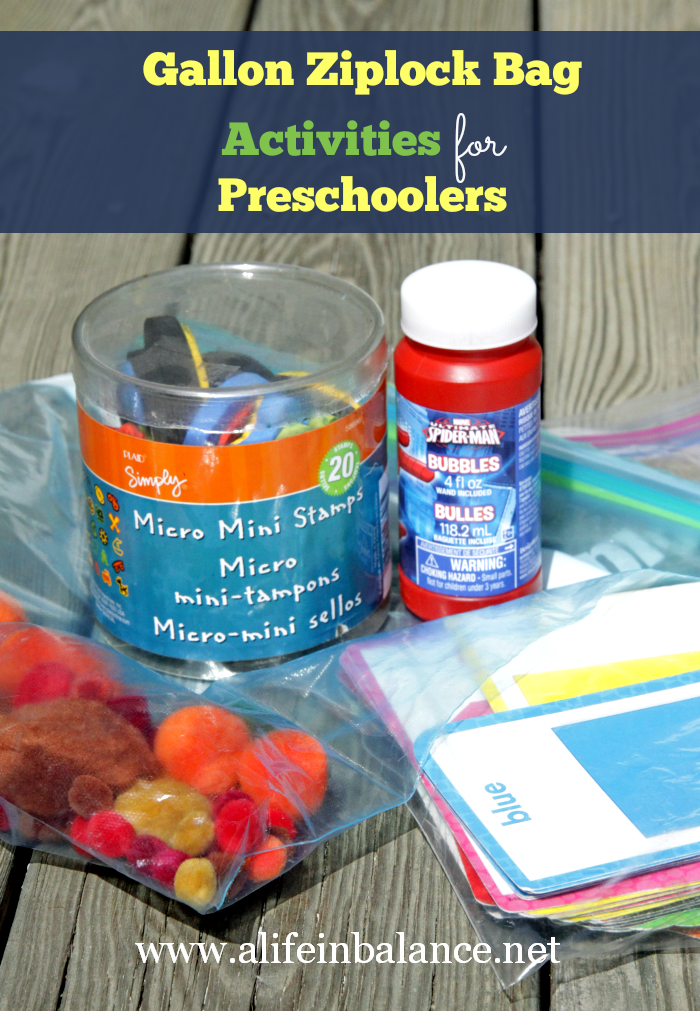
  • Shaving cream in a closed bag used for drawing pictures and shapes
  • Shoelaces or straws and large beads for stringing and cards with patterns for imitatingPaper towel tube and car to run through it
  • Tongs, 2 bowls, and stuff to pick up with tongs; same activity can be done with tweezers
  • Texture cards – felt, fake fur, leather, sandpaper
  • Magnifying glass with a few items for examining – rock, leaf, bark, patterned fabric
  • Nuts and Bolts
  • Finger puppets
  • Shape cards for matching
  • Pom poms for sorting
  • Make Your Own Mobile kit – seasonal, interests
  • I-Spy soda bottle – shoe, key, dime, marble, lego brick, paper clip, birdseed, photos of items for searching
  • Blank book and stickers or roll of paper with shapes drawn on it for filling with stickers
  • Egg carton with items for sorting – nuts, bolts, beans, pasta, paper clips, buttons
  • Alphabet book – small booklet made of papers stapled together with a glue stick and scissors
  • Paper and scissors
  • Bubble solution and bubble blowing wands
  • Shape and object cards for matching together or matching to the environment
  • Playdough

Where to Buy Supplies:

Thrift stores and garage sales – Fabric for cutting up, seasonal items like ornaments, small plastic kitchenware, toy figures
Ikea – finger puppets, child-sized plastic dishes, utensils, cups and kitchen items
Dollar Store – Craft supplies, gallon freezer bags, kitchen items, paper goods, stickers, seasonal items, birthday treat bag items
Dollar bin at craft stores and Target – small notebooks, crayons, markers, stickers
Hardware store – nuts and bolts, small tools, measuring tape, chain

Thank you, Barb! You have fabulous ideas!!

BarbBarb Hoyer is a mom of 5 kids who spends her day keeping track of socks, stuffed animals, library books, and a 5 year old when she isn’t writing about all the frugality, gardening, cooking, and reading she manages to fit in between the chaotic moments. She can be found at A Life in Balance.

Connect with Barb:
Pinterest | Google+ | Facebook | Twitter | Instagram | Blog

Looking for more ways to teach toddlers and preschoolers? Stop by and follow these great educational Pinterest boards:

  • Preschool Learning | A Life in Balance
  • Early Elementary Education | A Life in Balance
  • Cooking with Kids | A Life in Balance
  • we teach: Montessori / teach mama
  • we teach: toddlers / teach mama
  • cool & creative indoor fun | teachmama


This post is part of our new Rockstar Sunday posts.  Each week, I will highlight one ‘rockstar’ in the parenting and education field.  These posts? Seriously awesome.

Have something you’d like to share that in some way relates to fun learning, school, technology, education, or parenting? For a short time we’ll be accepting Rockstar Sunday guest posts.

 rockstar sunday promo teachmama

The response to our Rockstar Sunday feature has been overwhelming. I am in awe of the ideas, submissions, and shares!

Having been in the blogging space for 5+ years, we know for sure that our readers are always up for fresh and fun ideas on literacy, math, technology, parenting, and learning in the every day. They love crafts, hands-on teaching ideas, printables, cooking with kids, and anything that makes their job as parents easier, better, and more fun.

You don’t have to have a blog of your own–just cool ideas to share! We look forward to hearing from you!

other posts in the series:

  • sweet, sparkly flower craft
  • toddler shapes
  • stand up for yourself: at work, home, school
  • using iPad apps to create
  • phonemic awareness and classification with zoo pictures
  • what to do when kids find their passion
  • 8 ways of supporting advanced learners
  • tons more to come!
May 18, 2014 0 comments
0 FacebookTwitterPinterestPocketEmail
get kids to love reading litclub teachmama.com.png
reading

Getting Kids To Love Reading With A Literacy Club: LITClub

by Teach Mama May 4, 2014
written by Teach Mama

This post about getting reluctant readers to love reading is written by Ali Dent of Courage on the Edge of Tomorrow.

Thank you, Ali, for this incredible post!

____________________

  • Getting Kids to Love Reading with a Literacy Club–LITClub, by Ali Dent

Reading doesn’t come easy to everyone. Is there hope for those of us who would rather be on the playground, soccer field, or climbing a tree?

How important is it for our children to enjoy books?

We have an innate hunger for STORY.

What happens to this craving when reading is difficult, as it was for my daughter who has dyslexia, or as it was for me as a child, because I measured myself against my peers who read much faster than I did? Most of the time, it gets stuffed down inside, and we forget we ever took pleasure in the magic of a story. My daughter believed she couldn’t. I decided I wouldn’t. However, our appetite didn’t die; it went into hiding.

Like a pet rabbit in a home full of hunting dogs, it lurks around in the heart and mind. Now and again, it sneaks out of its hole, hoping to find a solution. Disappointed, it retreats back into the shadows, wishing for a way to enjoy the light without fear.


2012, The Hobbit Dinner and a Movie


With high school looming in my daughter’s future, we needed a solution that would allow her to read, comprehend, and interpret the classic novels on her high school reading list. In middle school, I read a lot of her books aloud to her, but the high school reading load felt overwhelming to both of us.

After a great deal of prayer, we discovered an answer that met her reading goals and turned out to be a way to satisfy a reluctant reader’s craving for stories.

Whether a child’s avoidance of books is from diagnosed reading issues, or a habit of choosing to do other things instead, a literature club can meet your child’s hidden craving for story.


get kids to love reading | litclub

Literature club was the answer to our prayers. It was the solution to Matti’s reading difficulties. We set out to get the books read on time and, hopefully, retain some comprehension. To our surprise, we got way more than we bargained for. Matti accomplished her reading list, understood the books, was able to interpret them, and she made lifelong friends.

It’s been 12 years since that first literature club started. Since then, I’ve seen shy, avid readers transform into confident public speakers (discussions and project presentations draw them out of their shells). Kids who are more interested in sports and electronics than a really good story transform into kids that say, “Mom, if we have to drop an activity, please don’t let it be literature club.”

LITClub kids experience books in a unique way. A literature club is a monthly activity that places a high value on the social needs of children and their parents. This entices the kids to give reading a chance. Interacting with family and friends is important to children. Moms need the camaraderie, too. Hanging out with their friends and sharing a meal together make literature club acceptable, even in the beginning, to those who think their moms have lost their minds when they tell them they are joining a classical book club. In a short period of time, the experience changes their opinion about reading.

LITClub gives the kids something to look forward to. Sure, they had to read an old book before coming to the meeting. They also had to prepare a project. They make this sacrifice, concluding, “The work is a small sacrifice to spend an exciting evening with my friends.” Hanging out is enough motivation during the first two or three months to keep the kids coming back.

get kids to love reading | litclub

After 2, 3, or 4 books, the kids get hooked on more than the social time. They find out that talking about the stories is a lot more interesting than they had imagined. They find themselves looking forward to what their friends have to say about the book, in comparison to their own thoughts. Most kids enjoy batting around thoughts, ideas, and opinions with each other. At first, the kids think that presenting a project to a group is either intimidating, or pointless. It doesn’t take them long to look forward to this part, too.

5 reasons moms love the outcome!

1.  LITClub kids become skilled in rhetorical conversations. When our kids reach adulthood, they will be in relationships with people who aren’t like them. They need to know how to talk with others in away that doesn’t cause a fight. Literature club provides a platform for the kids to express their thoughts about BIG ideas and practice their responses to people who might oppose them. In literature club, we do this through book conversations. In addition, at least once a year, the kids have an opportunity to participate in a formal round-table discussion. After reading Animal Farm, the kids were divided into two teams. One side argued for socialism, the other team for free market trade. In this way, the kids learned a lot about themselves. They realized that they had strengths and weaknesses when put on the spot conversationally. In the end, practicing in a round-table forum, whether casually or formally, equips LITClub kids to talk to others about their faith and lifestyle in a respectful and effective way.

2.  LITClub provides a stage for kids to learn how to be friends with people that are similar to them and different from them. They learn how to discuss their differences, instead of becoming enemies because they don’t know how to love others who aren’t like them.

3.  LITClub kids’ written and spoken communication skills are honed through project creation and presentation. Projects are geared to be fun and require thoughtfulness to complete. The Denver, Colorado middle school club read Death Be Not Proud. Lee, the facilitator, gave them this project: If you were given the news that in 6 months you will be leaving this earth and life as you know it, what kind of important-things-I-want-to-do-in-life list would you come up with? Kind of a bucket list, but preferably not ‘I’d make sure I go to NASCAR or visit Disney World’ (although maybe those could be at the bottom of your list).

So, in other words, if the Lord were to announce to you that He will be here in 6 months to take you Home, what MEANINGFUL and IMPORTANT things would be on your bucket list? Make the list real for you (not everyone has to make sure they witness to 600 people or kiss the Pope’s ring).

get kids to love reading | litclub


4.  Projects are designed to mature the kids’ hearts and minds. Another tough, but very fruitful project that stretches the kids’ minds and hearts is the monologue project. After reading Uncle Tom’s Cabin, the kids were asked to choose a character and write a monologue from the character’s viewpoint.

The kicker was that the monologue had to defend slavery from the character’s worldview. Imagine how absurd slavery is, how much you hate it. Then imagine putting yourself in the shoes of one of those characters and writing a speech from that vantage point. This exercise not only educates, it changes us in a positive way. By stepping into the life of another person, seeing things from his perspective, we become more compassionate and able to love. Writing this type of project, and then presenting it before a group, sharpens speaking skills, while simultaneously building confidence.

5.  LITClub kids’ critical thinking skills are stirred up through planning and implementing cool projects. These projects are less crafty, and more interactive, like pretending to be a news reporter and interviewing a character, or creating an original board game based on the plot of the story, with strategy based on symbols and motifs. Critical thinking is the ability to think in a circular fashion that spirals deep and wide, as opposed to a linear train of thought.

Imagine an idea that is brought to light in a conversation, a newspaper, magazine, news program, or on the radio. Linear thinking hears it and jumps to the first conclusion that comes to mind, and either owns that conclusion, or accepts the commentator’s conclusions without question. Circular thinking, which we sometimes call rhetorical or Socratic conversation, is less quick to jump to conclusions. Circular thinking takes time to listen to the other side. It ponders past, present, and future, and weighs the costs and outcomes.

    • LITClub thinkers learn to ask questions.
    • LITClub thinkers learn and respect for others.
    • LITClub thinkers learn to listen.
    • LITClub thinkers learn patience.

In the end, LITClub thinkers desire to know and love others more than they want to prove a point. This opens up conversations, whereas linear conversations tend to end abruptly and, often, are never broached again.

It might seem that a reluctant book lover would turn up his nose to all of this. My daughter thought she wouldn’t make it through her reading list. I wondered if I would be up for the task. Some kids push against the idea of a LITClub because they are introverts. The idea of presenting a project to a group is terrifying. Another child may insist that he just can’t corral his brain long enough to read a whole book. Regardless of a child’s reason for digging in his heels, hang tough. When it’s all said and done, he will be so grateful to you for the gift of literature club.

How do you transform reading into an experience?

If you would like to share this amazing process with your children, there is a handbook called The LITClub, Transforming Reading into an Experience. All the work is already done for you. It starts out with an explanation of the club, and ends with four classic book studies, along with all the tools you need to enjoy your very own literature club experience.

You might want to try it out before you buy. If so, you can download this free eBook, Transforming the Hunger Games into an Experience. This eBook, completely free, includes a quick-start guide to the literature club experience, a themed menu, a completely ready-made discussion guide, and a project guide.

If you have questions, send a message to Ali Dent.

Thank yoAliDentu, thank you, THANK you, Ali, for sharing your worldview conversations expertise–and totally cool idea with us!

Ali Dent is an author and story lover. She grew up in Georgia and was educated at Berry College, where her heart for writing was trained and nurtured. She currently resides in Texas with her family.  Check out her book, The LitClub, on Amazon. 


This post is part of our new Rockstar Sunday posts.  Each week, I will highlight one ‘rockstar’ in the parenting and education field.  These posts? Seriously awesome.

Have something you’d like to share that in some way relates to fun learning, school, technology, education, or parenting? For a short time we’ll be accepting Rockstar Sunday guest posts.

rockstar sunday promo teachmama

The response to our Rockstar Sunday feature has been overwhelming. I am in awe of the ideas, submissions, and shares!

Having been in the blogging space for 5+ years, we know for sure that our readers are always up for fresh and fun ideas on literacy, math, technology, parenting, and learning in the every day. They love crafts, hands-on teaching ideas, printables, cooking with kids, and anything that makes their job as parents easier, better, and more fun.

You don’t have to have a blog of your own–just cool ideas to share! We look forward to hearing from you!

other posts in the series:

  • sweet, sparkly flower craft
  • toddler shapes
  • paper plate puzzles
  • stand up for yourself: at work, home, school
  • using iPad apps to create
  • phonemic awareness and classification with zoo pictures
  • what to do when kids find their passion
  • 8 ways of supporting advanced learners
  • tons more to come!
May 4, 2014 0 comments
0 FacebookTwitterPinterestPocketEmail
fractions with food
computationmath

Fractions With FOOD: Hands-on Math

by Teach Mama April 6, 2014
written by Teach Mama


This post about fun with food and fractions is written by Jen of Beyond Traditional Math.

Hopefully after reading it, you’ll never look at food quite the same! Thank you, Jen, for your time, effort, and expertise!

____________________

  • Fractions with Our Favorite Thing…Food! by Jen

Before you first meet me, I should tell you that I am certifiably nuts about being anti-worksheets right now, so I am going to try to dial it back a bit to write this post.

This past school year, we adopted a new math series that is very heavy on worksheets and giving tons of practice problems. When we piloted the series, we knew that we’d need to supplement and scale back as needed.

It is difficult for me to expect children to work out between 30 and 50 problems a day.

I particularly struggle with this style of teaching when the concept is very abstract.  Right now, our team is introducing fractions, and I can’t tell you how difficult this is for third graders.

The idea of shading in boxes and naming fractions of symbols was so abstract that students had nothing to connect it to. It was actually making me crazy. The idea of doing it with 30 problems on a worksheet made me even crazier!

So I came up with a series of activities that would allow them to explore fractions with one of their favorite things: Food! (OK, I will admit it is my favorite thing, too.)

This change has made ALL the difference.  By cutting an apple in half, we could explore the definition of a fraction.  Then, we discovered the concepts of equal parts, numerators and denominators with a pan of brownies.

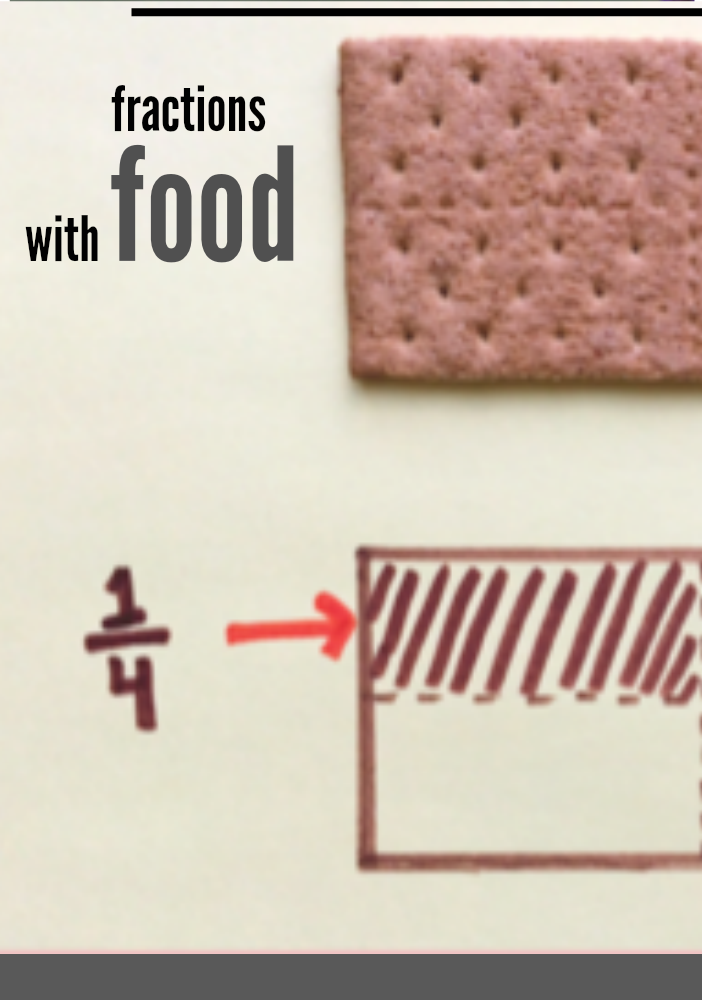
But my favorite activity that I believe was most effective is graham cracker fractions.  Instead of randomly coloring in boxes to show fractions, we laid a graham cracker down on a piece of paper and drew a symbol of it below.

fractions with food | teachmama.com

Now when it came time to shade in ¼ of the box, it made sense, because they had broken their graham cracker into four equal parts. When we eat a quarter of it, we can shade it in.

To extend this the next day, we took a graham cracker and transferred what we did the previous day to a number line.  This was the easiest it has ever been to teach fractions on a number line.  Again, since number lines represent counting, we simply counted by quarters instead of by whole numbers.

The best part was that when the graham cracker disappeared, they could still plot the numbers on the line!

fractions with food | teachmama.com

All things in math must absolutely be connected to the real world for students right from the start.

So often we jump right to symbols and numbers without giving them proper background knowledge needed.  This is truly a disservice to kids.  Helping them connect to real life (especially yummy snacks) will make us all successful!

 Thank you, thank you, THANK you, Jen, for sharing your math expertise–and totally cool idea!– with us!

Screen Shot 2013-08-15 at 9.29.25 PM
Jen is a third grade teacher with 8 years of experience teaching elementary students. Her passion is teaching math with a focus on conceptual knowledge through real world projects and rigorous problem solving. You can find more teaching tips and resources (and hear about how much she has learned from her mistakes) at her blog: Beyond Traditional Math. You can also connect with her on Pinterest, TpT, Twitter, and Facebook.


Stop by and follow these great educational Pinterest boards, filled with more fab sneaky learning ideas:

  • math   |  Beyond Traditional Math
  • Math Facts | Beyond Traditional Math
  • math  |  teachmama
  • math is fun |  Allie McDonald

Or check out the following math-happy posts:

  • everyday math
  • paper plate puzzles
  • 3 quick,  hands-on, totally cool math games
  • math bingo

This post is part of our new Rockstar Sunday posts.  Each week, I will highlight one ‘rockstar’ in the parenting and education field.  These posts? Seriously awesome.

Have something you’d like to share that in some way relates to fun learning, school, technology, education, or parenting? For a short time we’ll be accepting Rockstar Sunday guest posts.

rockstar sunday promo teachmama

The response to our Rockstar Sunday feature has been overwhelming. I am in awe of the ideas, submissions, and shares!

Having been in the blogging space for 5+ years, we know for sure that our readers are always up for fresh and fun ideas on literacy, math, technology, parenting, and learning in the every day. They love crafts, hands-on teaching ideas, printables, cooking with kids, and anything that makes their job as parents easier, better, and more fun.

You don’t have to have a blog of your own–just cool ideas to share! We look forward to hearing from you!

other posts in the series:

  • sweet, sparkly flower craft
  • toddler shapes
  • paper plate puzzles
  • stand up for yourself: at work, home, school
  • using iPad apps to create
  • phonemic awareness and classification with zoo pictures
  • what to do when kids find their passion
  • 8 ways of supporting advanced learners
  • tons more to come!
April 6, 2014 2 comments
0 FacebookTwitterPinterestPocketEmail
disneyland fun fact lunchbox notes | get kids ready for the trip | from teachmama.com
family lifetravel

disneyland fun facts: lunchbox notes

by Teach Mama March 31, 2014
written by Teach Mama

post contains affiliate links


We are gearing up for a Disneyland adventure, and to prepare our family, we’re rocking some Disneyland fun fact lunchbox notes.Actually, these little fun facts are perfect not only for lunchboxes–but they work just about anywhere!


I’m a firm believer in the power of a re-read.  Repeated readings help with fluency and comprehension, right?  Right.  And especially if the content is high-interest, the possibility of a kid sharing facts or actually reading the info to a friend is highly likely.

I’ll take it.

So I am throwing these Disneyland fun facts in lunchboxes, in school planners, on the shoes, in coat pockets, you name it.

And you can too.

Here’s the skinny. . .

Disneyland Fun Facts– Lunchbox Notes:   Really, these came out of the fact that I know nothing about Disneyland.

As in nada. Zip. Zilch. Nothing. Zero.

A few nights ago, I asked my husband, who had been planning our little getaway, So I know Disneyland is smaller than Disney World, but does it have the same rides, or is it totally different?

disneyland fun fact lunchbox notes | teachmama.com

disneyland fun fact lunchbox notes | teachmama.com


He looked at me like I was crazy, so I asked, Do you know? What’s the big difference? Same park, two locations? Or is Disneyland something extra-special? Will we see things there that we’ve never seen in Orlando? I mean. . . 

He knew a bit–but admitted that he wasn’t 100% sure of all the Disney deets. So I did a little research.

And? I printed a few fun facts for him, too.


disneyland fun fact lunchbox notes | teachmama.com


disneyland fun fact lunchbox notes | teachmama.com


There are seven facts on each sheet and two sheets. The topics cover anything from Walt Disney’s inspiration, focus, and favorite president to Disneyland rides, lands, and rules.  Quick, short, and cool, from several different sources, all outlined on the sheet.

I learned a ton. And I’m hoping that my kids do, too.

print them here: disneyland fun fact lunchbox notes

disneyland fun fact luncbox notes | teachmama.com screener


Don’t get me wrong–I’m not expecting to create little Disneyland experts here; rather, I want to give my kids a little bit o’ prep for what they’ll see so that they enjoy our little vay-cay to its fullest. I’m providing them with little bits of schema–or information–that they can store away and pull out in just a few weeks.

We’ve activated schema time and time again: before we watched Brave, before our last trip to Disney World, when we hit local museums, you name it.  Really. It works.

* new *

Want a little more to prepare your kiddos for the trip? I just added a Disneyland Word Search to our Disney Word Search post.  All of these activities help to activate schema and get kids ready–and excited!–for their Disney vacation!

Here are a few other ways to countdown or celebrate your own Disney vacation: 

  • Easy Disney t-shirts
  • Disney SURPRISE trip for kids
  • Disney pin trading 
  • Disney autograph book
  • Disney word searches
  • Disney surprise scavenger hunt
  • Countdown to Disney with Disney Dollars
  • Disney fun fact lunchbox love notes
  • Lessons from Disney Social Media Moms Celebration

fyi: affiliate links are used in this post

March 31, 2014 6 comments
0 FacebookTwitterPinterestPocketEmail
crafts

Sweet, Sparkly Flower Craft For Kids: Read, Learn, Create

by Teach Mama March 23, 2014
written by Teach Mama
post contains affiliate links
The following sweet, springtime guest post is written by the incredibly creative mom and teacher, Kristina Buskirk, of Toddler Approved.  Toddler Approved is a must-read.

Even though my babies are well beyond toddlerhood, I still read Kristina’s blog because it’s top notch.

____________________

  • Sweet, Sparkly Flower Craft for Kids–Read, Learn, Create by Kristina Buskirk

Learning and creating is always more fun if a book is involved.

We are big fans of reading books and then doing book-inspired activities to go along with them! Each month I host Virtual Book Club for Kids, and I also do a children’s book themed co-op preschool with some friends.
I am always on the lookout for awesome book inspired ideas and have fun creating a few new ones as well.

Last week we read Planting a Rainbow by Lois Ehlert and created a super simple sparkly flower craft to go along with it using muffin tin liners.

Planting a Rainbow is a darling book that helps kids understand how to plant seeds and grow a beautiful garden. The illustrations in the book are gorgeous, and the story introduces flowers in all the colors of the rainbow. My little students always enjoy chiming in as we read each page, look at the colors, and say the color names.
Since my little preschool students loved talking about colors and making colorful things, we decided to make sparkly & colorful muffin tin liner flowers.

Materials Needed: glue, colorful muffin tin liners, cardstock, green paper, scissors, markers, and sequins.

How to make sparkly flowers…

We started by coloring the inside of the muffin tin liners with markers, and then we cut thin pieces of green paper to make stems and leaves.
Next, we glued the stems, leaves, and muffin tin liners to our colorful cardstock.
Finally, we added a bunch of glue to the center of the muffin tin liners and then kids sprinkled (or dumped) sequins inside their muffin tin liners to make them extra colorful.
As we created, the kids talked about their flowers and decided what type they wanted to make, based on the new flower words they’d learned in Planting a Rainbow. I loved listening to the discussions about colors and color mixing as they covered their muffin tins in marker and sequins.
After we finished our art project and put it aside to dry, we read Planting a Rainbow again, and it was neat to the see the new connections the kids made with the book after having had a creative book inspired crafting experience.
There are so many simple ways to help kids connect with books while also creating and having a lot of fun.

Here are five of our other favorite books and some simple creative activities to do along with them…

  • Experiment with Fizzy Footprint Science along with The Foot Book by Dr. Seuss
  • Create a Felt Caterpillar Busy Bag to go with The Very Hungry Caterpillar by Eric Carle
  • Make some Chocolate Gruffalo Crumble as you read The Gruffalo by Julia Donaldson
  • Go on a Name Hunt with 10 Apples Up On Top by Dr. Seuss
  • Play with Gum along with David Goes to School by David Shannon

You can find even more book inspired crafts and activities on our Children’s Book Related Crafts & Activities Pinterest Boar

Thank you, thank you, Kristina!  You ROCK.  We appreciate your post and expertise!!

Camp Sunny Patch Honor Counselor Kristina of ToddlerApproved.comKristina is a mom of three and the founder of Toddler Approved, a blog where she helps parents capitalize on teachable moments in everyday life and motivates them to discover, create, and learn with their children. 
You can connect with Kristina on on Facebook, Google +, Pinterest, and Twitter.


This post is part of our new Rockstar Sunday posts.  Each week, I will highlight one ‘rockstar’ in the parenting and education field.  These posts? Seriously awesome.

Have something you’d like to share that in some way relates to fun learning, school, technology, education, or parenting? For a short time we’ll be accepting Rockstar Sunday guest posts.

 rockstar sunday promo teachmama

The response to our Rockstar Sunday feature has been overwhelming. I am in awe of the ideas, submissions, and shares!

Having been in the blogging space for 5+ years, we know for sure that our readers are always up for fresh and fun ideas on literacy, math, technology, parenting, and learning in the every day. They love crafts, hands-on teaching ideas, printables, cooking with kids, and anything that makes their job as parents easier, better, and more fun.

You don’t have to have a blog of your own–just cool ideas to share! We look forward to hearing from you!

other posts in the series:

  • toddler shapes
  • stand up for yourself: at work, home, school
  • using iPad apps to create
  • phonemic awareness and classification with zoo pictures
  • what to do when kids find their passion
  • 8 ways of supporting advanced learners
  • tons more to come!
March 23, 2014 0 comments
0 FacebookTwitterPinterestPocketEmail
lent for kids and family teachmama.com
easterholidays

Lent Ideas For Kids and Families

by Teach Mama March 6, 2014
written by Teach Mama

post contains affiliate links


Lent is here.

And this year, rather than have Lent be a time when my kids complain and moan because they can’t have dessert every night, I wanted it to be a more meaningful time of the year.

But Lent ideas for kids and family? Sometimes hard to come by.

Lent is super-important for many of us, as we prepare for Easter. It’s a time for sacrifice and reflection.

But it’s also a time for giving and kindness, which I think is especially important for our kids to learn.

So I’ve searched the ‘net and reached out to many friends this year, asking for ideas about how best to use these 40 days, the seven weeks of Lent.

Here’s what I found. . .

  • Lent Ideas for Kids & Family:

I have long brought books to mass with us, even when my kids head back to Children’s Liturgy of the Word.

Books like The Mass for Children or the Children’s Book of Saints or my kids could flip through dozens of times.

But this year, I wanted the season of Lent to mean more for them–for us.

I found these great resources for us to use:

  • 40 Acts: Love this. I printed the kids’ calendar and the 7-Week prayer book, and I just 100% love the focus of family time and giving.
  • Good Deed Beads: I ordered a few sets of these beads, because I like that kids are keeping track of good things they’re doing. And they’re tiny enough to keep in their pockets each day.   The cool thing is that you don’t need to order them–the site has instructions for making them at home!
  • Lenten Calendar for Kids & Family: a cute, hand-made follow-the-path calendar that kids can color as they days go by. I like this, too.
  • Stations of the Cross for Children: you can print this as coloring pages, in color, or in black and white book form.

how to teach the easter story to kids: resurrection rolls

  • Lent for Children–A Thought A Day: I printed this and bound it with ribbon, and it was great to take to Ash Wednesday Mass. Cora declared herself in charge of reading our daily prayer.
  • 10 Lent and Holy Week Activities for Kids: one-sheet printable that families can use for inspiration.
  • Crown of Thorns: a girlfriend gave this to me, and the Salt Dough Crown of Thorns is a very hands-on, visual representation of how your family can make sacrifices during Lent. I think we’ll do this next year.  Or maybe this weekend.

And of course, we’ll make Resurrection Rolls like we did last year. The kids really loved that!

Have a blessed and peaceful season!

Do you have any other Lent or Easter resources that work for you? Do share! 

fyi: affiliate links are used below

March 6, 2014 0 comments
0 FacebookTwitterPinterestPocketEmail
become a grammar shark | teachmama.com
grammarwriting

Turn Your Kids Into Grammar Sharks: National Grammar Day

by Teach Mama March 4, 2014
written by Teach Mama

I have been as sick as a dog–sick as a dawwwwg— for the past few days, but today I had a little spring in my step because it was National Grammar Day.

And this old gal, though she may have strep and she may have spend the last few days in bed, sure does love her grammar.

But what I realized is that my kids do not. 

My kids don’t even have the opportunities we had–way back when–to hunt down misplaced modifiers or to diagram sentences.

They’re too busy learning other super-important big stuff, analyzing poems for author’s voice and decomposing numbers and then composing them back up again like little magicians.

So what I decided was that, because our Word-A-Day Cards went over so well, why not get a little grammar-happy with something similar? Could I create Grammar Sharks out of my kids, just by hitting them with a little dose o’ grammar at breakfast time?

I am going to try!

Here’s the skinny. . .

Turn Your Kids into Grammar Sharks–National Grammar Day:

First of all, what’s a ‘Grammar Shark’?

A Grammar Shark is a person who in the blink of an eye can spot the misspelling on the restaurant menu.

turn your kids into grammar sharks: national grammar day

turn your kids into grammar sharks: national grammar day
A Grammar Shark is a person who has to bite her tongue in order hold back a

‘OhmygoshwillyouPLEASEstopsaying’feelbadly’whenitreallyshouldbe’feelbad’??!! or a ‘Sohelpmeifhesays’awholenotherstory’onemoretimeIamgoingtolosemymind!!!’ so as not to lose friends on a daily basis.
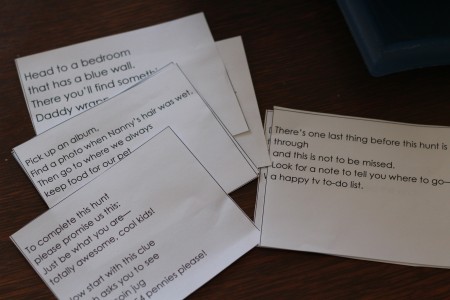
A Grammar Shark is a person who can clean up a misplaced modifier in no time flat, who knows the difference between who and whom and who likes to talk about the 7 Comma Rules.

turn your kids into grammar sharks: national grammar day

Really, there aren’t many of us out there, and I’m not planning on brainwashing my kids into becoming hard-core grammarians. I will, however, do my best to make sure that they move through life knowing the basics of our English grammar.

I am hoping that by capitalizing on that precious mealtime that they will read not only the cereal boxes and the Kids Post but also my teeny, tiny little Grammar Shark Cards.

turn your kids into grammar sharks: national grammar day

So I’ve included a ton of grammar hang-ups that everyone should know, including the ever-challenging:

  • to vs too vs two;
  • a lot vs alot;
  • they’re vs there vs their;
  • who vs whom;
  • are vs our. . .

And some cards have little ?’s — questions to ponder.  Not all, but some.

All I did was print the grammar shark cards cards onto brightly colored cardstock (because grammar is FUN! and BRIGHT! and EXCITING!), punch a hole in one corner and throw a ring clip to keep them secure.

Feel free to print, share, email to a buddy, pin, tweet, whatever. And if you tag me (@teachmama or @teachmama or @teachmama1) I’ll respond! Give you a virtual high five! A huge and happy thanks hug!

I’ll chest bump ‘ya–from one mama who’s trying to another!

And that’s it. We keep our Grammar Shark Cards  on the snack bar open to one card a day.  Slowly but surely, we’re creating Grammar Sharks over here. Slowly but surely.

Do you have a grammar hang-up or pet peeve? Let me know! 

If it’s not currently on the Grammar Shark Cards, I’ll make sure it’s on the next batch. And happy National Grammar Day, my friends!

March 4, 2014 0 comments
0 FacebookTwitterPinterestPocketEmail
disney surprise scavenger hunt
family funfamily lifeindoor activities

Disney Surprise Scavenger Hunt

by Teach Mama February 20, 2014
written by Teach Mama

post contains affiliate links


It’s been busy here for the last few days, with our insane weather and with FutureCity, Toy Fair, and National Center for Families Learning Summit all in the last week.

But somewhere in between all of this excitement, my husband and I surprised our kids with a super-fun, totally awesome Disney Surprise Scavenger Hunt!

That’s right–we’re heading to Disney this spring. And we’re thrilled.

We wanted to tell Maddy, Owen, and Cora in a way that made them work a bit, so we came up with a Scavenger Hunt. Nothing too crazy, but we wanted a hunt got them reading, thinking, and putting their heads (and feet!) together to figure out clues and learn about their trip.

Here’s the skinny. . .

  • Disney Surprise Scavenger Hunt:

You can use this scavenger hunt whether you’re going to Disney World or Disneyland; it doesn’t matter.

Our goal was to give them an idea that they were going without outright telling them.

Check out our video for a closer look at how it went:


SO funny, right?

They seemed to have a blast!

disney surprise scavenger hunt for kids | teachmama.com

Our Disney Scavenger Hunt can be downloaded here if you want to use it (and modify it) yourself: disney surprise scavenger hunt

Or here it is as a pdf if you like it just the way it is: disney surprise scavenger hunt (pdf)

disney surprise scavenger hunt for kids | teachmama.com

disney surprise scavenger hunt for kids | teachmama.com

Our Disney Scavenger Hunt includes things like:

  • counting pennies for the number of days until our trip;
  • doing jumping jacks and headstands;
  • putting together Mickey sock puzzles;
  • unscrambling Disney-related words: vacation, spring, suitcase, sunshine, and more;
  • watching a Disney video on YouTube.

disney surprise scavenger hunt for kids | teachmama.com

disney surprise scavenger hunt for kids | teachmama.com

We’re really excited.

Here are a few other ways to countdown or celebrate your own Disney vacation: 

  • Disney word search
  • Homemade Disney autograph books
  • Countdown to Disney with Disney Dollars
  • Disney fun fact lunchbox love notes
  • Lessons from Disney Social Media Moms Celebration

Fyi: Huge thanks to the amazing and creative Tiffany Dale of Peanut Blossom for the Disney video inspiration as part of our reveal.  

February 20, 2014 9 comments
0 FacebookTwitterPinterestPocketEmail
sparkle slime SNOW DAY teachmama.com
family funfamily lifeindoor activities

How To Make Homemade Slime: Snow Day Sparkle Slime

by Teach Mama February 14, 2014
written by Teach Mama

It’s been snowing a whole lot over here for the last few weeks, and in fact, this week, about 15 inches of the white stuff were dumped on us.

So this mama has had to pull out the stops when it comes to finding things to do.

Homemade slime–snow day sparkle slime–has helped save our sanity.

Not really. But kind of.

We’ve spent a boatload of time outside. We’ve watched movies. Read books. Completed puzzles. Cleaned, finished homework, Valentines, and cooked.

There’s been a lot of downtime. A lot of ‘plugged in’ time. A lot of great, blissful getting along times, and a lot of bickering.

And we tried, for the first time, to make sparkle slime.

The kids loved it.

Here’s the skinny. . .

How to Make Homemade Slime–Snow Day Sparkle Slime:

It’s super easy.

And there are about a million different ways to do this–be forewarned.

My way is just one.

Here’s a super-quick video about how you can make sparkle slime (our snow day sanity saver!): 


And now you definitely need the Sparkle Slime recipe, right? Yes, yes you do.

Grab the sparkle slime recipe by throwing your email in the box below: 

You’ll need:

  • Borax
  • Elmer’s clear glue
  • glitter
  • water
  • liquid or gel food coloring

Once you have everything, you can get started!

how to make sparkle slime | owen

homemade sparkle slime


homemade sparkle slime

SO fun.

Do you have any cool ideas for passing days when you’re stuck inside? Activities to keep kids interested, engaged, and unplugged? Let us know by leaving a comment!

Check out our cool and creative indoor fun board:

Follow Teach Mama’s board cool & creative indoor fun on Pinterest.


Or check out these popular posts:

  • soap dough
  • candy experiments
  • foam dough
  • candy cane fun
  • ziplock icecream
  • crayon melts
  • fast finger playdough
  • candy sushi
  • water beads
  • dog treats

I by NO MEANS invented this cool activity; in fact, I’d love to offer huge and happy thanks to the following posts for inspiration. Please check them out! thank you, ladies!

  • Coffee Cups & Crayons: how to make slime
  • Coffee Cups & Crayons: how to make borax-free slime
  • All Things Simple: magical monster slime
February 14, 2014 0 comments
0 FacebookTwitterPinterestPocketEmail
quick and easy addition game: finding addends | teachmama.com | math printable #weteach
computationmath

Quick And Easy Addition Game: Finding Addends

by Teach Mama February 4, 2014
written by Teach Mama

Cora has really been into playing math games lately.

That’s right. Math games. I love it.

Like while Maddy and Owen are doing their homework, all my littlest one wants to do is math.

So I’m doing what I can to run with it.

She came home with a Finding Addends game a few weeks back, so lately, that’s been in our rotation.

Finding Addends is a quick and easy addition game that gets kids thinking, practicing their facts, and flexing their mental calculators.

Though it looks like it came from a program or texbook, I mirrored the game and have it here as a freebie printable. Because some days Cora and I like to write in our own numbers instead of the game ones.

We crazy like that.

Here’s the skinny. . .

  • Quick and Easy Addition Game– Finding Addends:  Super-simple premise here.

The idea is that players take turns flipping cards from a pile which have numbers 1-10 on them.

Once you get your number, you try to find the addends–or the numbers that, when added together, equal the number on the card.

quick and easy addition game | finding addends | teachmama.com

quick and easy addition game | finding addends | teachmama.com

Each player has his or her own tokens to cover the addends, and the winner is the person who has the most color blocks on the board at the end of the game.

No ‘tokens’? Use stickers (two different ones), coins (dimes and pennies), legos, cheerios, candy hearts, you name it.  Or just color in the blocks using crayons. No biggie.

Or something like that. I’m sure there are a million ways to play this, but that’s how we’ve been rolling lately.

quick and easy addition game | finding addends | teachmama.com

We’ve also played with mixed up manipulatives and did our best to cover each square of the board.

That works, too.

quick and easy addition game | teachmama.com

Want the Quick and Easy Addition Game to play today after school?

Download it here: addends game _ teachmama.com

It is a pretty basic download–one page is the board and the other is the set of cards. Print the cards out on cardstock so you can’t see through the back.

Or if you want to personalize your game, use the last two pages–they’re the board and cards but blank. Write in the numbers you need to work on, and you’re done.

So fun.

Looking for more super-fun, sneaky math activities?

Or check out the following math-happy posts:

  • everyday math
  • 5 super-fun ways to learn math facts
  • 3 quick,  hands-on, totally cool math games
  • math bingo
  • lego baseball
  • make-your-own math games

Stop by and follow these great educational Pinterest boards:

  • math  |  teachmama
  • math is fun |  Allie McDonald
  • math madness & stem  |  Zina
February 4, 2014 2 comments
0 FacebookTwitterPinterestPocketEmail
musical hearts reading, moving, & crazy-fun kid game teachmama.com
Best Of Teach Mamaholidaysvalentine's day

Musical Hearts: Reading, Moving, & Crazy-Fun Kid Game

by Teach Mama January 30, 2014
written by Teach Mama

The snow and freezing cold temps has cause my three kids to be on energy overload lately.

They need to burn steam.

They need to run, jump, skip, hop, spin, and then do it all again.

They need to loosen up, wiggle out those wiggles, laugh hard, and be super silly.

So when I was looking for some cool indoor games for us to play in the down time between school and homework, I stumbled upon my dear friend Allie’s Musical Hearts game.  And like everything she does, it’s awesome.

When the girls and I were at the craft store this week, you better believe I added big foam hearts to our cart so that I could make Musical Hearts work for us and hold up for more than one game.

And it sure did.

I turned Musical Hearts into a reading game, a moving game, and a crazy-fun after school, burn-some-serious-steam game.

Here’s the skinny. . .

Musical Hearts– Reading, Moving, and Crazy-Fun Kid Game:

musical hearts reading, moving, & crazy-fun kid game teachmama.com

musical hearts | reading, moving, crazy fun game for kids - 03
I wrote my actions on the fly, thinking about what I both wanted my kids to read and what I wanted them to do. I wanted simple but fun. And I wanted Cora, Owen, and Maddy to be able to play.

My list of Musical Hearts Actions is here for you to check out, print, and use as inspiration. Just scroll down below and throw your email in the box!

It includes 30+ ideas, like:

  • Hula dance.
  • Do 5 jumping jacks.
  • Spin on one foot five times then spin on the other.
  • Do 5 pushups.
  • Hop on one foot 10 times.
  • Hug the person on your right.
  • Plank for 10 seconds.
  • Jump as high as you can—8 times.

musical hearts reading, moving, & crazy-fun kid game teachmama.com

It took virtually no persuading for the kids to try out this game.

I said, Hey, you guys, after your snack I’d like for you to try out something that I found online that I think will be a lot of fun. I know you haven’t had recess outside lately, so this will get us up and moving.  Who’s game?

musical hearts reading, moving, & crazy-fun kid game teachmama.com

Maddy’s nose was buried in a book, so she sat this one out–for a bit. Literally Cora and Owen dropped their snacks, jumped down from their stools at the snack bar, and found me in the kitchen.

Okay, so here’s the deal: We flip these hearts upside down and put them in a huge circle.

And then I blast some Frozen soundtrack and we play just like Musical Chairs–except this is called Musical Hearts. And there are no chairs. Instead, there are hearts with little messages underneath. When the music stops, you flip your heart and do what’s on the other side. Get it?

They did.

musical hearts reading, moving, & crazy-fun kid game teachmama.com

musical hearts reading, moving, & crazy-fun kid game teachmama.com

We played and played and played.

And laughed and laughed and laughed.

Music on, kids walking on the hearts. Music off. Hearts flipped. Kids jumping, planking, spinning, and singing. Music on. Kids up. . . 

Maddy even ditched the book and joined us, and before I knew it, they were all overheated and burning some much-needed energy.

It got hilarious. And surprisingly, they didn’t want to stop.

musical hearts reading, moving, & crazy-fun kid game teachmama.com

But after the millionth time, when I looked at the clock and realized that OHMYGOSH! we needed to do homework–ack! homework!–before we took Maddy to gymnastics, we had to wrap up the game.

But I’m betting they’ll ask to play tomorrow. . .

And really, that was that.

Just a really fun, super-cool way to get kids up, reading, and moving–and laughing!–on a freezing cold, grey winter afternoon.

Love this idea and cannot thank Allie enough for sharing.  The possibilities for adapting Musical Hearts are endless:

  • play it during class parties
  • use basic shape foamies and play it for indoor recess
  • put sight words on the foamie
  • put spelling words on the foamies
  • put math problems on the foamies
  • put letters of the alphabet on the foamies
  • put family names on the foamies
  • play a larger-than-life matching game with foamies

Check out Musical Hearts in action, even with some of my students playing:

[adthrive-in-post-video-player video-id=”XoUSa7Wf” upload-date=”2020-02-01T22:09:14.000Z” name=”musical_hearts_read” description=”Just a really fun, super-cool way to get kids up, reading, and moving–and laughing!–on a freezing cold, grey winter afternoon, at a club meeting, or at a Valentine’s Day party. We LOVE Musical Hearts!” player-type=”default” override-embed=”default”]

Grab the ideas for your own Musical Hearts game here:

Want a few more fun Valentine’s Day ideas? Check out: 

how to throw a rockstar valentine's day party teachmama.com 2

valentine's day class party ideas, 2.0 | teachmama.com

  • Musical Leaves a Fun Fall Indoor Activity
  • How to throw a rockstar Valentine’s Day class party
  • Valentine’s Day Class party 2.0
  • Melted Crayon Valentines
  • Mini-Stained Glass Hearts
  • Musical Hearts
  • Secret Message Valentines
  • Bookmark Valentines
  • Scratch-Off Ticket Valentines
  • Valentine’s Day Lunchbox Notes
  • HEART Bingo

fyi: Some of the links in the post above are “affiliate links.” This means if you click on the link and purchase the item, I will receive an affiliate commission. Forever and always I recommend only products or services I use personally and believe will add value to my readers. I am disclosing this in accordance with the Federal Trade Commission’s 16 CFR, Part 255: “Guides Concerning the Use of Endorsements and Testimonials in Advertising.”  For more information, please see teachmama media, llc. disclosure policy. 

January 30, 2014 31 comments
0 FacebookTwitterPinterestPocketEmail
Newer Posts
Older Posts

About Me

About Me

Hi! I'm Hannah.

A mother of one, I am passionate about inspiring mamas and educators with hands-on, meaningful learning ideas that make everyday moments fun, purposeful, and filled with curiosity.

Follow Teach Mama

13.4K Fans Like
2.8K Subscribers Subscribe
132K Followers Follow Us

Recent Posts

  • Summer Learning Activities for Kids: A Low-Pressure Guide for Reading, Play, and Family Connection

    June 15, 2026
  • Effective Techniques for Teaching Complex Historical Topics

    June 13, 2026
  • 4 Neighborhood Adventures That Teach Kids Real-World Skills

    June 12, 2026
  • What Does an Urgent Care Visit Cost in Manhattan Without Insurance?

    June 12, 2026
  • Future Trends Influencing Enterprise Learning Management System Adoption

    June 10, 2026
  • How to Survive Your Husband’s Grad School Years Without Going Broke

    June 9, 2026

LEARN

PLAY

CRAFTS

PRINTABLES

About Me

A mother of one, I am passionate about inspiring mamas and educators with hands-on, meaningful learning ideas that make everyday moments fun, purposeful, and filled with curiosity.

Useful Links

  • About
  • Contact

Popular Posts

  • Words 3 Ways: Learning Sight Words For Kindergarten

    May 17, 2012
  • Quick Trick: Magnetic Letters (How To Use Them With Your Kids!)

    December 1, 2010

Recent Posts

  • Summer Learning Activities for Kids: A Low-Pressure Guide for Reading, Play, and Family Connection

    June 15, 2026
  • Effective Techniques for Teaching Complex Historical Topics

    June 13, 2026
  • Facebook
  • Pinterest
  • Youtube
Teach Mama
  • Reading
  • Early Literacy
  • Writing
  • STEM
  • Activities
  • Digital Literacy

Shopping Cart

Close

No products in the cart.

Close